

The Python Data Model
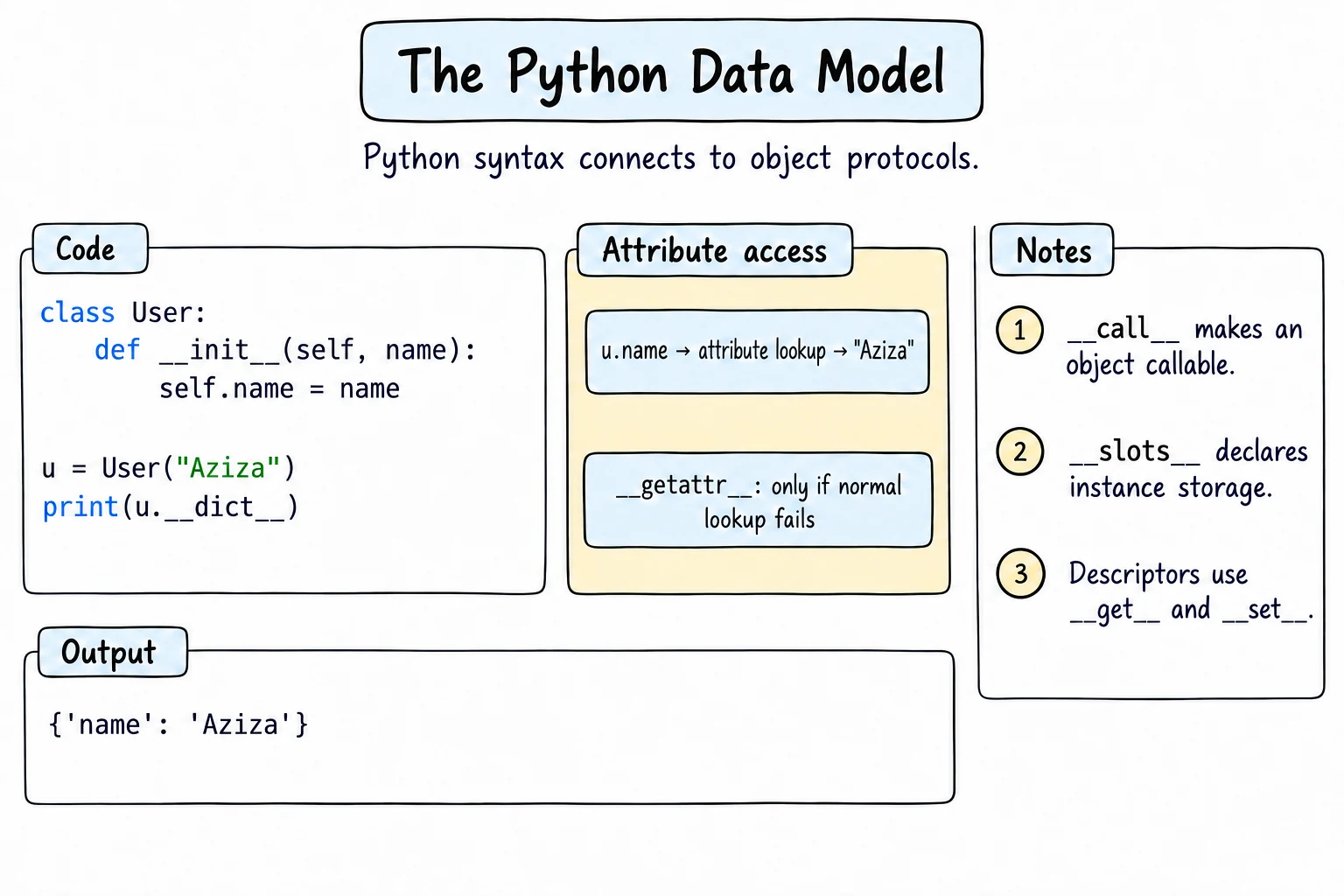
What you'll learn
- Why everything is an object:
type(),__class__, and__dict__ - How
__getattr__,__getattribute__,__setattr__, and__delattr__hook into attribute access - How
__call__makes callable objects and__slots__removes the per-object dictionary - How descriptors (
__get__/__set__) powerproperty - How
__init_subclass__registers subclasses, plus__class_getitem__and metaclasses in brief
Why it matters
Representing and Comparing Objects and Operators and Containers taught your classes to print, compare, add, and loop. The data model goes deeper: the rules for how Python reads and writes attributes, calls objects, and creates classes. Frameworks use these hooks to validate fields or register plugins the moment you define a class; once you know them, that "magic" is ordinary code.
Everything is an object
Numbers, functions, and classes are all objects with a type; a class's type is type. An instance keeps its attributes in a dictionary, __dict__:
class City:
    country = "Uzbekistan"

    def __init__(self, name, population):
        self.name = name
        self.population = population

tashkent = City("Tashkent", 3_000_000)

print(type(tashkent), tashkent.__class__ is City)
print(type(42), type(len), type(City))
print(tashkent.__dict__)
print("country" in tashkent.__dict__, tashkent.country)<class '__main__.City'> True
<class 'int'> <class 'builtin_function_or_method'> <class 'type'>
{'name': 'Tashkent', 'population': 3000000}
False Uzbekistancountry is not in the instance dictionary, so Python looked in the class next (then in parent classes). The hooks below change steps of that lookup.
Hooking attribute access
__getattr__ is a fallback: Python calls it only when normal lookup fails. __getattribute__ runs on every attribute access, even for methods:
class Settings:
    def __init__(self):
        self.language = "uz"

    def __getattr__(self, name):              # only for missing attributes
        print(f"  __getattr__({name!r})")
        return f"<default {name}>"

class Logged:
    def __init__(self, city):
        self.city = city

    def __getattribute__(self, name):         # every attribute read
        print(f"  reading {name!r}")
        return super().__getattribute__(name)

settings = Settings()
print(settings.language)
print(settings.theme)
print(Logged("Bukhara").city)uz
__getattr__('theme')
<default theme>
reading 'city'
BukharaInside __getattribute__, delegate to super().__getattribute__(name); reading self.something there recurses forever. You rarely need it; __getattr__ covers most wrappers.
__setattr__ runs on every assignment, including those in __init__. Its partner __delattr__ runs on every del obj.attr (you'll use it in Practice):
class Product:
    def __init__(self, name, price):
        self.name = name
        self.price = price                    # goes through __setattr__ too

    def __setattr__(self, name, value):
        if name == "price" and value < 0:
            raise ValueError(f"price cannot be negative: {value}")
        super().__setattr__(name, value)      # the real assignment

tea = Product("Tea", 15000)
tea.price = 18000
print(tea.__dict__)

try:
    tea.price = -5
except ValueError as error:
print("ValueError:", error){'name': 'Tea', 'price': 18000}
ValueError: price cannot be negative: -5For one attribute, @property from Properties and Encapsulation is clearer. __setattr__ shines when one rule covers all attributes, such as a read-only object.
__call__: objects you can call
Define __call__ and obj(...) works. A callable object is a function that remembers state, and you can pass it anywhere a function is expected:
class MinLength:
    def __init__(self, minimum):
        self.minimum = minimum
        self.rejected = 0

    def __call__(self, text):
        ok = len(text) >= self.minimum
        if not ok:
            self.rejected += 1
        return ok

valid_name = MinLength(3)
names = ["Aziza", "Bo", "Jasur", "", "Dilnoza"]

print(list(filter(valid_name, names)))
print(valid_name("Li"), valid_name.rejected, callable(valid_name))['Aziza', 'Jasur', 'Dilnoza']
False 3 TrueA closure from Closures and Decorators can do the same; a class reads better with more state or methods.
__slots__: no per-object dictionary
Normally every instance has its own __dict__. __slots__ lists the only allowed attributes, stored in fixed places without a dictionary, which saves memory across many small objects (Memory and Performance measures it):
class Point:
    def __init__(self, x, y):
        self.x = x
        self.y = y

class SlotPoint:
    __slots__ = ("x", "y")

    def __init__(self, x, y):
        self.x = x
        self.y = y

print(hasattr(Point(1, 2), "__dict__"), hasattr(SlotPoint(1, 2), "__dict__"))
try:
    SlotPoint(1, 2).z = 3
except AttributeError as error:
print("AttributeError:", error)True False
AttributeError: 'SlotPoint' object has no attribute 'z' and no __dict__ for setting new attributesA typo like point.zz = 3 now fails loudly.
How property works: descriptors
A descriptor is an object stored as a class attribute that has __get__ and/or __set__. Reading or assigning that attribute on an instance calls those methods. property is a built-in descriptor; here is a reusable one:
class Positive:
    def __set_name__(self, owner, name):      # gets "quantity" or "price"
        self.name = "_" + name

    def __get__(self, obj, objtype=None):
        if obj is None:                       # accessed on the class itself
            return self
        return getattr(obj, self.name)

    def __set__(self, obj, value):
        if value <= 0:
            raise ValueError(f"{self.name[1:]} must be positive, got {value}")
        setattr(obj, self.name, value)

class Order:
    quantity = Positive()
    price = Positive()

    def __init__(self, item, quantity, price):
        self.item = item
        self.quantity = quantity              # calls Positive.__set__
        self.price = price

order = Order("samsa", 4, 8000)
print(order.quantity * order.price, order.__dict__)

try:
    order.price = 0
except ValueError as error:
    print("ValueError:", error)

print(hasattr(property, "__get__"), hasattr(property, "__set__"))32000 {'item': 'samsa', '_quantity': 4, '_price': 8000}
ValueError: price must be positive, got 0
True TrueOne Positive class replaces two copy-pasted properties. Functions are descriptors too, which is how methods receive self.
Class-level hooks
A parent's __init_subclass__ runs whenever a subclass is defined, with the new class as cls, to register or check it. Keywords in the class line are passed to it:
class Exporter:
    registry = {}

    def __init_subclass__(cls, fmt, **kwargs):
        super().__init_subclass__(**kwargs)
        if not hasattr(cls, "export"):
            raise TypeError(f"{cls.__name__} must define export()")
        Exporter.registry[fmt] = cls

class CsvExporter(Exporter, fmt="csv"):
    def export(self, cities):
        return ",".join(cities)

print(Exporter.registry["csv"]().export(["Tashkent", "Bukhara"]))

try:
    class XmlExporter(Exporter, fmt="xml"):
        pass
except TypeError as error:
print("TypeError:", error)Tashkent,Bukhara
TypeError: XmlExporter must define export()__class_getitem__ is why list[int] from Type Hints works: list[int] calls list.__class_getitem__(int), which returns a types.GenericAlias object that remembers both list and int. You rarely write it yourself: a generic class declared with a type parameter, such as class Box[T]:, gets it automatically.
A metaclass is the class of a class: type is the default, and a custom one changes how classes are built. __init_subclass__ and class decorators cover almost every need more simply; read the metaclasses section when you meet one.
Try it
Make MinLength also reject names longer than 8 letters, and count those too.
Common mistakes
1. Infinite recursion in __setattr__
class Account:
    def __setattr__(self, name, value):
        if name == "owner":
            value = value.title()
        setattr(self, name, value)    # Bad: calls __setattr__ again

Account().owner = "aziza"RecursionError: maximum recursion depth exceededsetattr(self, ...) or self.x = ... inside __setattr__ calls the same hook again. Fix: use super().__setattr__(name, value). The same trap exists in __getattribute__, where the fix is super().__getattribute__(name).
2. __getattr__ that silently hides typos
class User:
    def __init__(self, email):
        self.email = email

    def __getattr__(self, name):
        return None                   # Bad: every missing name "exists"

user = User("bobur@example.uz")
print(user.emial)NoneThe typo gives None, not an error. Fix: handle only the names you expect and raise AttributeError(name) for the rest.
3. A subclass without __slots__
class Point:
    __slots__ = ("x", "y")

class ColorPoint(Point):
    pass                              # no __slots__ here

p = ColorPoint()
p.colour = "red"                      # typo accepted
print(hasattr(p, "__dict__"), p.colour)True redThe subclass gets a __dict__ again. Fix: give each subclass its own __slots__ with only its new names, e.g. __slots__ = ("color",).
4. __eq__ without __hash__
class Coordinate:
    def __init__(self, lat, lon):
        self.lat, self.lon = lat, lon

    def __eq__(self, other):
        return (self.lat, self.lon) == (other.lat, other.lon)

visits = {Coordinate(41.31, 69.28): "Tashkent"}TypeError: cannot use 'Coordinate' as a dict key (unhashable type: 'Coordinate')__eq__ removes the default __hash__. Fix: add __hash__ returning hash((self.lat, self.lon)), as in Representing and Comparing Objects.
Practice
1. A multiplier
Write a class Multiplier(factor) whose instances, called with a number, return it multiplied by factor. Print double(21) and triple(5), then list(map(double, [1, 2, 3])).
Solution
class Multiplier:
    def __init__(self, factor):
        self.factor = factor

    def __call__(self, number):
        return number * self.factor

double = Multiplier(2)
triple = Multiplier(3)
print(double(21), triple(5))
print(list(map(double, [1, 2, 3])))42 15
[2, 4, 6]2. Config with dot access
Write a Config(data) class where config.city returns data["city"], using __getattr__. A missing key raises AttributeError with the message no setting 'port'. For {"city": "Samarkand", "debug": False}, print city and debug, then try config.port.
Solution
class Config:
    def __init__(self, data):
        self._data = dict(data)

    def __getattr__(self, name):
        try:
            return self._data[name]
        except KeyError:
            raise AttributeError(f"no setting {name!r}") from None

config = Config({"city": "Samarkand", "debug": False})
print(config.city, config.debug)
try:
    config.port
except AttributeError as error:
print("AttributeError:", error)Samarkand False
AttributeError: no setting 'port'3. A read-only point
Write FrozenPoint(x, y) whose __setattr__ and __delattr__ raise AttributeError("FrozenPoint is read-only"). Print p.x, p.y, try p.x = 10 and del p.y (print each error), then print p.x, p.y again.
Solution
class FrozenPoint:
    def __init__(self, x, y):
        object.__setattr__(self, "x", x)      # bypass our own __setattr__
        object.__setattr__(self, "y", y)

    def __setattr__(self, name, value):
        raise AttributeError("FrozenPoint is read-only")

    def __delattr__(self, name):
        raise AttributeError("FrozenPoint is read-only")

p = FrozenPoint(3, 4)
print(p.x, p.y)
try:
    p.x = 10
except AttributeError as error:
    print("set:", error)
try:
    del p.y
except AttributeError as error:
    print("delete:", error)
print(p.x, p.y)3 4
set: FrozenPoint is read-only
delete: FrozenPoint is read-only
3 44. A range descriptor
Write a descriptor InRange(low, high) that raises ValueError like grade must be between 1 and 11, got 12. Use it for grade (1-11) and score (0-100) in Student(grade, score). Print a student's grade and score (9, 87), then try a grade of 12 and a score of 101.
Solution
class InRange:
    def __init__(self, low, high):
        self.low, self.high = low, high

    def __set_name__(self, owner, name):
        self.name = name

    def __get__(self, obj, objtype=None):
        if obj is None:
            return self
        return obj.__dict__[self.name]

    def __set__(self, obj, value):
        if not self.low <= value <= self.high:
            raise ValueError(f"{self.name} must be between {self.low} and {self.high}, got {value}")
        obj.__dict__[self.name] = value

class Student:
    grade = InRange(1, 11)
    score = InRange(0, 100)

    def __init__(self, grade, score):
        self.grade = grade
        self.score = score

dilnoza = Student(9, 87)
print(dilnoza.grade, dilnoza.score)
for field, value in [("grade", 12), ("score", 101)]:
    try:
        setattr(dilnoza, field, value)
    except ValueError as error:
print("ValueError:", error)9 87
ValueError: grade must be between 1 and 11, got 12
ValueError: score must be between 0 and 100, got 1015. A command plugin registry
Write a base class Command whose __init_subclass__ registers each subclass in Command.commands by lower-case name minus command (HelloCommand is hello). Add HelloCommand and AddCommand with run(args). Print the sorted names, then run "hello Jasur", "add 2 3 10", and "sing Lazgi" (print unknown command: sing).
Solution
class Command:
    commands = {}

    def __init_subclass__(cls, **kwargs):
        super().__init_subclass__(**kwargs)
        name = cls.__name__.lower().removesuffix("command")
        Command.commands[name] = cls

class HelloCommand(Command):
    def run(self, args):
        return f"Salom, {args[0]}!"

class AddCommand(Command):
    def run(self, args):
        return sum(int(n) for n in args)

print(sorted(Command.commands))
for line in ["hello Jasur", "add 2 3 10", "sing Lazgi"]:
    name, *args = line.split()
    if name in Command.commands:
        print(Command.commands[name]().run(args))
    else:
print(f"unknown command: {name}")['add', 'hello']
Salom, Jasur!
15
unknown command: singRecap
- Everything is an object; classes are instances of
type, and instance attributes live in__dict__. __getattr__is a fallback;__getattribute__and__setattr__run on every access and must delegate tosuper().__call__makes stateful callables;__slots__drops__dict__.- A descriptor (
__get__/__set__) controls a class attribute;propertyis one. __init_subclass__registers or checks subclasses;__class_getitem__powerslist[int]; metaclasses are rarely needed.