

Input Validation
What you'll learn
- Why you should never trust input, and how to normalize it with
strip()andlower() - How to build reusable helpers like
ask_intandask_choice - How to validate usernames and phone numbers without special libraries
- Two ways to report problems: returning
(ok, message)or raising an exception - How to limit the number of attempts
Why it matters
Users mistype, add spaces, write Yes instead of yes, and ask for -5 tickets. A program that trusts input crashes, or worse, runs on with wrong data. Validation checks data at the door, so the rest of your code can rely on it.
Never trust input
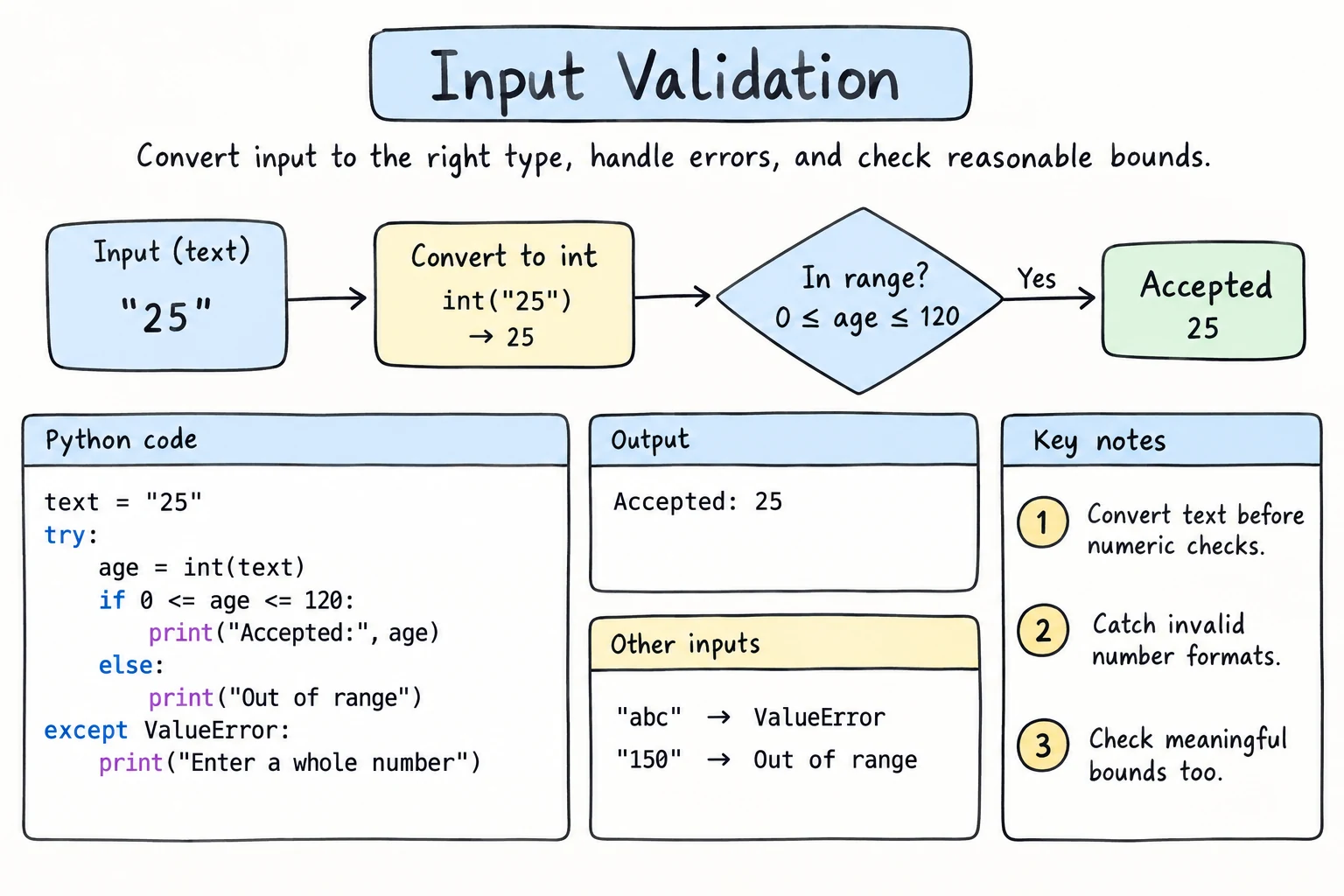
You expect 7 and get seven, 7.5 or ""; you expect an age and get -4. Validation has three steps: normalize (spaces, letter case), convert (to int or float), and check rules (range, choices, length, format).
strip() removes spaces at both ends, and lower() ignores case:
for raw in ["yes", " Yes", "YES  ", "no"]:
    answer = raw.strip().lower()
print(f"{raw!r:>9} -> {answer!r:>6} -> accepted: {answer in {'yes', 'y'}}") 'yes' -> 'yes' -> accepted: True
' Yes' -> 'yes' -> accepted: True
'YES ' -> 'yes' -> accepted: True
'no' -> 'no' -> accepted: FalseNormalize before checking, and store the normalized value, or "Tashkent " and "tashkent" become two cities.
A reusable ask_int helper
Converting can fail, so use try/except; after it succeeds, check the range. Put the loop into a function that returns only a valid int:
def ask_int(prompt, min_value=None, max_value=None):
    while True:
        text = input(prompt).strip()
        try:
            value = int(text)
        except ValueError:
            print(f"  {text!r} is not a whole number.")
            continue
        if min_value is not None and value < min_value:
            print(f"  The smallest allowed value is {min_value}.")
            continue
        if max_value is not None and value > max_value:
            print(f"  The largest allowed value is {max_value}.")
            continue
        return value

nights = ask_int("Nights in Samarkand (1-14): ", 1, 14)
print(f"Booked {nights} nights")Nights in Samarkand (1-14): 3.5
'3.5' is not a whole number.
Nights in Samarkand (1-14): 20
The largest allowed value is 14.
Nights in Samarkand (1-14): 7
Booked 7 nightsEach failed check prints a specific message and continues; return value ends the loop and the function. The limits are optional, and the test is is not None because 0 is a valid but falsy limit.
Choosing from a set of options: ask_choice
For menus and yes/no questions, compare the normalized answer with a set of allowed values:
def ask_choice(prompt, choices):
    allowed = {choice.lower() for choice in choices}
    options = ", ".join(sorted(allowed))
    while True:
        answer = input(prompt).strip().lower()
        if answer in allowed:
            return answer
        print(f"  Please choose one of: {options}")

print("1) Balance  2) Transfer  3) History  0) Exit")
action = ask_choice("Choose: ", {"1", "2", "3", "0"})
print(f"You chose {action}")1) Balance 2) Transfer 3) History 0) Exit
Choose: 5
Please choose one of: 0, 1, 2, 3
Choose: 3
You chose 3Validating strings
For text, write small checks. String methods do most of the work:
| Method | True when | Example |
|---|---|---|
isdecimal() | all characters are decimal digits (and there is at least one) | "2026".isdecimal() |
isdigit() | the same, but also accepts digit-like symbols such as ² | "2²".isdigit() |
isalpha() | all characters are letters | "Aziza".isalpha() |
isalnum() | letters or digits only | "bekzod99".isalnum() |
isdecimal() and isdigit() are not number checks
"-5".isdecimal() and "4.5".isdecimal() are False, yet both are valid numbers: to check a number, convert inside try. Use isdecimal() for digit-only codes like a PIN, and prefer it over isdigit(): "²".isdigit() is True, but int("²") raises ValueError.
A username
def check_username(name):
    if not name:
        return False, "username cannot be empty"
    if not 3 <= len(name) <= 16:
        return False, f"username must be 3-16 characters, got {len(name)}"
    if not name[0].isalpha():
        return False, "username must start with a letter"
    if not name.replace("_", "").isalnum():
        return False, "use only letters, digits and _"
    return True, "ok"

for name in ["aziza_07", "ab", "7bekzod", "dilnoza!", ""]:
    ok, message = check_username(name)
print(f"{name!r:12} {str(ok):5} {message}")'aziza_07' True ok
'ab' False username must be 3-16 characters, got 2
'7bekzod' False username must start with a letter
'dilnoza!' False use only letters, digits and _
'' False username cannot be emptyEach if is a guard clause that leaves as soon as a rule is broken. The empty check comes first, so name[0] cannot raise IndexError.
An Uzbek phone number
Normalize first by removing spaces, dashes and brackets, then check the format:
def normalize_phone(raw):
    phone = raw.strip()
    for symbol in " -()":
        phone = phone.replace(symbol, "")
    if not phone.startswith("+998"):
        return None
    digits = phone[1:]
    if len(digits) != 12 or not digits.isdecimal():
        return None
    return phone

for raw in ["+998 90 123-45-67", "+998(91)7654321", "90 123 45 67"]:
print(f"{raw!r:22} -> {normalize_phone(raw)}")'+998 90 123-45-67' -> +998901234567
'+998(91)7654321' -> +998917654321
'90 123 45 67' -> NoneIt returns the cleaned number, ready to store, or None.
Returning (ok, message) or raising?
check_username returns (False, message). The alternative is to raise, as in Raising and Custom Exceptions.
Return (ok, message) | Raise an exception | |
|---|---|---|
| Good for | forms, where invalid input is normal | core functions, where bad data is unexpected |
| If the caller forgets to check | the bad value slips through | the program stops loudly |
| Collecting all problems at once | easy | harder |
A common combination: validate at the edge (where the user types) with friendly loops, and raise inside core functions as a safety net.
Limiting attempts
A PIN should not allow endless guesses. Use for with range instead of while True:
def ask_pin(correct_pin, max_attempts=3):
    for attempt in range(1, max_attempts + 1):
        pin = input(f"PIN (attempt {attempt} of {max_attempts}): ").strip()
        if len(pin) != 4 or not pin.isdecimal():
            print("  A PIN is exactly 4 digits.")
        elif pin == correct_pin:
            return True
        else:
            print("  Wrong PIN.")
    return False

if ask_pin("2580"):
    print("Access granted")
else:
print("Card blocked. Please visit your bank.")PIN (attempt 1 of 3): 7
A PIN is exactly 4 digits.
PIN (attempt 2 of 3): 2580
Access grantedA general helper could raise after the last attempt instead.
Try it
Run it and answer the questions with values such as abc, 25, 3. Then add a second question for the dish.
Common mistakes
1. Converting before checking for errors
text = "twenty"          # what input("Age: ") returned
age = int(text)
if age < 0:
print("Invalid age")ValueError: invalid literal for int() with base 10: 'twenty'int() crashes before the range check runs. Convert inside try, and check the range after it succeeds.
2. Validating, then using the original value
city = " tashkent "
cities = []
if city.strip().title() in {"Tashkent", "Samarkand", "Bukhara"}:
    cities.append(city)      # Bad: stores the raw text
print(cities)[' tashkent ']Save the normalized value in a variable (city = city.strip().title()) and use that one everywhere.
Practice
1. Clean the answers
Given raw = [" Tashkent", "samarkand ", "BUKHARA", "Tashkent"], normalize each city with strip() and title() and print the set of unique cities.
Solution
raw = ["  Tashkent", "samarkand ", "BUKHARA", "Tashkent"]

cities = {city.strip().title() for city in raw}
print(sorted(cities))['Bukhara', 'Samarkand', 'Tashkent']2. Postal code
An Uzbek postal code has exactly 6 digits, like 100000. Write is_postal_code(text) that ignores surrounding spaces. Test "100000", " 140100 ", "10000" and "1OOOOO" (letter O).
Solution
def is_postal_code(text):
    code = text.strip()
    return len(code) == 6 and code.isdecimal()

for text in ["100000", " 140100 ", "10000", "1OOOOO"]:
print(f"{text!r:10} {is_postal_code(text)}")'100000' True
' 140100 ' True
'10000' False
'1OOOOO' False3. Password rules
Write check_password(password) that returns (ok, problems), where problems lists every broken rule: at least 8 characters, a digit, a letter, no spaces. Test "secret", "my pass 1" and "samarkand2026".
Solution
def check_password(password):
    problems = []
    if len(password) < 8:
        problems.append("at least 8 characters")
    if not any(ch.isdigit() for ch in password):
        problems.append("at least one digit")
    if not any(ch.isalpha() for ch in password):
        problems.append("at least one letter")
    if " " in password:
        problems.append("no spaces")
    return len(problems) == 0, problems

for password in ["secret", "my pass 1", "samarkand2026"]:
    ok, problems = check_password(password)
print(password, "->", "OK" if ok else "; ".join(problems))secret -> at least 8 characters; at least one digit
my pass 1 -> no spaces
samarkand2026 -> OK4. ask_float with attempts
Write ask_float(prompt, min_value, max_value, attempts=3) that returns a valid float (accept 7,5 too), or raises ValueError("too many invalid attempts"). Ask for a parcel weight from 0.1 to 30 kg.
Solution
def ask_float(prompt, min_value, max_value, attempts=3):
    for _ in range(attempts):
        text = input(prompt).strip().replace(",", ".")
        try:
            value = float(text)
        except ValueError:
            print("  Not a number.")
            continue
        if min_value <= value <= max_value:
            return value
        print(f"  Must be between {min_value} and {max_value}.")
    raise ValueError("too many invalid attempts")

try:
    weight = ask_float("Parcel weight in kg: ", 0.1, 30)
    print(f"Weight: {weight} kg")
except ValueError as e:
print(f"Order cancelled: {e}")Parcel weight in kg: heavy
Not a number.
Parcel weight in kg: 7,5
Weight: 7.5 kg5. Validate a whole record
Write validate_student(record) for form dictionaries like {"name": "Aziza", "age": "20"} (string values, fields may be missing). The name must be 2-30 letters; the age an int from 7 to 99. Return (cleaned, errors): normalized values (title-case name, int age) and a dictionary of messages per field. Test {"name": " bekzod ", "age": "15"}, {"name": "D1lnoza", "age": "150"} and {"age": "x"}.
Solution
def validate_student(record):
    cleaned = {}
    errors = {}

    name = record.get("name", "").strip()
    if name.isalpha() and 2 <= len(name) <= 30:
        cleaned["name"] = name.title()
    else:
        errors["name"] = "letters only, 2-30 characters"

    try:
        age = int(record.get("age", ""))
    except ValueError:
        errors["age"] = "must be a whole number"
    else:
        if 7 <= age <= 99:
            cleaned["age"] = age
        else:
            errors["age"] = f"must be 7-99, got {age}"

    return cleaned, errors

for record in [{"name": " bekzod ", "age": "15"}, {"name": "D1lnoza", "age": "150"}, {"age": "x"}]:
print(validate_student(record))({'name': 'Bekzod', 'age': 15}, {})
({}, {'name': 'letters only, 2-30 characters', 'age': 'must be 7-99, got 150'})
({}, {'name': 'letters only, 2-30 characters', 'age': 'must be a whole number'})record.get(..., "") turns a missing field into a normal error instead of a KeyError. Note that isalpha() rejects O'tkir (plain apostrophe) but accepts Gʻayrat; a real form would remove ' and ʻ first.
Recap
- Never trust input: normalize (
strip(),lower()), convert insidetry, then check ranges and allowed choices. - Wrap the loop in helpers such as
ask_int(prompt, min_value, max_value)andask_choice(prompt, choices). - Validate strings with guard clauses and methods like
isdecimal()andisalpha(). - Return
(ok, message)for friendly forms; raise exceptions for unexpected bad data in core code. - Limit attempts with
for ... in range(max_attempts), and store the normalized value.