

Project: Number Guessing Game
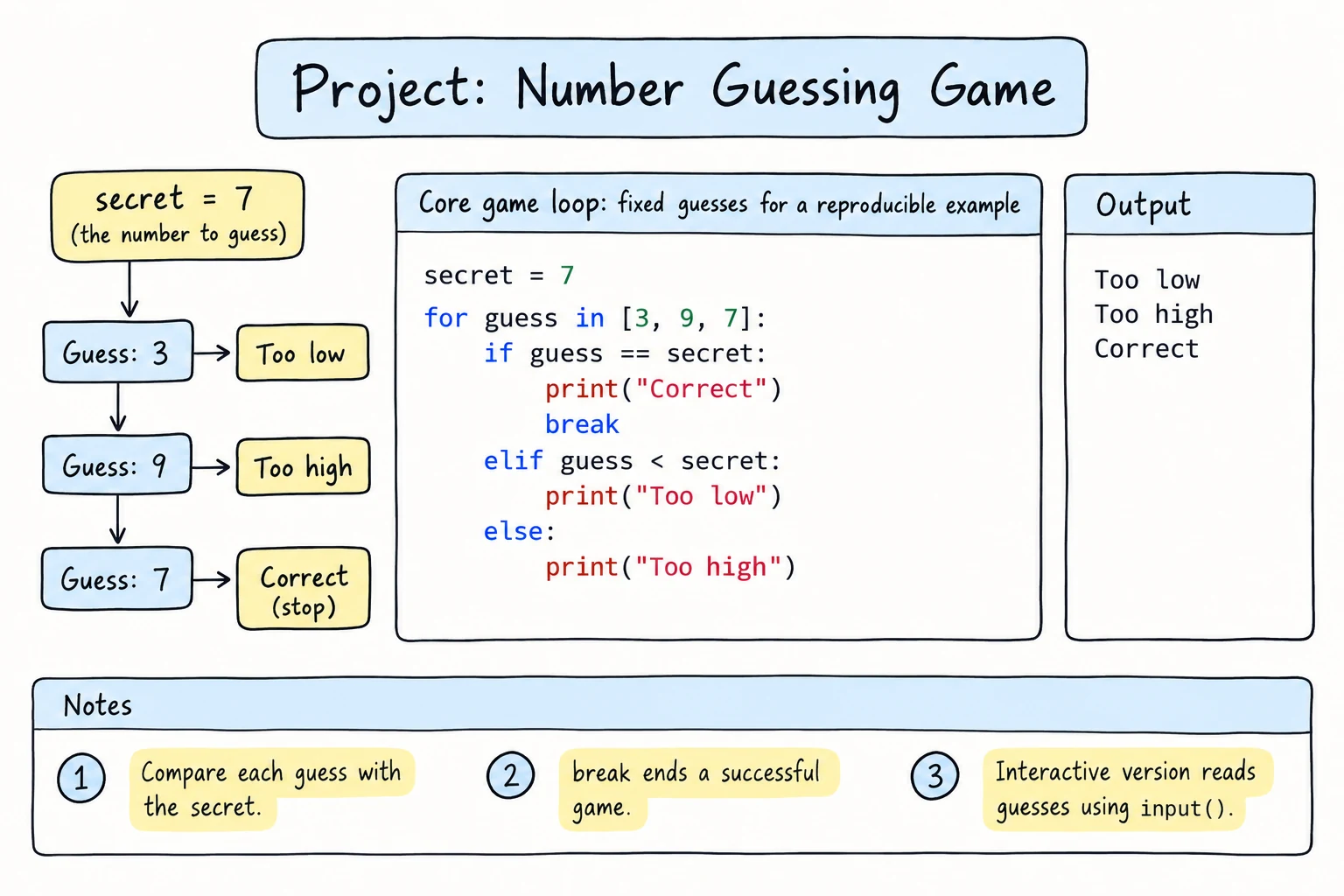
What you'll learn
- How to plan a small program before you write any code
- How to combine
whileloops,if/elif/else,match,break, andcontinuein one program - How to validate player input with
isdecimal()so a typo doesn't crash the game - How to track state across rounds: attempts, wins, and a best score
- How to leave nested loops cleanly with a flag variable
Why it matters
You now know variables, strings, input, conditions, and loops. Each lesson showed one tool at a time. A real program uses all of them together, and the new challenge is deciding which loop goes where and which variables must survive between rounds.
A guessing game is a classic first project because it is small but complete: it talks to the player, reacts to mistakes, keeps score, and ends cleanly. Every interactive program you write later, from an ATM menu to a chat bot, follows the same shape.
Goal and features
The computer picks a secret number. The player guesses, and the computer answers "too high" or "too low" until the player finds it or runs out of attempts. A finished session looks like this:
Guess 1/7: 50
  Too high!
Guess 2/7: 25
  Too low!
Guess 3/7: abc
  That is not a whole number. Try again.
...
Correct! The number was 42. You needed 7 attempts.
New best score!
Play again? (y/n):
Features:
| Feature | Tools you will use |
|---|---|
| A random secret number | random.randint() |
| "Too high" / "Too low" hints | if / elif / else |
| Count attempts and limit them | while, a counter variable |
Reject bad input like abc or -5 | strip(), isdecimal(), continue |
| Difficulty levels (range and attempts) | match with or-patterns |
| Play again, best score, and a summary | an outer while loop, break |
Type quit at any prompt | a flag variable |
Design
Before writing code, draw the flow. The game has two loops: an outer loop for rounds and an inner loop for guesses inside one round.
- start
rounds_played = 0,wins = 0,best_score = None,playing = True
- OUTER LOOP: one roundrepeats while
playing
- ask difficultybad answer: message, ask again
- set
max_number,max_attempts - pick
secret,attempts = 0,won = False - INNER LOOP: one guessrepeats while
attempts < max_attempts"quit"?playing = False, leave both loops- not a number / too big?message, ask again (no attempt used)
attempts += 1- too low / too high?hint, next guess
- correct?
won = True, leave inner loop
- show result, update
winsandbest_score - "Play again?"not
y:playing = False
- print summary
The variables fall into two groups, and keeping them apart is the key design decision:
| Lives for the whole session | Reset at the start of every round |
|---|---|
rounds_played, wins, best_score, playing | secret, attempts, won, max_number, max_attempts |
Session variables are created before the outer loop. Round variables are set inside it.
Step 1: Pick a secret number
Python has a built-in collection of ready-made tools called the standard library. The random module can pick random numbers. You will learn about modules properly in Modules and Imports. For now, one line at the top of the file is enough: import random.
import random

random.seed(7)

secret = random.randint(1, 100)
print(f"Secret number: {secret}")

dice = random.randint(1, 6)
print(f"Dice roll: {dice}")Secret number: 42
Dice roll: 2random.randint(a, b) returns a whole number from a to b, and both ends are included, so randint(1, 100) can return 1 or 100.
Normally you want a different number every game. While you are building and testing, though, a changing number is annoying: you cannot repeat a bug. random.seed(7) makes the "random" numbers the same on every run. This lesson uses a seed so the outputs you see here are real and repeatable. Delete the seed line when you want to play for real.
Step 2: One guess with hints and validation
int(input()) crashes if the player types abc. Check the text first with isdecimal(), which is True only when a string is non-empty and every character is a decimal digit (a character int() can convert):
print("42".isdecimal())
print("abc".isdecimal())
print("-5".isdecimal())
print("4.5".isdecimal())
print("".isdecimal())
print(" 42".isdecimal(), " 42".strip().isdecimal())True
False
False
False
False
False TrueNotice that "-5" and "4.5" are rejected. That is fine for this game, because the secret is never negative or a decimal. Always strip() first, so a stray space does not make a good answer fail.
You may also meet isdigit(). It looks similar, but it also accepts characters like ², and int("²") raises ValueError. isdecimal() is the safe test before int().
Now one complete guess:
secret = 42

text = input("Guess a number from 1 to 100: ").strip()

if not text.isdecimal():
    print("That is not a whole number.")
else:
    guess = int(text)
    if guess < 1 or guess > 100:
        print("Please stay between 1 and 100.")
    elif guess < secret:
        print("Too low!")
    elif guess > secret:
        print("Too high!")
    else:
        print("Correct!")
Two runs, typing abc and then 70:
Guess a number from 1 to 100: abc
That is not a whole number.
Guess a number from 1 to 100: 70
Too high!
The order of the checks matters. First "is it a number at all?", then "is it in range?", and only then compare it with the secret. int(text) is safe inside the else, because isdecimal() already said yes.
Step 3: A loop with an attempt counter and a limit
One guess is not a game. Wrap it in a while loop that counts attempts and stops at the limit:
secret = 42
max_attempts = 5
attempts = 0

while attempts < max_attempts:
    text = input(f"Guess {attempts + 1}/{max_attempts}: ").strip()
    if not text.isdecimal():
        print("  That is not a whole number. Try again.")
        continue

    guess = int(text)
    attempts += 1
    if guess < secret:
        print("  Too low!")
    elif guess > secret:
        print("  Too high!")
    else:
        print(f"Correct! You needed {attempts} attempts.")
        break
else:
    print(f"Out of attempts. The number was {secret}.")
A winning run:
Guess 1/5: 50
  Too high!
Guess 2/5: 30
  Too low!
Guess 3/5: hello
  That is not a whole number. Try again.
Guess 3/5: 45
  Too high!
Guess 4/5: 42
Correct! You needed 4 attempts.
And a losing run:
Guess 1/5: 10
  Too low!
Guess 2/5: 20
  Too low!
Guess 3/5: 30
  Too low!
Guess 4/5: 40
  Too low!
Guess 5/5: 50
  Too high!
Out of attempts. The number was 42.
Three details to notice:
continueskips the rest of the loop body, sohellodoes not use up an attempt. The counter only grows after the input passed validation.breakleaves the loop as soon as the player wins.- The
elseblock of thewhileloop runs only when the loop ended withoutbreak, which here means "the player ran out of attempts". You met this in break, continue, and else.
Step 4: Difficulty levels with match
Each difficulty sets two values: the size of the range and the number of attempts. match handles this neatly, and | lets the player type either the number or the word:
while True:
    print("1) Easy   2) Medium   3) Hard")
    choice = input("Choose a difficulty: ").strip().lower()

    match choice:
        case "1" | "easy":
            max_number = 50
            max_attempts = 10
        case "2" | "medium":
            max_number = 100
            max_attempts = 7
        case "3" | "hard":
            max_number = 100
            max_attempts = 5
        case _:
            print("  Please type 1, 2, or 3.")
            continue
    break

print(f"Range 1-{max_number}, {max_attempts} attempts")1) Easy 2) Medium 3) Hard
Choose a difficulty: 5
Please type 1, 2, or 3.
1) Easy 2) Medium 3) Hard
Choose a difficulty: hard
Range 1-100, 5 attemptsThe loop runs until the player gives a valid answer. The case _: branch catches everything else and uses continue to ask again. After a valid case, the code reaches break.
With 7 attempts on 1-100, a smart player always wins: guess the middle (50), then the middle of the half that is left (25 or 75), and so on. Each guess cuts the range in half, and 100 halves to 1 in 7 steps. With only 5 attempts on the same range, the player needs some luck. That is what makes "hard" hard.
Step 5: Best score and playing again
The best score is the smallest number of attempts in a won round. Start with None to mean "no wins yet", the "nothing found yet" marker from Common Loop Patterns, and replace it when there is no best score yet or the new result is better. Here is the logic on its own, with made-up results:
results = "7 4 9 3 5"   # attempts used in five won rounds

best_score = None       # no wins yet
for word in results.split():
    attempts = int(word)
    if best_score is None or attempts < best_score:
        best_score = attempts
        print(f"Won in {attempts} attempts. New best score!")
    else:
print(f"Won in {attempts} attempts. Best is still {best_score}.")Won in 7 attempts. New best score!
Won in 4 attempts. New best score!
Won in 9 attempts. Best is still 4.
Won in 3 attempts. New best score!
Won in 5 attempts. Best is still 3.best_score is None or attempts < best_score is checked left to right. The first win always becomes the best score, because best_score is None is True. Short-circuiting also matters here: while best_score is None, Python never runs attempts < best_score, which would raise a TypeError.
The play-again loop wraps a whole round. Accept y or yes, and treat anything else as "no":
rounds = 0

while True:
    rounds += 1
    print(f"--- Round {rounds} ---")
    print("(one full game runs here)")

    again = input("Play again? (y/n): ").strip().lower()
    if again != "y" and again != "yes":
        break

print(f"Thanks for playing {rounds} rounds!")--- Round 1 ---
(one full game runs here)
Play again? (y/n): y
--- Round 2 ---
(one full game runs here)
Play again? (y/n): Y
--- Round 3 ---
(one full game runs here)
Play again? (y/n): no
Thanks for playing 3 rounds!.lower() turns Y into y, so both work.
Step 6: Quit from anywhere
The game has a loop inside a loop. break leaves only the innermost loop, so typing quit during a guess would just end the round and ask "Play again?". To stop everything, set a flag that the outer loop checks:
playing = True

while playing:
    print("New round")
    while True:
        text = input("Guess: ").strip().lower()
        if text == "quit":
            playing = False
            break
        print(f"  You guessed {text}")

print("Bye!")New round
Guess: 50
You guessed 50
Guess: 20
You guessed 20
Guess: quit
Bye!playing = False alone does not stop the inner loop right away, and break alone does not stop the outer loop. Together they end the program at once. In the full game, one more if not playing: break right after the inner loop skips the result and the "Play again?" question.
The full program
Here is everything in one file. The comments show which step each part came from. Copy it into guessing_game.py and run it.
import random

random.seed(7)  # same numbers every run while testing; delete this line to play for real

print("=== Number Guessing Game ===")
print("Type quit at any prompt to stop.")

rounds_played = 0
wins = 0
best_score = None   # no wins yet
playing = True

while playing:
    # ---------- Step 4: choose a difficulty ----------
    print()
    print("Difficulty:  1) Easy   1-50,  10 attempts")
    print("             2) Medium 1-100,  7 attempts")
    print("             3) Hard   1-100,  5 attempts")
    choice = input("Choose 1, 2, or 3: ").strip().lower()

    match choice:
        case "1" | "easy":
            max_number = 50
            max_attempts = 10
        case "2" | "medium":
            max_number = 100
            max_attempts = 7
        case "3" | "hard":
            max_number = 100
            max_attempts = 5
        case "quit" | "q":
            break
        case _:
            print("  Please type 1, 2, 3, or quit.")
            continue

    # ---------- Step 1: pick a secret number ----------
    secret = random.randint(1, max_number)
    attempts = 0
    won = False
    print(f"I am thinking of a number from 1 to {max_number}.")
    print(f"You have {max_attempts} attempts. Good luck!")

    # ---------- Steps 2-3: the guessing loop ----------
    while attempts < max_attempts:
        text = input(f"Guess {attempts + 1}/{max_attempts}: ").strip().lower()

        if text == "quit" or text == "q":
            playing = False
            break
        if not text.isdecimal():
            print("  That is not a whole number. Try again.")
            continue

        guess = int(text)
        if guess < 1 or guess > max_number:
            print(f"  Please stay between 1 and {max_number}.")
            continue

        attempts += 1
        if guess < secret:
            print("  Too low!")
        elif guess > secret:
            print("  Too high!")
        else:
            won = True
            break

    if not playing:
        break

    # ---------- Step 5: results and best score ----------
    rounds_played += 1
    if won:
        wins += 1
        print(f"Correct! The number was {secret}. You needed {attempts} attempts.")
        if best_score is None or attempts < best_score:
            best_score = attempts
            print("New best score!")
    else:
        print(f"Out of attempts. The number was {secret}.")

    # ---------- Step 6: play again? ----------
    again = input("Play again? (y/n): ").strip().lower()
    if again != "y" and again != "yes":
        playing = False

print()
print("=== Game over ===")
print(f"Rounds played: {rounds_played}")
print(f"Rounds won:    {wins}")
if best_score is not None:
    print(f"Best score:    {best_score} attempts")
else:
    print("Best score:    no wins yet")
A real session. The player chooses medium, wins in 7 attempts, plays a hard round, and wins it in 5:
=== Number Guessing Game ===
Type quit at any prompt to stop.

Difficulty:  1) Easy   1-50,  10 attempts
             2) Medium 1-100,  7 attempts
             3) Hard   1-100,  5 attempts
Choose 1, 2, or 3: 2
I am thinking of a number from 1 to 100.
You have 7 attempts. Good luck!
Guess 1/7: 50
  Too high!
Guess 2/7: 25
  Too low!
Guess 3/7: abc
  That is not a whole number. Try again.
Guess 3/7: 37
  Too low!
Guess 4/7: 43
  Too high!
Guess 5/7: 40
  Too low!
Guess 6/7: 41
  Too low!
Guess 7/7: 42
Correct! The number was 42. You needed 7 attempts.
New best score!
Play again? (y/n): y

Difficulty:  1) Easy   1-50,  10 attempts
             2) Medium 1-100,  7 attempts
             3) Hard   1-100,  5 attempts
Choose 1, 2, or 3: 4
  Please type 1, 2, 3, or quit.

Difficulty:  1) Easy   1-50,  10 attempts
             2) Medium 1-100,  7 attempts
             3) Hard   1-100,  5 attempts
Choose 1, 2, or 3: 3
I am thinking of a number from 1 to 100.
You have 5 attempts. Good luck!
Guess 1/5: 150
  Please stay between 1 and 100.
Guess 1/5: 50
  Too high!
Guess 2/5: 25
  Too high!
Guess 3/5: 12
  Too low!
Guess 4/5: 18
  Too low!
Guess 5/5: 20
Correct! The number was 20. You needed 5 attempts.
New best score!
Play again? (y/n): n

=== Game over ===
Rounds played: 2
Rounds won:    2
Best score:    5 attempts
Match the output to the rules:
abcand150were rejected, and they did not use an attempt: the counter stayed at3/7and1/5.- The first win set the best score to 7. The second win took only 5 attempts, so it replaced it.
4is not a difficulty, so the menu appeared again.- The summary counts rounds and wins that were stored outside the outer loop, so they survived every round.
Try it
A compact version with one round on medium difficulty and no seed, so the number changes every run. Run it and type your guesses as it asks (for example 50, 25, 37). Then try adding a difficulty menu.
Common mistakes
1. Converting input without checking it
text = "abc"          # what the player typed
guess = int(text)ValueError: invalid literal for int() with base 10: 'abc'One typo and the whole game crashes. Fix: strip() the text, check isdecimal(), and continue when it fails. Convert with int() only after the check.
2. Comparing text with a number
secret = 42
guess = input("Guess: ")      # the player types 50, but guess is the string "50"
if guess < secret:
print("Too low!")TypeError: '<' not supported between instances of 'str' and 'int'input() always returns a string. "42" == 42 does not crash, but it is always False, so the player could never win. Fix: convert with int() (after validation) before comparing.
3. Picking the secret inside the guessing loop
import random

random.seed(7)
for text in "50 50 50".split():       # the same guess three times
    secret = random.randint(1, 100)   # Bad: a new secret before every guess
    guess = int(text)
    if guess < secret:
        print(f"{guess}: Too low!")
    elif guess > secret:
        print(f"{guess}: Too high!")
    else:
print(f"{guess}: Correct!")50: Too high!
50: Too high!
50: Too low!The same guess gets different hints, because each one refers to a new secret. Fix: pick the secret once per round, before the inner loop starts.
4. Forgetting to reset round variables
max_attempts = 3
attempts = 0          # Bad: set once, outside the rounds loop

for round_number in range(1, 3):
    print(f"Round {round_number}")
    while attempts < max_attempts:
        attempts += 1
print(f" Guess {attempts}/{max_attempts}")Round 1
Guess 1/3
Guess 2/3
Guess 3/3
Round 2In the second round attempts is still 3, so the inner loop does not run at all and the player loses without a single guess. Fix: set attempts = 0 and won = False at the start of every round, inside the outer loop.
Challenges
Try each one before opening the hints. Challenges 1 and 2 also have a reference solution. To make its output repeatable (and let the Check button compare yours with it), the solution uses a fixed secret and takes the guesses from a string instead of input(). Test your version the same way before adding it to the full game.
1. Attempts left
After each wrong guess, show how many attempts remain, for example Too low! 4 attempts left., and use the word "attempt" (not "attempts") when only one is left.
Hints
max_attempts - attemptsis the number left.- Pick the word with a conditional expression:
word = "attempt" if left == 1 else "attempts". - Do not print the message after the winning guess.
Test it with secret = 42, max_attempts = 5, and the guesses "50 25 40 41 42".
Solution
secret = 42
max_attempts = 5
attempts = 0

for text in "50 25 40 41 42".split():   # the player's guesses
    guess = int(text)
    attempts += 1
    if guess == secret:
        print(f"Correct! You needed {attempts} attempts.")
        break

    left = max_attempts - attempts
    word = "attempt" if left == 1 else "attempts"
    if guess < secret:
        print(f"Too low! {left} {word} left.")
    else:
        print(f"Too high! {left} {word} left.")
else:
print(f"Out of attempts. The number was {secret}.")Too high! 4 attempts left.
Too low! 3 attempts left.
Too low! 2 attempts left.
Too low! 1 attempt left.
Correct! You needed 5 attempts.In the game, replace the for line with the while attempts < max_attempts: loop and input().
2. Hot and cold
Add a second hint based on distance: (very hot) when the guess is within 3 of the secret, (warm) within 10, and (cold) otherwise.
Hints
abs(guess - secret)gives the distance without worrying about the sign.- Check the smallest distance first:
if distance <= 3thenelif distance <= 10. - Build the message with an f-string, for example
f" Too low! ({heat})".
Test it with secret = 42 and the guesses "70 35 45 42".
Solution
secret = 42

for text in "70 35 45 42".split():   # the player's guesses
    guess = int(text)
    if guess == secret:
        print("Correct!")
        break

    distance = abs(guess - secret)
    if distance <= 3:
        heat = "very hot"
    elif distance <= 10:
        heat = "warm"
    else:
        heat = "cold"

    if guess < secret:
        print(f"{guess}: Too low! ({heat})")
    else:
print(f"{guess}: Too high! ({heat})")70: Too high! (cold)
35: Too low! (warm)
45: Too high! (very hot)
Correct!3. Show the remaining range
Help the player by showing what is still possible: after 50 -> too high and 25 -> too low, print The number is between 26 and 49.
Hints
- Keep two round variables,
low = 1andhigh = max_number, reset every round. - Too low:
low = guess + 1. Too high:high = guess - 1. Without the bonus below, a guess outside the range could widen it again, so only move a bound inward: changelowonly ifguess + 1 > low, andhighonly ifguess - 1 < high. - Bonus: reject guesses outside
low..highwithout using an attempt, because they cannot be right.
4. Custom difficulty and statistics
Add a fourth level, 4) Custom, where the player enters the largest number and the number of attempts (both validated). At the end, also print the average attempts per won round.
Hints
- Reuse the
isdecimal()validation pattern in a smallwhile Trueloop for each value. - Reject a custom range smaller than 2 and attempts smaller than 1.
- Keep
total_attemptsas a session variable. Add to it only when a round is won, and divide bywinsonly ifwins > 0.
5. The computer guesses your number
Reverse the game: the player thinks of a number from 1 to 100, and the computer guesses. The player answers h (too high), l (too low), or c (correct). The computer should always win within 7 guesses and should detect cheating (for example, answers that make low bigger than high).
Hints
- Keep
low = 1andhigh = 100. The computer guesses(low + high) // 2. - On
h, sethigh = guess - 1. Onl, setlow = guess + 1. - If
low > high, the player gave inconsistent answers: print a message and stop. - Validate the answer with
match answer:andcase _:for anything that is noth,l, orc.
Recap
- Plan first: draw the loops and decide which variables live for the whole session and which reset every round.
random.randint(a, b)includes both ends.random.seed()makes results repeatable while testing.- Validate before converting:
strip(), thenisdecimal(), thenint(). Usecontinueso bad input does not cost an attempt. - A counter plus
while attempts < max_attemptslimits the attempts, andbreakends the loop early on a win. matchwith|patterns turns a menu choice into settings, andcase _:catches everything else.breakleaves only the innermost loop, so a flag likeplayingstops the outer loop. Test every path: win, lose, invalid input, and quitting at each prompt.