

Composition vs. Inheritance
What you'll learn
- The difference between has-a (composition) and is-a (inheritance)
- How to build objects out of other objects, and delegate calls to them
- Why "favor composition over inheritance" is common advice
- How to pass parts into a class (dependency injection) to make it flexible and testable
Why it matters
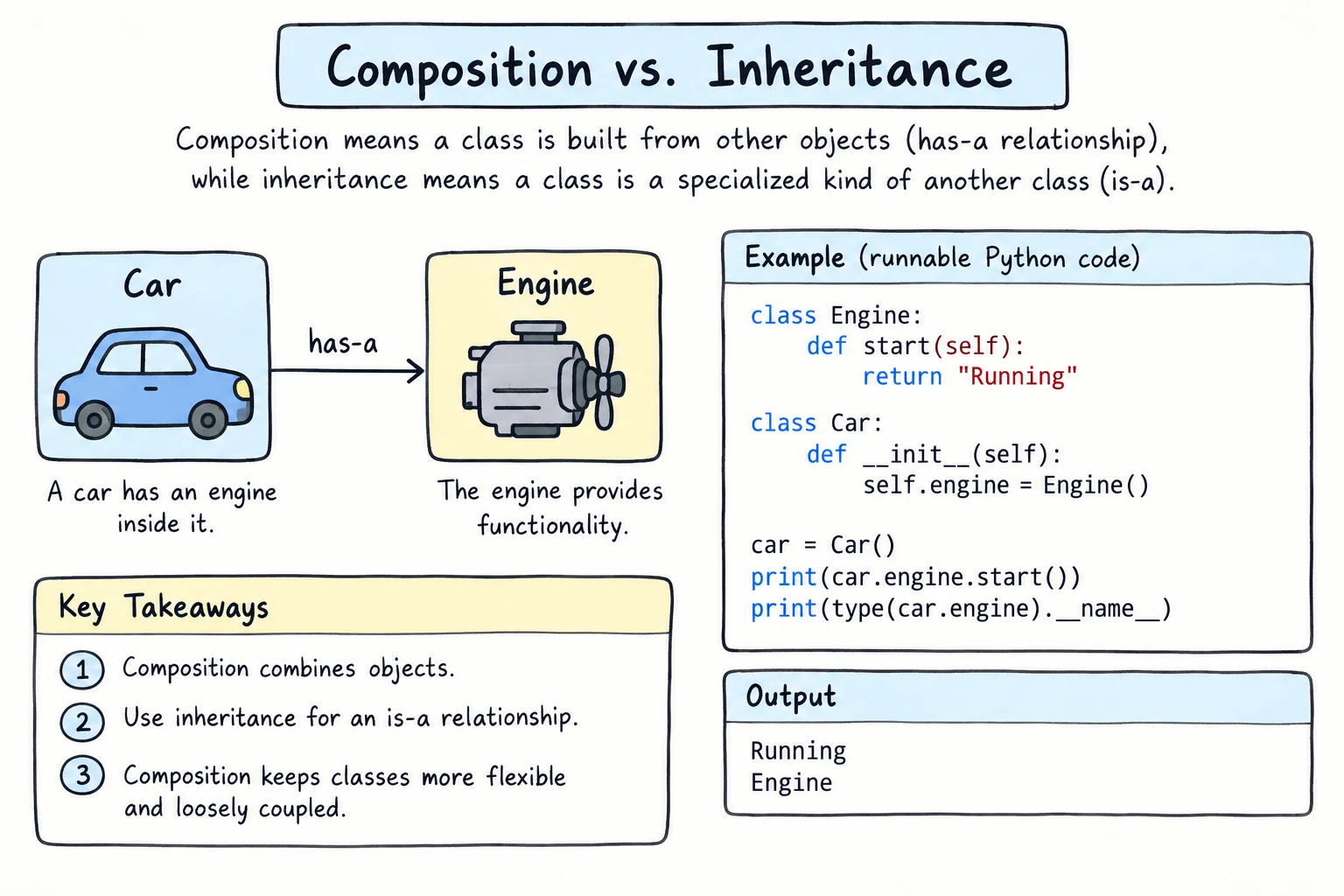
A car is not an engine, but it has one. Most objects in real programs are built from other objects, like real things from parts. Inheritance is the tightest possible link between classes: the child gets every parent method, forever. Composition is looser and more flexible, and choosing between them is a core design skill.
Has-a vs. is-a
"A manager is an employee" calls for inheritance: class Manager(Employee):. "A car has an engine" calls for composition: the car stores the engine in an attribute, self.engine = engine, and uses it to do its work.
Worked example: a car with a swappable engine
class Engine:
    def __init__(self, horsepower, fuel="petrol"):
        self.horsepower = horsepower
        self.fuel = fuel

    def describe(self):
        return f"{self.horsepower} hp, {self.fuel}"


class ElectricMotor:
    def __init__(self, kw):
        self.kw = kw

    def describe(self):
        return f"{self.kw} kW, electric"


class Car:
    def __init__(self, model, engine):
        self.model = model
        self.engine = engine          # the car HAS an engine

    def spec(self):
        return f"{self.model}: {self.engine.describe()}"


cars = [Car("Cobalt", Engine(106, "methane")), Car("Spark EV", ElectricMotor(105))]
for car in cars:
print(car.spec())Cobalt: 106 hp, methane
Spark EV: 105 kW, electricEach class has one job. Inheritance would need PetrolCar, MethaneCar, ElectricCar... With composition, the same Car works with any part that has describe(): duck typing inside composition.
Worked example: an order with line items
An order is made of line items, and each line item is a product and a quantity:
class Product:
    def __init__(self, name, price):
        self.name = name
        self.price = price


class LineItem:
    def __init__(self, product, quantity):
        self.product = product
        self.quantity = quantity

    @property
    def subtotal(self):
        return self.product.price * self.quantity


class Order:
    def __init__(self, customer):
        self.customer = customer
        self.items = []

    def add(self, product, quantity=1):
        self.items.append(LineItem(product, quantity))

    @property
    def total(self):
        return sum(item.subtotal for item in self.items)


order = Order("Bekzod")
order.add(Product("Samsa", 8_000), 6)
order.add(Product("Lagman", 38_000), 2)
print(f"Total for {order.customer}: {order.total:,} som")Total for Bekzod: 124,000 somOrder.total asks each item for its subtotal instead of multiplying prices itself, which keeps each class simple. A library that has books and members works the same way; you will build one in Project: Library Management System.
Before and after: a stack that inherits from list
A stack is a pile of plates: you add to the top (push) and take from the top (pop). Here is a tempting shortcut:
class Stack(list):                    # "a stack is a list"?
    def push(self, item):
        self.append(item)


plates = Stack()
plates.push("plate 1")
plates.push("plate 2")
plates.insert(0, "sneaky plate")      # every list method came along
print(plates)['sneaky plate', 'plate 1', 'plate 2']The class inherited more than 40 list methods, and any of them can break the stack rule: not everything you can do with a list makes sense for a stack. After refactoring, the stack delegates to a hidden list, forwarding only the operations it wants:
class Stack:
    def __init__(self):
        self._items = []                  # the part

    def push(self, item):
        self._items.append(item)          # delegate to the list

    def pop(self):
        return self._items.pop()

    def __len__(self):
        return len(self._items)           # delegate


plates = Stack()
for n in range(1, 4):
    plates.push(f"plate {n}")
print(plates.pop(), len(plates), hasattr(plates, "insert"))plate 3 2 FalseNow you control the interface, and could replace the list later without changing any caller. The underscore in _items marks an internal detail.
Dependency injection: passing parts in
The Car received its engine from outside. That is dependency injection: a class receives its parts instead of creating them:
class SmsNotifier:
    def notify(self, customer, text):
        print(f"[SMS to {customer}] {text}")


class FakeNotifier:
    """For testing: remembers messages instead of sending them."""
    def __init__(self):
        self.sent = []

    def notify(self, customer, text):
        self.sent.append((customer, text))


class Shop:
    def __init__(self, notifier=None):
        self.notifier = notifier if notifier is not None else SmsNotifier()
        self.orders = []

    def place_order(self, customer, total):
        self.orders.append((customer, total))
        self.notifier.notify(customer, f"Order #{len(self.orders)} received: {total:,} som")


Shop().place_order("Aziza", 145_000)

fake = FakeNotifier()
test_shop = Shop(fake)
test_shop.place_order("Dilnoza", 10_000)
test_shop.place_order("Dilnoza", 20_000)
assert fake.sent[1] == ("Dilnoza", "Order #2 received: 20,000 som")
print("Test passed:", len(fake.sent), "messages recorded, none sent")[SMS to Aziza] Order #1 received: 145,000 som
Test passed: 2 messages recorded, none sentThe same Shop can send SMS, email, or nothing at all in tests (Module 11). The default keeps simple uses simple. Write it with is not None, not notifier or SmsNotifier(): or would silently replace an injected fake that happens to be falsy, for example one whose __len__ returns 0.
Why "favor composition over inheritance"
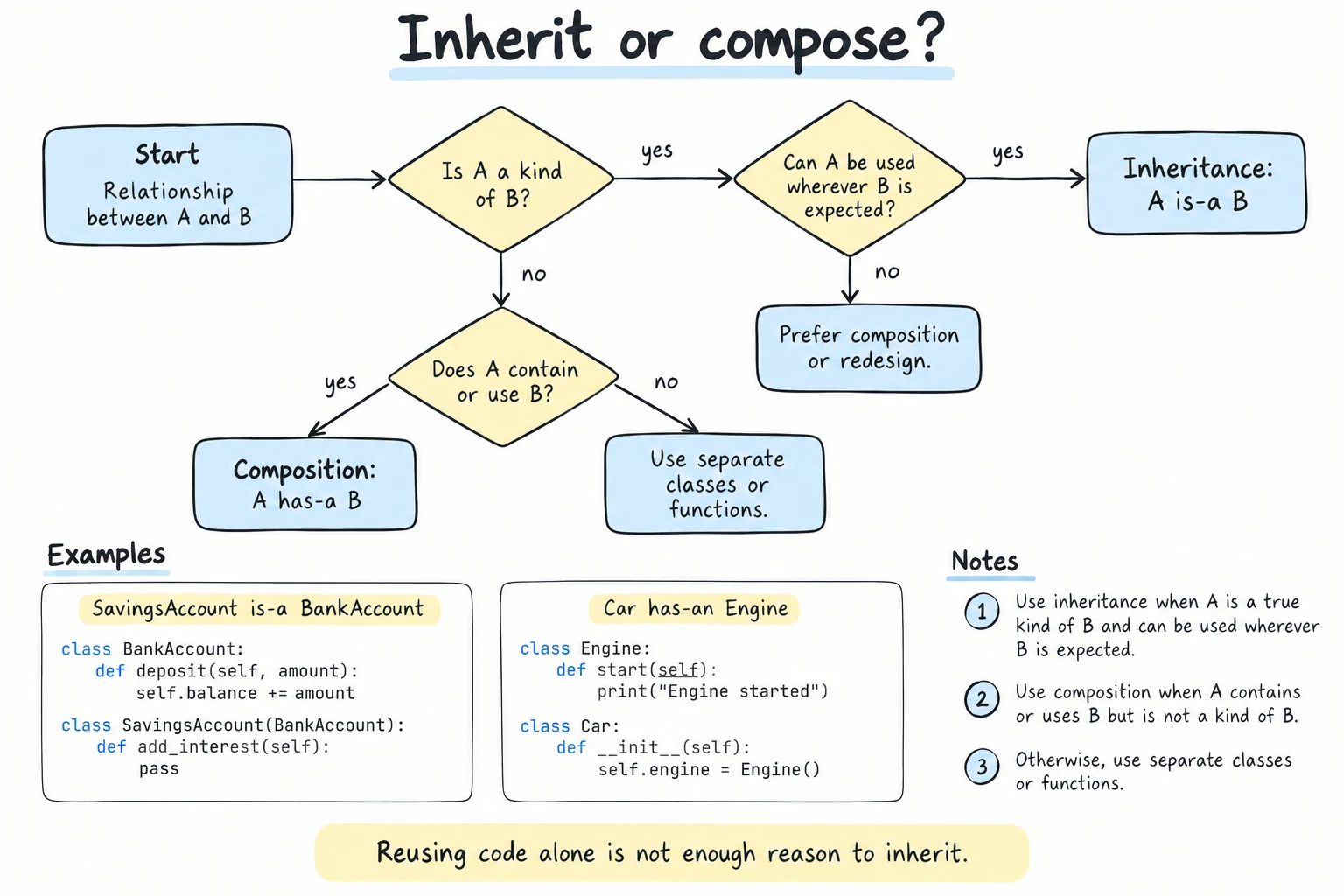
Inheritance is a tight link: the child gets every parent method, and a change in the parent can break it. Composition is loose: you choose what to expose, and you can swap or combine parts, even at runtime. "Favor" does not mean "never inherit". Inherit only when "every X is a Y" sounds right, every method of Y makes sense for X, and you will not need to swap behaviors. Otherwise, compose.
Try it
Give the Robot class a different Battery or add a Speaker part with a say() method, and delegate to it from the robot.
Common mistakes
1. Inheriting to get a feature
class Logger:
    def clear_log_file(self):
        print("log file deleted")

class Order(Logger):             # Bad: an order is not a logger
    pass

order = Order()
print(isinstance(order, Logger))
order.clear_log_file()True
log file deletedAn order now "is a" logger and can delete the log file. Fix: give it a part: self.logger = Logger().
2. Reaching deep into parts
class LineItem:
    def __init__(self, product, quantity):
        self.product_name = product.name     # was self.product
        self.unit_price = product.price
        self.quantity = quantity

# Bad: the caller relied on the old internal structure
print(order.items[0].product.price * order.items[0].quantity)AttributeError: 'LineItem' object has no attribute 'product'Every caller that reached inside breaks. Fix: ask the object: order.items[0].subtotal.
3. Forgetting the part does not exist yet
class Car:
    def __init__(self, model, engine=None):
        self.model = model
        self.engine = engine

    def start(self):
        return self.engine.start()

Car("Nexia").start()AttributeError: 'NoneType' object has no attribute 'start'Fix: require the part in __init__, or check for None before delegating.
Practice
1. Computer parts
Create Cpu (cores) and Memory (gb) classes, and a Computer class that has one of each. Add a spec() method to Computer that returns a string like "Office PC: 4 cores, 8 GB RAM".
Solution
class Cpu:
    def __init__(self, cores):
        self.cores = cores


class Memory:
    def __init__(self, gb):
        self.gb = gb


class Computer:
    def __init__(self, name, cpu, memory):
        self.name = name
        self.cpu = cpu
        self.memory = memory

    def spec(self):
        return f"{self.name}: {self.cpu.cores} cores, {self.memory.gb} GB RAM"


print(Computer("Office PC", Cpu(4), Memory(8)).spec())Office PC: 4 cores, 8 GB RAM2. Shopping cart delegation
Write a Cart class that stores products in a private dictionary _items (name -> quantity). Provide add(name, qty=1), __len__ (number of different products), and __contains__, delegating to the dictionary. Add samsa (3), tea, and samsa again, then print the length and whether samsa and plov are in the cart.
Solution
class Cart:
    def __init__(self):
        self._items = {}

    def add(self, name, qty=1):
        self._items[name] = self._items.get(name, 0) + qty

    def __len__(self):
        return len(self._items)

    def __contains__(self, name):
        return name in self._items


cart = Cart()
cart.add("samsa", 3)
cart.add("tea")
cart.add("samsa")
print(len(cart), "samsa" in cart, "plov" in cart)2 True False3. Queue refactor
A bank queue was written as class Queue(list). Rewrite it with composition, using a collections.deque part, so that only join(person), next(), and __len__ exist. next() serves people in the order they joined and raises IndexError("nobody is waiting") when the queue is empty. Test with Aziza, Bekzod, and Dilnoza.
Solution
from collections import deque


class Queue:
    def __init__(self):
        self._people = deque()

    def join(self, person):
        self._people.append(person)

    def next(self):
        if not self._people:
            raise IndexError("nobody is waiting")
        return self._people.popleft()

    def __len__(self):
        return len(self._people)


q = Queue()
for name in ["Aziza", "Bekzod", "Dilnoza"]:
    q.join(name)
print(q.next(), q.next(), len(q))
q.next()
try:
    q.next()
except IndexError as error:
print("Error:", error)Aziza Bekzod 1
Error: nobody is waiting4. Design from a description: weather station
A weather station in Samarkand has a thermometer (with read()) and a display (with show(text)). Its report() method shows text like "Samarkand: 31.5 C". Design the station with dependency injection, then test it with a FakeThermometer that returns fixed values (31.5, then 29.0) and a RecordingDisplay that stores lines in a list. Check two reports with assert and print Tests passed.
Solution
class FakeThermometer:
    def __init__(self, values):
        self.values = list(values)

    def read(self):
        return self.values.pop(0)


class RecordingDisplay:
    def __init__(self):
        self.lines = []

    def show(self, text):
        self.lines.append(text)


class WeatherStation:
    def __init__(self, city, thermometer, display):
        self.city = city
        self.thermometer = thermometer
        self.display = display

    def report(self):
        self.display.show(f"{self.city}: {self.thermometer.read()} C")


display = RecordingDisplay()
station = WeatherStation("Samarkand", FakeThermometer([31.5, 29.0]), display)
station.report()
station.report()
assert display.lines == ["Samarkand: 31.5 C", "Samarkand: 29.0 C"]
print("Tests passed")Tests passedThe station never creates its own parts, so real hardware can replace the fakes.
5. Pizza with toppings
A pizza has a size ("S", "M", "L": 45,000 / 60,000 / 75,000 som) and any number of toppings with a name and price. Subclasses like CheeseMushroomPizza would explode in number, so compose: Pizza has a size and a list of Topping objects, add_topping() (returning self), a price property, and __str__. An invalid size raises ValueError. Print a large pizza with cheese (12,000) and mushroom (9,000), a plain medium, and the error for "XL".
Solution
class Topping:
    def __init__(self, name, price):
        self.name = name
        self.price = price


class Pizza:
    BASE_PRICES = {"S": 45_000, "M": 60_000, "L": 75_000}

    def __init__(self, size):
        if size not in self.BASE_PRICES:
            raise ValueError(f"Unknown size {size!r}, choose S, M or L")
        self.size = size
        self.toppings = []

    def add_topping(self, topping):
        self.toppings.append(topping)
        return self

    @property
    def price(self):
        return self.BASE_PRICES[self.size] + sum(t.price for t in self.toppings)

    def __str__(self):
        names = ", ".join(t.name for t in self.toppings) or "plain"
        return f"{self.size} pizza ({names}): {self.price:,} som"


print(Pizza("L").add_topping(Topping("cheese", 12_000)).add_topping(Topping("mushroom", 9_000)))
print(Pizza("M"))
try:
    Pizza("XL")
except ValueError as error:
print("Error:", error)L pizza (cheese, mushroom): 96,000 som
M pizza (plain): 60,000 som
Error: Unknown size 'XL', choose S, M or LRecap
- Composition: an object holds other objects as attributes. A car has an engine.
- Inherit only for true is-a relationships where every parent method makes sense for the child.
- Delegation: forward work to a part and expose only what you choose. Wrap a
list; do not inherit from it. - Dependency injection: pass parts into
__init__so you can swap them and use fakes in tests. - Ask objects for answers (
item.subtotal) instead of reaching into their structure.