

Testing in Depth
What you'll learn
- How to organize tests with a
tests/folder,conftest.pyand-k - Fixture scopes and
yieldfixtures for setup and teardown - The built-in fixtures
monkeypatch,capsysandcaplog unittest.mock:Mock,patch,return_value,side_effect- When to use a test double, and what makes a test good
Why it matters
A delivery app in Samarkand sends SMS, reads environment variables (settings kept outside the code, read through os.environ) and logs failed payments. Tests cannot send real SMS or wait for a network. Testing with pytest covered the basics; this lesson tests code that talks to the outside world.
Run pytest on your computer
Run the pytest files (blocks without a Run button) locally. The runnable blocks use unittest.mock, logging and plain assert, which work in the browser.
Organizing a test suite
With several test files, use a tests/ folder:
shop_project/
├── shop.py
├── pytest.ini          # pythonpath = .
└── tests/
    ├── conftest.py     # shared fixtures
    ├── test_orders.py
└── test_shop.py- pytest loads
conftest.pyautomatically; its fixtures work in every test file in its folder and the folders below. - Name tests after behavior:
test_large_discount_logs_warning, nottest_discount2. pythonpath = .inpytest.inilets testsimport shop.pytest -k "currency or receipt"runs only tests whose names match (collected 6 items / 4 deselected / 2 selected).
Fixture scopes and yield fixtures
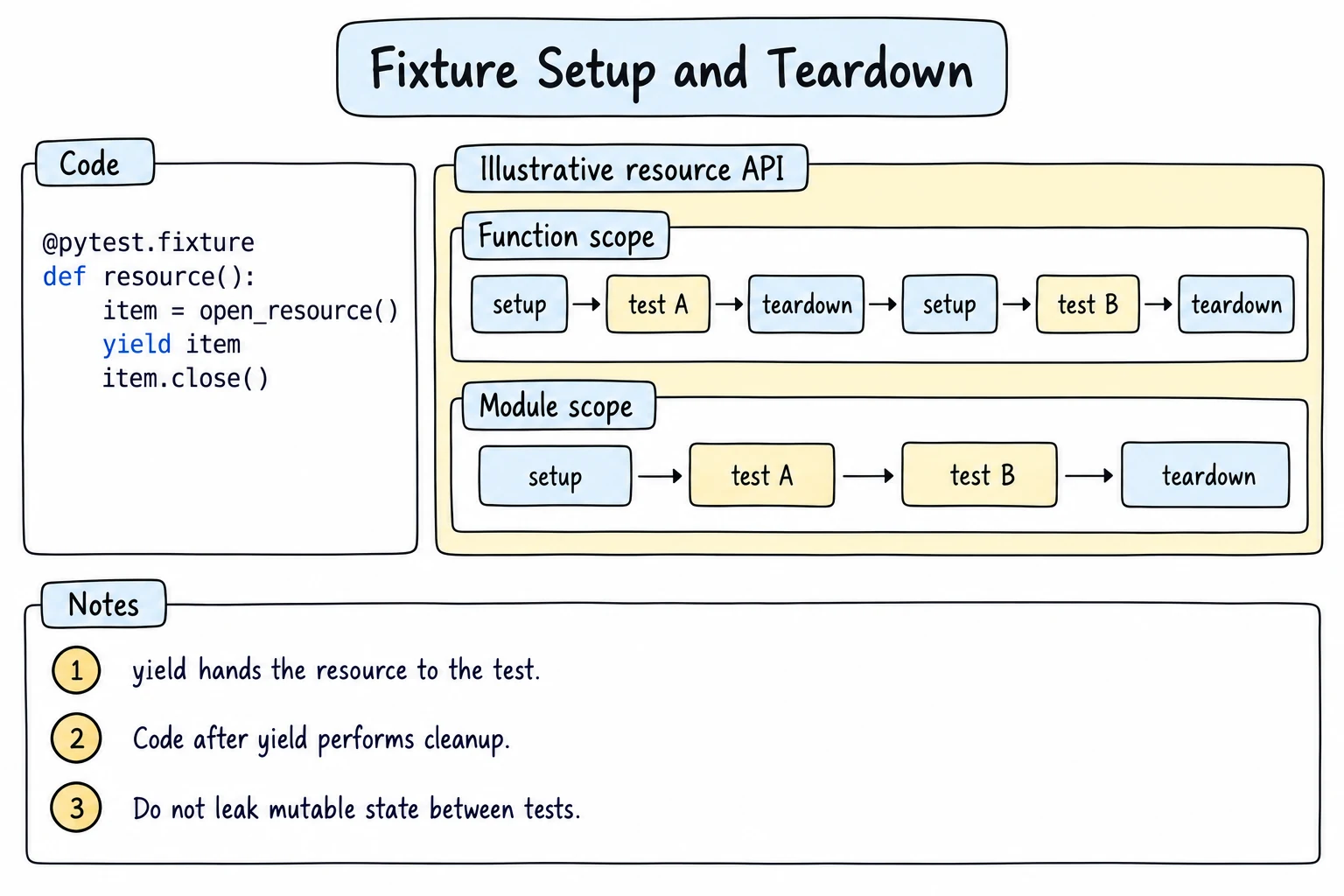
A fixture that uses yield instead of return gets a teardown: the code after yield runs after the test, even a failed one. tests/conftest.py:
import pytest


class FakeDatabase:
    def __init__(self):
        self.orders = []

    def close(self):
        print("closed")


@pytest.fixture
def db():
    database = FakeDatabase()   # setup
    print("connected")
    yield database              # the test runs here
    database.close()            # teardown, even if the test failed
With two tests using db, pytest -q -s (show prints) gives:
connected
.closed
connected
.closed

2 passed in 0.01s
The scope decides how often a fixture is created:
| Scope | Created once per | Use for |
|---|---|---|
function (default) | test | anything a test changes |
module | test file | slow, read-only setup |
session | test run | a test server |
Wider scopes, like @pytest.fixture(scope="module"), are faster but shared (see Common mistakes).
Built-in fixtures: monkeypatch, capsys, caplog
You already know tmp_path. Three more come with pytest. shop.py isn't shown, but the runnable block after these tests defines similar functions. tests/test_shop.py:
import shop


def test_currency_from_env(monkeypatch):
    monkeypatch.setenv("SHOP_CURRENCY", "USD")
    assert shop.get_currency() == "USD"


def test_ask_quantity(monkeypatch):
    monkeypatch.setattr("builtins.input", lambda prompt: "3")
    assert shop.ask_quantity() == 3


def test_receipt(capsys):
    shop.print_receipt({"somsa": 8000})
    captured = capsys.readouterr()
    assert captured.out == "somsa: 8000 som\n"


def test_large_discount_logs(caplog):
    assert shop.apply_discount(100000, 60) == 40000
assert "large discount 60%" in caplog.textmonkeypatchsets environment variables (setenv,delenv) and attributes (setattr), and undoes every change after the test.capsyscaptures printed output;caplogcaptures log records.
The standard library can do the same in the browser:
import logging
import os
import unittest
from unittest.mock import patch

logger = logging.getLogger("shop")

def get_currency():
    return os.environ.get("SHOP_CURRENCY", "som")

def ask_quantity():
    return int(input("How many? "))

def apply_discount(price, percent):
    if percent > 100:
        raise ValueError("percent must be at most 100")
    if percent > 50:
        logger.warning("large discount %s%%", percent)
    return price * (100 - percent) // 100

with patch.dict(os.environ, {"SHOP_CURRENCY": "USD"}):
    assert get_currency() == "USD"

with patch("builtins.input", return_value="3"):
    assert ask_quantity() == 3

case = unittest.TestCase()
with case.assertLogs("shop", level="WARNING") as logs:
    assert apply_discount(100000, 60) == 40000
print(logs.output)

with case.assertRaisesRegex(ValueError, "at most 100"):
    apply_discount(100000, 150)
print("all checks passed")['WARNING:shop:large discount 60%']
all checks passedassertLogs fails if nothing is logged; assertRaisesRegex works like pytest.raises(..., match=...).
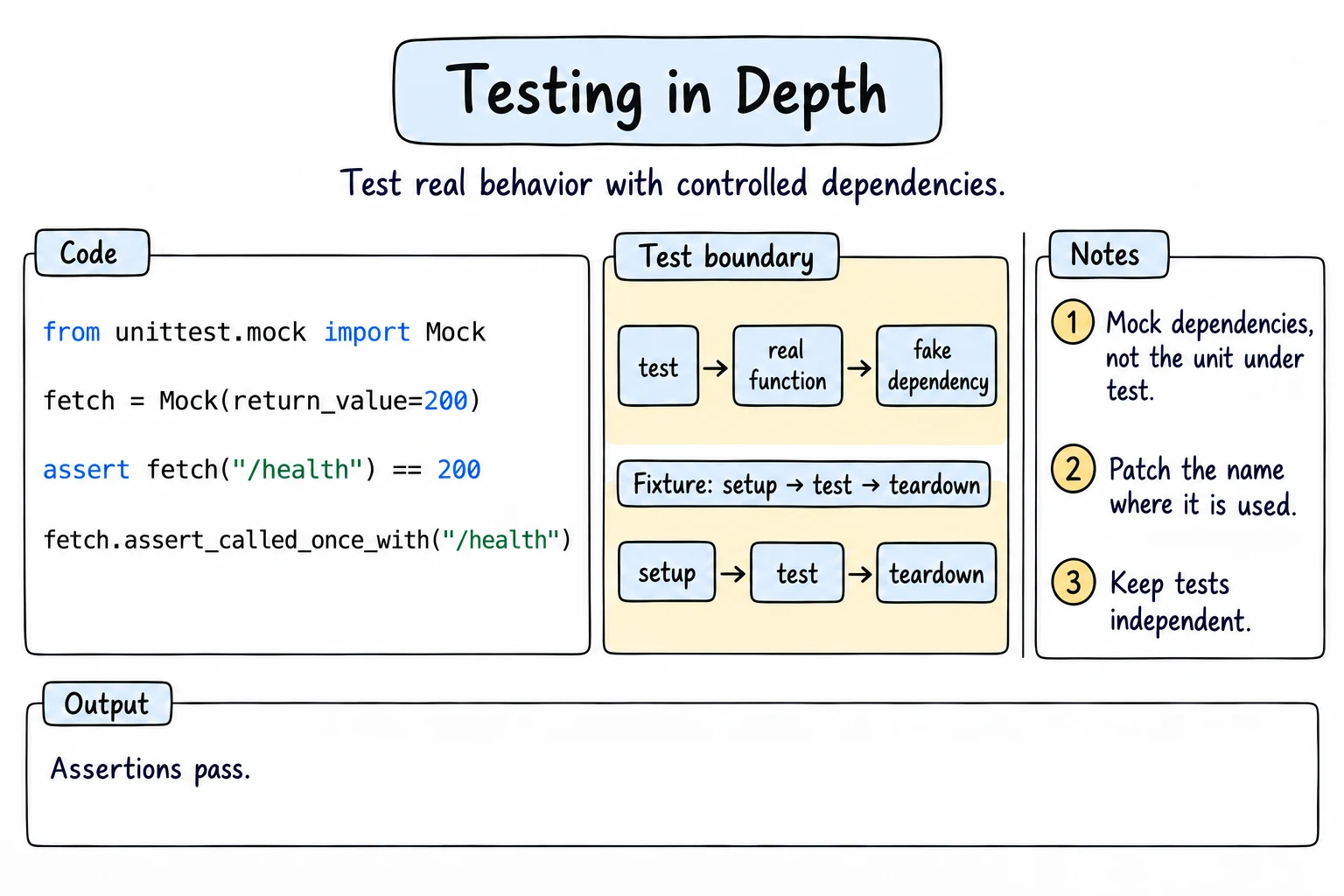
Mock: a fake object that records calls
A Mock accepts any attribute or call and records it. return_value sets what a call returns:
from unittest.mock import Mock

sms = Mock()
sms.send.return_value = "delivered"

print(sms.send("+998901234567", "Your plov is on its way"))
print("calls:", sms.send.call_count)
sms.send.assert_called_once_with("+998901234567", "Your plov is on its way")
print("assert_called_once_with passed")delivered
calls: 1
assert_called_once_with passedside_effect makes a call raise an exception or return list items one by one, which is how you test error handling:
from unittest.mock import Mock

def notify(sms, phone):
    try:
        return sms.send(phone, "Order ready")
    except ConnectionError:
        return "will retry later"

sms = Mock()
sms.send.side_effect = ConnectionError("network down")
print(notify(sms, "+998901234567"))

sms.send.side_effect = ["failed", "delivered"]
print(sms.send(), sms.send())will retry later
failed deliveredpatch: replacing a name for one test
When code finds its dependency itself, you cannot pass a mock in. patch("module.name") swaps the name for a Mock and restores it afterwards, as a context manager or a decorator:
import random
from unittest.mock import patch

def pick_winner(names):
    return random.choice(names)

with patch("random.choice", return_value="Dilnoza") as fake_choice:
    print(pick_winner(["Aziza", "Bobur", "Dilnoza"]))
fake_choice.assert_called_once_with(["Aziza", "Bobur", "Dilnoza"])

@patch("random.choice")
def test_winner(fake_choice):
    fake_choice.return_value = "Jasur"
    assert pick_winner(["Jasur", "Bobur"]) == "Jasur"

test_winner()
print("test_winner passed")Dilnoza
test_winner passedThe decorator passes the mock in as an argument. This works because pick_winner looks up random.choice when it runs (see Common mistakes).
Test doubles or real objects?
A test double (a mock, fake class or stub) replaces something slow, unreliable or uncontrollable: the network, an SMS gateway, the clock, randomness. Use real objects for your own logic.
For time and randomness you often need no mock: inject the clock or a seeded generator, that is, pass it in as an argument:
import random
from datetime import datetime

def greeting(now=datetime.now):
    return "Xayrli tong" if now().hour < 12 else "Xayrli kun"

assert greeting(lambda: datetime(2026, 9, 16, 9, 0)) == "Xayrli tong"
assert greeting(lambda: datetime(2026, 9, 16, 15, 0)) == "Xayrli kun"

rng = random.Random(42)
print([rng.randint(1, 6) for _ in range(5)])[6, 1, 1, 6, 3]Production code calls greeting(); tests pass a fixed clock. A seeded random.Random gives the same numbers on every run.
Coverage shows which lines your tests ran: install pytest-cov and run pytest --cov=shop. 100% means every line ran, not that it was checked, so treat it as a map of untested code.
A good test:
- checks one behavior, named after it;
- is fast and deterministic (same result every run);
- is independent: passes alone and in any order;
- asserts on results, not internal details;
- fails when the code is broken (break it once to check).
Try it
This retry gives up too early. Make the test pass.
Common mistakes
1. Patching where a name is defined, not where it is used
rates.py defines fetch_rate(), and prices.py does from rates import fetch_rate, creating a second name. Patching rates.fetch_rate misses it:
from unittest.mock import patch

from prices import price_in_som


def test_price_wrong_path():
    with patch("rates.fetch_rate", return_value=12500):  # Bad
assert price_in_som(2) == 25000 def fetch_rate():
> raise ConnectionError("no internet in tests")
E ConnectionError: no internet in testsFix: patch the name where the code looks it up: patch("prices.fetch_rate", return_value=12500).
2. A module-scoped fixture with mutable state
The db fixture from above, now with scope="module" (Bad: one list for the whole file):
def test_add_order(db):
    db.orders.append("plov")
    assert db.orders == ["plov"]


def test_no_orders_yet(db):
assert db.orders == []E AssertionError: assert ['plov'] == []
E
E Left contains one more item: 'plov'test_no_orders_yet passes alone but fails after test_add_order. Fix: use the default function scope for mutable objects.
3. Mocking the thing you are testing
from unittest.mock import Mock

class Cart:
    def __init__(self, prices):
        self.prices = prices

    def total(self):
        return sum(self.prices) * 2   # bug

cart = Cart([15000, 8000])
cart.total = Mock(return_value=23000)   # Bad: replaces the real method
assert cart.total() == 23000
print("test passed, but the real total is", Cart.total(cart))test passed, but the real total is 46000The test only tests the mock. Fix: mock the edges (network, time, SMS) and run your own code for real.
4. Asserting a call that never happened
from unittest.mock import Mock

def place_order(items, sms):
    total = sum(items.values())
    if total > 1_000_000:          # bug: every order should send an SMS
        sms.send(f"Order total: {total} som")
    return total

sms = Mock()
place_order({"plov": 35000}, sms)
sms.send.assert_called_with("Order total: 35000 som")AssertionError: expected call not found.
Expected: send('Order total: 35000 som')
Actual: not called.The test found a real bug. Fix: the code, not the test; call_args shows what really happened.
Practice
1. A fake exchange-rate API
Write usd_to_som(amount, api) returning amount * api.get_rate("USD"). With a Mock whose get_rate returns 12650, print the result for 20 USD, check the call with assert_called_once_with, and print "call checked".
Solution
from unittest.mock import Mock

def usd_to_som(amount, api):
    return amount * api.get_rate("USD")

api = Mock()
api.get_rate.return_value = 12650

print(usd_to_som(20, api))
api.get_rate.assert_called_once_with("USD")
print("call checked")253000
call checked2. Environment variables with monkeypatch
Run locally: greet.py has greeting(), which returns f"Salom, {name}!" where name is the USER_NAME environment variable or "friend". Write two pytest tests with monkeypatch: one sets the variable, one removes it.
Solution
test_greet.py:
from greet import greeting


def test_name_from_env(monkeypatch):
    monkeypatch.setenv("USER_NAME", "Aziza")
    assert greeting() == "Salom, Aziza!"


def test_default_name(monkeypatch):
    monkeypatch.delenv("USER_NAME", raising=False)
assert greeting() == "Salom, friend!".. [100%]
2 passed in 0.01s3. Retry until it works
Write send_with_retry(sms, text, attempts=3): call sms.send(text) until it does not raise ConnectionError; return the attempt number, or None if all fail. With side_effect, test a mock that fails twice then succeeds and one that always fails. Print each result and call count.
Solution
from unittest.mock import Mock

def send_with_retry(sms, text, attempts=3):
    for attempt in range(1, attempts + 1):
        try:
            sms.send(text)
            return attempt
        except ConnectionError:
            pass
    return None

flaky = Mock()
flaky.send.side_effect = [ConnectionError(), ConnectionError(), "ok"]
print(send_with_retry(flaky, "Salom"), flaky.send.call_count)

broken = Mock()
broken.send.side_effect = ConnectionError("down")
print(send_with_retry(broken, "Salom"), broken.send.call_count)3 3
None 34. A yield fixture with tmp_path
Run locally: orders.py has count_orders(path), which returns the number of lines in a file. Write a yield fixture that creates a two-line orders.csv in tmp_path, and after the test prints "deleting orders.csv" and deletes it. Run pytest -q -s.
Solution
test_orders.py:
import pytest

from orders import count_orders


@pytest.fixture
def orders_file(tmp_path):
    path = tmp_path / "orders.csv"
    path.write_text("plov,35000\nsomsa,8000\n", encoding="utf-8")
    yield path
    print("deleting", path.name)
    path.unlink()


def test_count_orders(orders_file):
assert count_orders(orders_file) == 2.deleting orders.csv
1 passed in 0.01s5. Weekend reports
Write daily_report(sms, now): on weekends (now().weekday() >= 5) it logs INFO "weekend, no report" to the "reports" logger; otherwise it calls sms.send("Daily report ready"). Test both cases with a Mock, fixed clocks, assertLogs and assert_not_called, then print "2 tests passed".
Solution
import logging
import unittest
from datetime import datetime
from unittest.mock import Mock

logger = logging.getLogger("reports")

def daily_report(sms, now=datetime.now):
    if now().weekday() >= 5:
        logger.info("weekend, no report")
        return
    sms.send("Daily report ready")

def test_weekday_sends():
    sms = Mock()
    daily_report(sms, now=lambda: datetime(2026, 9, 16))  # Wednesday
    sms.send.assert_called_once_with("Daily report ready")

def test_weekend_logs():
    sms = Mock()
    with unittest.TestCase().assertLogs("reports", level="INFO") as logs:
        daily_report(sms, now=lambda: datetime(2026, 9, 19))  # Saturday
    sms.send.assert_not_called()
    assert logs.output == ["INFO:reports:weekend, no report"]

test_weekday_sends()
test_weekend_logs()
print("2 tests passed")2 tests passedRecap
- Put tests in
tests/, share fixtures inconftest.py, and run a subset with-k. yieldfixtures add teardown; widerscopes are faster but share state.monkeypatch,capsysandcaploghandle environment, output and logs.Mockrecords calls;return_valueandside_effectcontrol them.- Patch a name where it is used, and mock only the edges: network, time, randomness.