

Type Hints
What you'll learn
- What type hints are and why to write them
- How to annotate variables, parameters, return values, and collections (
list[int],dict[str, float]) - How to write optional values (
str | None), function parameters (Callable), and classes that refer to themselves - How
Protocolandtypealiases describe larger ideas - Why hints are not enforced when the program runs
Why it matters
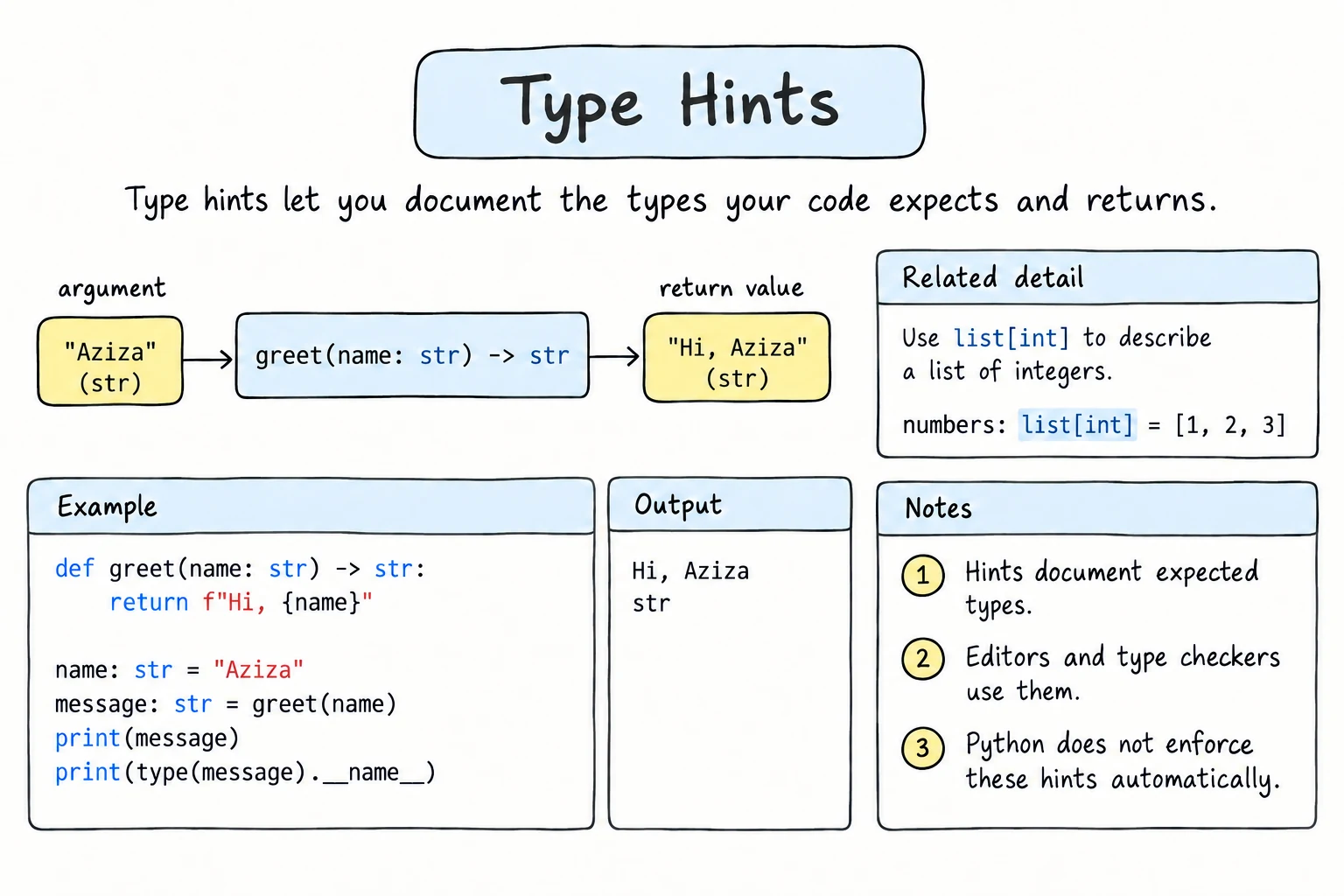
In def calculate(items, rate, rounding):, is items a list or a dictionary? Is rate 12 or 0.12? With type hints the signature answers without making you read the body:
def calculate(items: list[float], rate: float, rounding: int = 0) -> float:
    ...
Hints are documentation inside the code. Editors use them to autocomplete and underline mistakes, and type checkers such as mypy or pyright report wrong calls before you run anything.
Variables and functions
Write name: type for variables and parameters, and -> type for the return value:
scores: dict[str, list[int]] = {}           # an empty dict filled later


def average(numbers: list[float]) -> float:
    return sum(numbers) / len(numbers)


def greet(name: str, times: int = 1) -> str:
    return " ".join([f"Salom, {name}!"] * times)


scores.setdefault("Aziza", []).append(91)
print(scores, average([4.5, 5.0, 3.5]))
print(greet("Bekzod", times=2)){'Aziza': [91]} 4.333333333333333
Salom, Bekzod! Salom, Bekzod!Simple variables rarely need hints, but an empty collection deserves one. With a default, the hint comes first: times: int = 1. A function that returns nothing gets -> None.
Collections and optional values
Put item types in square brackets; tuples describe each position. Use | ("or") for a value that may be missing or have several types:
| Hint | Meaning | Example value |
|---|---|---|
list[int] / set[str] | a list of ints / a set of strings | [90, 85] / {"tea"} |
dict[str, float] | string keys, float values | {"USD": 12650.0} |
tuple[str, int] / tuple[int, ...] | a string then an int / any number of ints | ("Aziza", 20) / (1, 2, 3) |
str | None | a string or None | None |
def find_phone(contacts: dict[str, str], name: str) -> str | None:
    return contacts.get(name)


contacts = {"Aziza": "+998901234567"}
for name in ["Aziza", "Dilnoza"]:
    phone = find_phone(contacts, name)
    if phone is None:
        print(f"{name}: no phone saved")
    else:
print(f"{name}: {phone[-4:]}")Aziza: 4567
Dilnoza: no phone savedstr | None warns the caller to check for None first.
Functions as arguments: Callable
For a function parameter, use Callable from collections.abc: a list of parameter types, then the return type:
from collections.abc import Callable


def apply_discount(prices: list[int], rule: Callable[[int], int]) -> list[int]:
    return [rule(p) for p in prices]


print(apply_discount([50_000, 8_000], lambda p: round(p * 0.9)))[45000, 7200]Callable[[int], int] is "a function taking an int and returning an int". For data you cannot describe, typing.Any switches checking off; use it sparingly.
Hints are not enforced at runtime
Python stores hints but does not check them when the code runs:
def line_total(price: int, qty: int) -> int:
    return price * qty


print(line_total(25_000, 3))
print(line_total("100", 3)) # wrong type, no error75000
100100100"100" * 3 repeats the string. A type checker would flag this call before running, but bad data from users and files still needs if checks and raise. You need both.
What Python 3.14 changed (PEP 649)
Python 3.14 evaluates annotations lazily, only when something reads them. So a hint may name a class defined later, and annotationlib can read hints as strings:
import annotationlib


def ship(order: Order) -> Receipt:     # neither class exists yet
    ...


print(annotationlib.get_annotations(ship, format=annotationlib.Format.STRING)){'order': 'Order', 'return': 'Receipt'}Hints in classes
Annotate methods like functions (self needs no hint). Your own classes are types too, and thanks to lazy annotations a class can name itself:
from typing import Self


class Money:
    def __init__(self, amount: int, currency: str = "UZS") -> None:
        self.amount = amount
        self.currency = currency

    def add(self, other: Money) -> Money:
        return Money(self.amount + other.amount, self.currency)

    def __repr__(self) -> str:
        return f"Money({self.amount:,} {self.currency})"


class Counter:
    def __init__(self) -> None:
        self.count = 0

    def tick(self) -> Self:
        self.count += 1
        return self


class LoudCounter(Counter):
    pass


print(Money(150_000).add(Money(35_000)))
c = LoudCounter().tick().tick()
print(type(c).__name__, c.count)Money(185,000 UZS)
LoudCounter 2typing.Self means "the class this method was called on", so LoudCounter().tick() is known to be a LoudCounter.
Protocol: hints for duck typing
With duck typing, any object with the right method works. Protocol says that in a hint, without inheritance:
from typing import Protocol


class Notifier(Protocol):
    def send(self, to: str, text: str) -> bool: ...


class SmsNotifier:                      # does NOT inherit from Notifier
    def send(self, to: str, text: str) -> bool:
        print(f"SMS to {to}: {text}")
        return True


def remind(notifier: Notifier, person: str) -> bool:
    return notifier.send(person, "Meeting at 10:00")


print(remind(SmsNotifier(), "Aziza"))SMS to Aziza: Meeting at 10:00
TrueA type checker accepts SmsNotifier because its send has the right signature.
Type aliases
Give a long hint a name with the type statement:
type Grades = dict[str, list[int]]


def best_student(grades: Grades) -> str:
    return max(grades, key=lambda name: sum(grades[name]) / len(grades[name]))


print(best_student({"Aziza": [90, 95], "Bekzod": [70, 81]}))
print(type(Grades).__name__)Aziza
TypeAliasTypeThe alias is a TypeAliasType, not a dict, so use it only in hints: Grades() raises TypeError.
In older code
Existing projects use older spellings:
Optional[str],Union[int, float],List[int],Dict[str, float](fromtyping).Grades = dict[str, list[int]]instead of thetypestatement.- Quoted class names (
-> "Money") orfrom __future__ import annotations, needed before 3.14 for a class naming itself. The future import turns every hint into a string, and PEP 749 schedules it for deprecation (no sooner than the first release after 3.13 reaches end of life) and later removal, so do not add it to new code.
Try it
Pass wrong types at the bottom (like a string for qty) and see that the hints do not stop the call.
Common mistakes
1. Asking for a list when any collection would do
def average(scores: list[int]) -> float:
    return sum(scores) / len(scores)

print(average((80, 90)))                    # a tuple: runs fine
print(average({"a": 1, "b": 3}.values())) # dict values: runs fine85.0
2.0Both run, but a type checker rejects them: neither is a list. Fix: hint what the function needs, from collections.abc: Sequence[int] (lists, tuples), Collection[int] (anything with len(), dict values too), or Iterable[int] (anything you can loop over).
2. Promising a value that might be None
def find_email(users: dict[str, str], name: str) -> str:      # hint lies
    return users.get(name)

email = find_email({"aziza": "aziza@mail.uz"}, "bekzod")
print(email.upper())AttributeError: 'NoneType' object has no attribute 'upper'dict.get() can return None, so the honest hint is -> str | None, which tells the caller to check first.
3. Writing the wrong syntax for collection hints
def total(prices: [int]) -> int: ...             # Bad: a list containing int
def pair() -> (int, int): ...                    # Bad: a tuple of types
def count(prices: list(int)) -> int: ...         # Bad: not a type (fails when tools read the hints)

count.__annotations__TypeError: 'type' object is not iterableThe lines run, but tools cannot use them. Fix: list[int], tuple[int, int].
Practice
1. Annotate the functions
Add type hints to these functions, then call each one:
def is_adult(age):
    return age >= 18

def word_lengths(words):
    return {w: len(w) for w in words}
Solution
def is_adult(age: int) -> bool:
    return age >= 18


def word_lengths(words: list[str]) -> dict[str, int]:
    return {w: len(w) for w in words}


print(is_adult(17))
print(word_lengths(["tea", "samsa", "plov"]))False
{'tea': 3, 'samsa': 5, 'plov': 4}2. Optional search
Write first_long_word(words: list[str], min_length: int) -> str | None (the first word that long, or None). For ["sun", "river", "mountain"] and limits 5 and 10, print the word in uppercase, or No word with 10+ letters.
Solution
def first_long_word(words: list[str], min_length: int) -> str | None:
    for word in words:
        if len(word) >= min_length:
            return word
    return None


words = ["sun", "river", "mountain"]
for limit in [5, 10]:
    found = first_long_word(words, limit)
    if found is None:
        print(f"No word with {limit}+ letters")
    else:
print(found.upper())RIVER
No word with 10+ letters3. Typed statistics
Write summarize(values: list[float]) -> tuple[float, float] returning the min and max, and apply_to_all(values: list[float], func: Callable[[float], float]) -> list[float]. Convert [31.0, 38.0, 29.5] from Celsius to Fahrenheit and summarize both lists.
Solution
from collections.abc import Callable


def summarize(values: list[float]) -> tuple[float, float]:
    return min(values), max(values)


def apply_to_all(values: list[float], func: Callable[[float], float]) -> list[float]:
    return [func(v) for v in values]


celsius = [31.0, 38.0, 29.5]
fahrenheit = apply_to_all(celsius, lambda c: c * 9 / 5 + 32)
print(summarize(celsius), summarize(fahrenheit))(29.5, 38.0) (85.1, 100.4)4. Design from a description: parking garage
A Tashkent garage has numbered spots, and cars are identified by plate strings. Design a fully annotated Garage storing occupied spots in a dict[int, str], with park(plate) (returning the spot, or None when full) and free_spots(). With 2 spots, park three cars, then print the free spots.
Solution
class Garage:
    def __init__(self, capacity: int) -> None:
        self.capacity = capacity
        self.spots: dict[int, str] = {}

    def park(self, plate: str) -> int | None:
        for spot in self.free_spots():
            self.spots[spot] = plate
            return spot
        return None

    def free_spots(self) -> list[int]:
        return [s for s in range(1, self.capacity + 1) if s not in self.spots]


g = Garage(2)
for plate in ["01A777AA", "10B123CD", "30C555EF"]:
    print(plate, "->", g.park(plate))
print("Free:", g.free_spots())01A777AA -> 1
10B123CD -> 2
30C555EF -> None
Free: []5. Protocol-based report
Define a Protocol called Priced with a method price() -> int. Create two unrelated dataclasses that satisfy it, Hotel (nights, per_night) and Flight (cost), and write trip_total(things: list[Priced]) -> int. Print each item's class name and price, then the total.
Solution
from dataclasses import dataclass
from typing import Protocol


class Priced(Protocol):
    def price(self) -> int: ...


@dataclass
class Hotel:
    nights: int
    per_night: int

    def price(self) -> int:
        return self.nights * self.per_night


@dataclass
class Flight:
    cost: int

    def price(self) -> int:
        return self.cost


def trip_total(things: list[Priced]) -> int:
    for thing in things:
        print(f"{type(thing).__name__:<7} {thing.price():>9,}")
    return sum(t.price() for t in things)


print(f"Total {trip_total([Flight(780_000), Hotel(2, 450_000)]):>9,}")Flight 780,000
Hotel 900,000
Total 1,680,000Neither class inherits from Priced.
Recap
- Hints describe what a function takes and returns:
def f(x: list[int]) -> str:. - Use
X | Nonefor values that may be missing, andCallable[[args], return]for functions. - Your own classes are types, and on 3.14 a class can name itself in hints.
Protocoldescribes duck-typed interfaces, andtype Name = ...names a long hint.- Hints are not enforced at runtime. Type checkers check them;
if/raisestill validates data.