

Raising and Custom Exceptions
What you'll learn
- How to raise an exception when a function gets invalid arguments, and which built-in type fits
- How to re-raise with
raise, and chain or hide the cause withfrom eandfrom None - How to create your own exception types, a small hierarchy of them, and one that carries data
- When to use
assertinstead ofraise, and how to write error messages that help
Why it matters
Your own functions meet problems Python cannot detect: withdraw(balance, -50000) is valid arithmetic, but nonsense for a bank. Returning None or -1 is easy to ignore, and the bug appears far from its cause. Raising an exception stops the wrong action immediately, with a clear message, and lets the caller decide what to do.
raise an exception
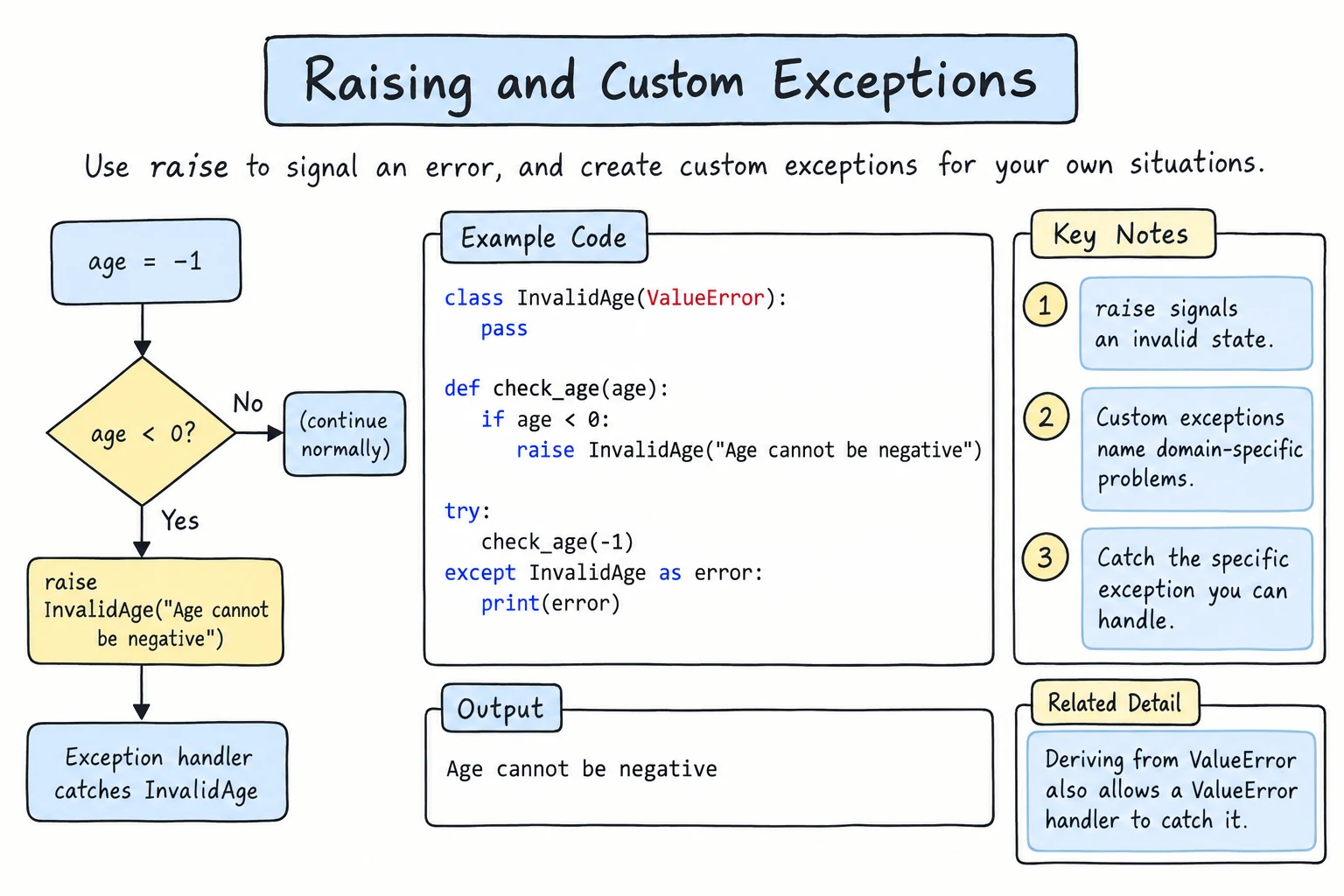
raise creates an exception on purpose. Write the exception type and pass a message. The function stops at that line, and the exception travels up to the caller, which can catch it as usual:
def withdraw(balance, amount):
    if amount <= 0:
        raise ValueError(f"amount must be positive, got {amount}")
    if amount > balance:
        raise ValueError(f"cannot withdraw {amount:,} som, balance is {balance:,} som")
    return balance - amount

balance = 250000
for amount in [50000, -1000, 900000]:
    try:
        balance = withdraw(balance, amount)
        print(f"Withdrew {amount:,}. New balance: {balance:,}")
    except ValueError as e:
print(f"Refused: {e}")Withdrew 50,000. New balance: 200,000
Refused: amount must be positive, got -1000
Refused: cannot withdraw 900,000 som, balance is 200,000 somThe function only detects the problem; the caller decides what to do. Put such checks at the top, like the guard clauses from Return Values.
Choosing the right built-in exception
Callers often catch by type, so pick the exception whose meaning matches the problem:
| Exception | Raise it when |
|---|---|
ValueError | the type is right but the value is not allowed |
TypeError | the argument has the wrong type |
KeyError | a key or ID is not found in a mapping |
LookupError | something is not found, and a sentence explains it better |
NotImplementedError | a feature is planned but not written yet |
A typical type check is if not isinstance(percent, (int, float)): raise TypeError(...). Two details: True and False count as integers, so isinstance(True, int) is True; and a KeyError always shows its message in quotes (raise KeyError("P999") prints 'P999'), so use it for a single key and LookupError or ValueError for a sentence.
Re-raising and chaining
To react to an error (say, log it) and still let it reach the caller, use a bare raise inside except:
except KeyError:
    print(f"[log] price lookup failed for {product!r}")
    raise
A low-level KeyError: 'Nukus' says nothing about what the program was doing. Raise a clearer exception, naming the original with as e and linking it with from e:
rates = {"Tashkent": 20000, "Samarkand": 35000}

def delivery_cost(city):
    try:
        return rates[city]
    except KeyError as e:
        raise ValueError(f"we do not deliver to {city}") from e

try:
    delivery_cost("Nukus")
except ValueError as e:
    print(e)
print("caused by:", repr(e.__cause__))we do not deliver to Nukus
caused by: KeyError('Nukus')If nobody catches it, the traceback shows both errors, joined by "The above exception was the direct cause of the following exception". Without from, it says "During handling of the above exception, another exception occurred", which looks like a second bug.
When the original error adds nothing, hide it with from None. The traceback then shows only your exception:
    except KeyError:
        raise ValueError(f"we do not deliver to {city}") from None
Use from e when the cause helps debugging (a failed file read, say), and from None when your message already says everything.
Your own exception types
Exceptions named after your app's problems, like OutOfStockError, let callers catch exactly that situation. Create one base exception and specific ones under it:
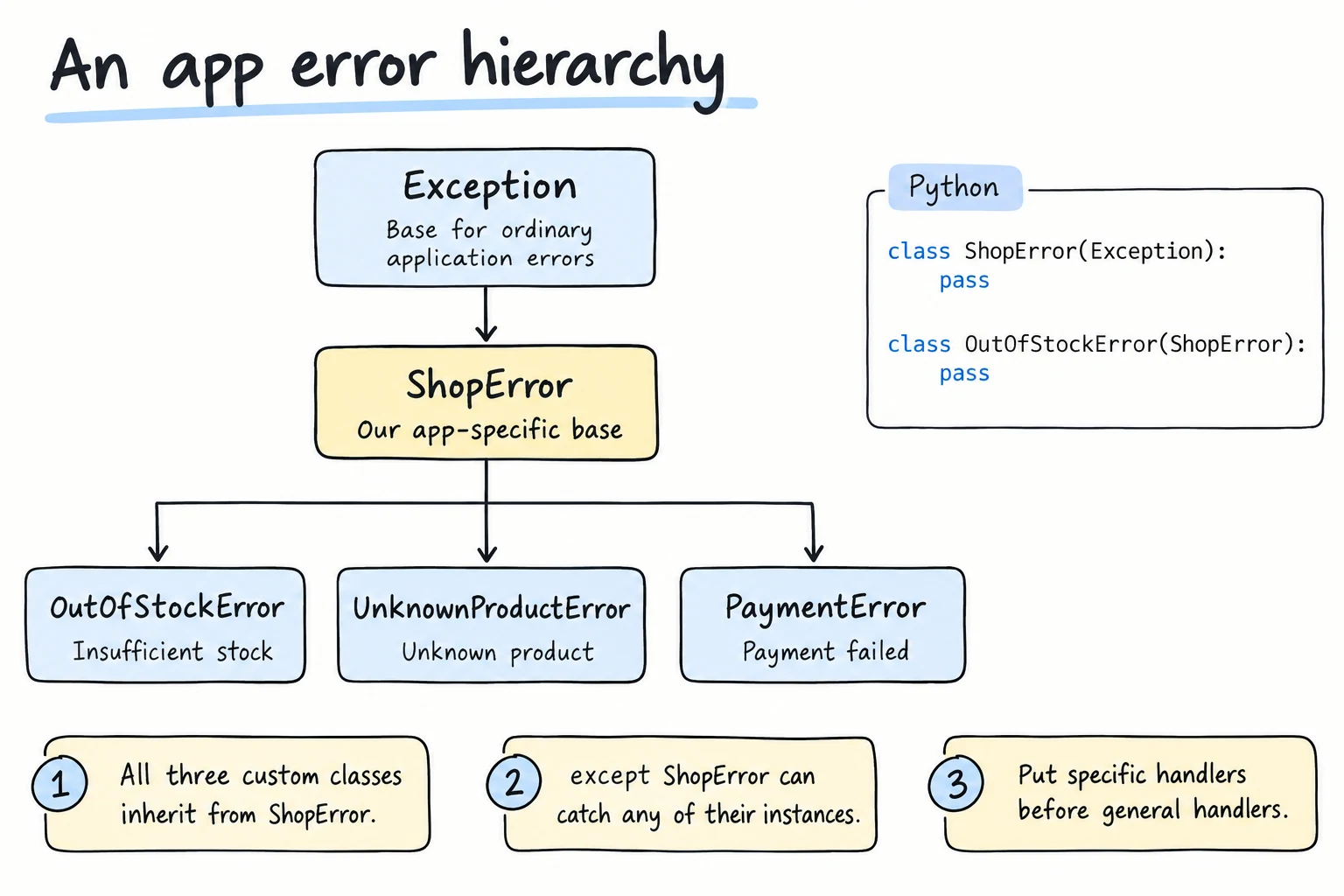
class ShopError(Exception):
    pass

class OutOfStockError(ShopError):
    pass

class UnknownProductError(ShopError):
    pass

stock = {"tea": 5, "samsa": 0}

def buy(product, quantity):
    if product not in stock:
        raise UnknownProductError(f"no product called {product!r}")
    if stock[product] < quantity:
        raise OutOfStockError(f"only {stock[product]} {product} left, wanted {quantity}")
    stock[product] -= quantity

for product, quantity in [("tea", 2), ("samsa", 3), ("cake", 1)]:
    try:
        buy(product, quantity)
        print(f"Bought {quantity} {product}")
    except OutOfStockError as e:
        print(f"Sorry: {e}")
    except ShopError as e:
print(f"Order failed ({type(e).__name__}): {e}")Bought 2 tea
Sorry: only 0 samsa left, wanted 3
Order failed (UnknownProductError): no product called 'cake'Classes come properly in Classes and Objects; for now, read class ShopError(Exception): pass as "a new exception type under Exception, with nothing extra". OutOfStockError(ShopError) is its child, so except ShopError catches every shop problem, while bugs such as NameError are not hidden. You can also inherit from a built-in: class InvalidPhoneError(ValueError) is caught by except ValueError too. End the names with Error, like the built-in ones.
An exception that carries data
A pass class is enough for now. Once you know classes, an exception can also store values, so the caller does not have to parse the message:
class InsufficientFundsError(Exception):
    def __init__(self, balance, amount):
        super().__init__(f"need {amount:,} som, balance is {balance:,} som")
        self.balance = balance
        self.amount = amount

try:
    raise InsufficientFundsError(120000, 300000)
except InsufficientFundsError as e:
    print(f"Payment declined: {e}")
print(f"Missing: {e.amount - e.balance:,} som")Payment declined: need 300,000 som, balance is 120,000 som
Missing: 180,000 som__init__ and super() are explained in Classes and Objects and Inheritance and super().
assert vs raise
assert condition, message (from Designing Good Functions) raises AssertionError when the condition is false. Its job is different:
assert | raise SomeError(message) | |
|---|---|---|
| Purpose | catch programmer mistakes ("this should never happen") | report expected problems (bad input, missing data) |
| Can be switched off | (python -O skips all asserts) |
Because asserts can be disabled, never use them to check user input or money amounts.
Writing good error messages
A good message says what was wrong, what value was received, and ideally what is allowed: "quantity must be a whole number, got '2.5'" instead of "invalid input", "month must be 1-12, got 13" instead of "bad date". Use !r so empty text is visible (got ''), start in lowercase like Python's own messages, and never include passwords.
Try it
Add a daily limit to transfer with its own custom exception, and catch it.
Common mistakes
1. Raising the class name as a string
raise "ValueError: amount is negative"TypeError: exceptions must derive from BaseExceptionRaise an exception object: raise ValueError("amount is negative").
2. Returning an error instead of raising it
# Bad:
def withdraw(balance, amount):
    if amount > balance:
        return "error: not enough money"
    return balance - amount

balance = withdraw(1000, 5000)
print(balance - 100)TypeError: unsupported operand type(s) for -: 'str' and 'int'The error string was stored in balance, and the program crashed later, somewhere else. Raise at the source instead.
3. Forgetting Exception in a custom class
class OutOfStockError:
    pass

raise OutOfStockError("no tea left")TypeError: OutOfStockError() takes no argumentsWithout (Exception) it is an ordinary class, not an exception. Write class OutOfStockError(Exception):.
Practice
1. Validate a score
Write check_score(score) that returns the score, or raises ValueError if it is not 0-100. Test 85 and 120.
Solution
def check_score(score):
    if not 0 <= score <= 100:
        raise ValueError(f"score must be between 0 and 100, got {score}")
    return score

for score in [85, 120]:
    try:
        print(check_score(score))
    except ValueError as e:
print(f"Error: {e}")85
Error: score must be between 0 and 100, got 1202. Type and value checks
Write make_ticket(passengers) for a Tashkent-Samarkand train: raise TypeError if passengers is not an int and ValueError if it is not 1-6, else return f"Ticket for {passengers}". Test 2, "2" and 9.
Solution
def make_ticket(passengers):
    if not isinstance(passengers, int):
        raise TypeError(f"passengers must be an int, got {type(passengers).__name__}")
    if not 1 <= passengers <= 6:
        raise ValueError(f"passengers must be 1-6, got {passengers}")
    return f"Ticket for {passengers}"

for value in [2, "2", 9]:
    try:
        print(make_ticket(value))
    except (TypeError, ValueError) as e:
print(f"{type(e).__name__}: {e}")Ticket for 2
TypeError: passengers must be an int, got str
ValueError: passengers must be 1-6, got 93. Library exceptions
Create LibraryError with two children, BookNotFoundError and BookAlreadyBorrowedError. Write borrow(library, title), where library maps titles to True (available) or False (borrowed): raise the right exception, or mark the book borrowed. Borrow "Python Basics" twice and "Dune" once, catching LibraryError.
Solution
class LibraryError(Exception):
    pass

class BookNotFoundError(LibraryError):
    pass

class BookAlreadyBorrowedError(LibraryError):
    pass

def borrow(library, title):
    if title not in library:
        raise BookNotFoundError(f"no book titled {title!r}")
    if not library[title]:
        raise BookAlreadyBorrowedError(f"{title!r} is already borrowed")
    library[title] = False

library = {"Python Basics": True, "Samarkand Travel Guide": True}

for title in ["Python Basics", "Python Basics", "Dune"]:
    try:
        borrow(library, title)
        print(f"Borrowed {title}")
    except LibraryError as e:
print(f"{type(e).__name__}: {e}")Borrowed Python Basics
BookAlreadyBorrowedError: 'Python Basics' is already borrowed
BookNotFoundError: no book titled 'Dune'4. Translate the error
With exchange_rates = {"USD": 12600, "EUR": 13700}, write to_som(amount, currency). For an unknown currency, raise ValueError("unsupported currency: ...") from the original KeyError. Print e and e.__cause__ for to_som(10, "GBP").
Solution
exchange_rates = {"USD": 12600, "EUR": 13700}

def to_som(amount, currency):
    try:
        rate = exchange_rates[currency]
    except KeyError as e:
        raise ValueError(f"unsupported currency: {currency}") from e
    return amount * rate

print(to_som(10, "USD"))
try:
    to_som(10, "GBP")
except ValueError as e:
    print(e)
print(repr(e.__cause__))126000
unsupported currency: GBP
KeyError('GBP')5. A clean quantity error
Create QuantityError(ValueError). Write parse_quantity(text) that converts text with int(): if that fails, raise QuantityError from None; also raise it for a quantity below 1. For "3", "three" and "0", print the result, or the error and its __cause__.
Solution
class QuantityError(ValueError):
    pass

def parse_quantity(text):
    try:
        quantity = int(text)
    except ValueError:
        raise QuantityError(f"quantity must be a whole number, got {text!r}") from None
    if quantity < 1:
        raise QuantityError(f"quantity must be at least 1, got {quantity}")
    return quantity

for text in ["3", "three", "0"]:
    try:
        print(parse_quantity(text))
    except QuantityError as e:
print(f"Error: {e} (cause: {e.__cause__})")3
Error: quantity must be a whole number, got 'three' (cause: None)
Error: quantity must be at least 1, got 0 (cause: None)Recap
raise ValueError("message")stops a function and hands the error to the caller. Pick the type that matches the problem.- A bare
raisere-raises;from ekeeps the cause,from Nonehides it. class MyError(Exception): passcreates a custom exception; a base class with children lets callers catch broadly or precisely.assertis for programmer checks;raiseis for input and data.- Good messages say what was wrong, what was received, and what is allowed.