

Polymorphism, Duck Typing, and Abstract Classes
What you'll learn
- What polymorphism is: one method name, many behaviors, one loop for all
- Duck typing: why Python cares what an object can do, not what it is
- How to check abilities with
hasattr()or with EAFP (try/except) - How abstract base classes (
abc.ABC,@abstractmethod) force subclasses to fill in required methods
Why it matters
An online shop in Tashkent accepts cards, cash, and a mobile wallet. Its checkout should not be an if kind == "card": ... elif ... chain that grows with every payment method. Polymorphism lets the checkout say method.pay(amount) and each object decide how. A new payment method is one new class, and abstract classes make sure it has the required methods.
One name, many behaviors
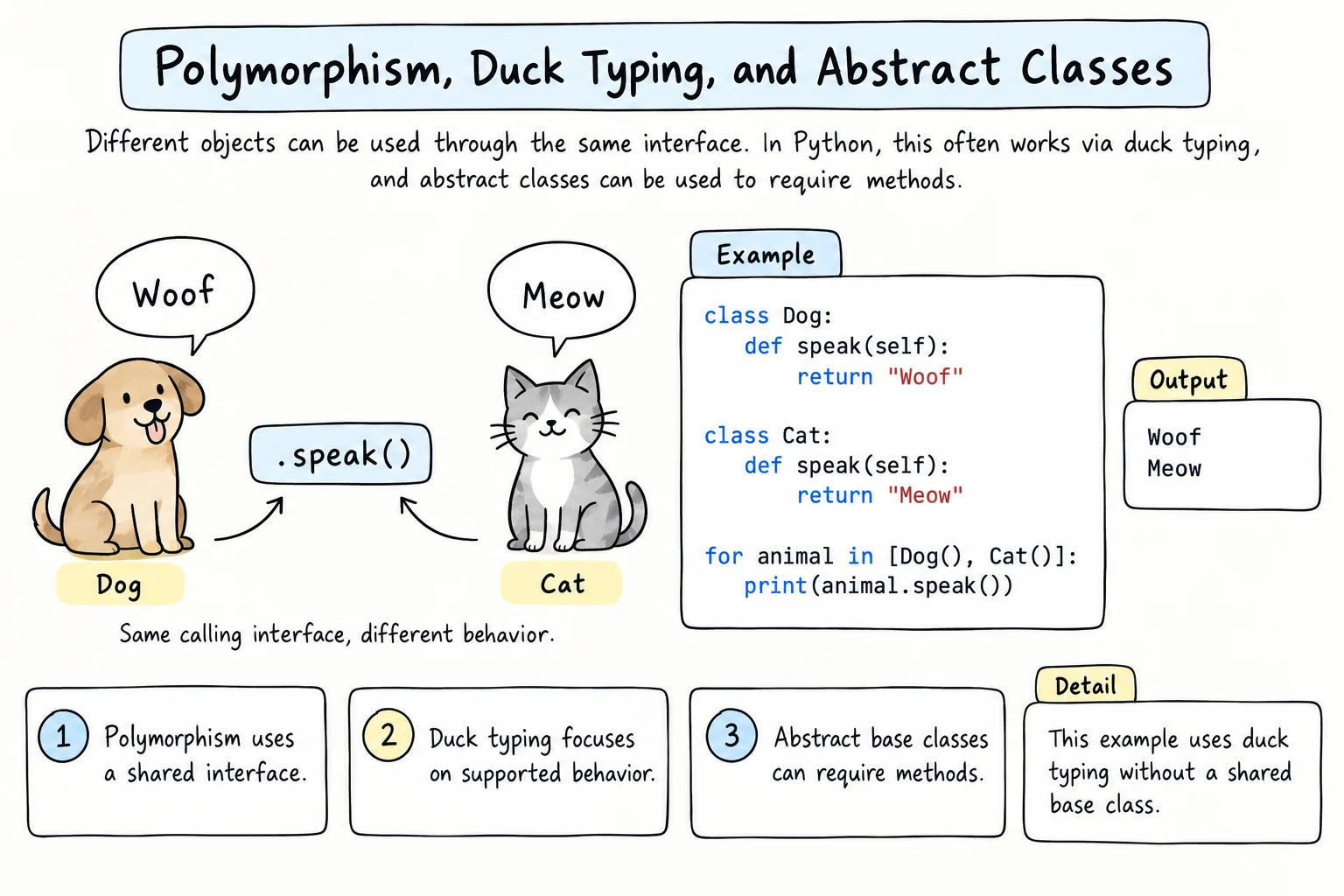
Polymorphism means "many forms": different classes provide a method with the same name, each in its own way:
class Cat:
    def speak(self):
        return "Meow"

class Dog:
    def speak(self):
        return "Woof"

for animal in [Cat(), Dog()]:
    print(animal.speak())

print(2 + 3, "non" + "voy", [1] + [2])Meow
Woof
5 nonvoy [1, 2]The loop only calls speak(); the classes do not even share a parent. + is polymorphic too: each type defines its own __add__ (see Operators and Containers).
Duck typing
"If it walks like a duck and quacks like a duck, it is a duck." Python does not check an object's class before calling a method: any object with the right method works. Built-ins do the same: len() accepts anything with __len__:
class Field:
    """A farm field: not a shape, but it has an area."""
    def __init__(self, hectares):
        self.hectares = hectares

    def area(self):
        return self.hectares * 10_000   # square meters


class Playlist:
    def __init__(self, songs):
        self.songs = songs

    def __len__(self):
        return len(self.songs)


print(Field(0.5).area())
for thing in ["hello", [1, 2, 3], Playlist(["Yalla", "Sevara"])]:
print(type(thing).__name__, len(thing))5000.0
str 5
list 3
Playlist 2Any code that calls .area() accepts a Field, with no shared base class. len() has no list of "allowed" types either.
Checking abilities: hasattr vs. EAFP
When an object may lack a method, you can look before you leap: if hasattr(doc, "export"):. Or use EAFP ("easier to ask forgiveness than permission"): try, and handle the error:
class PdfReport:
    def export(self):
        return "report.pdf"

class Draft:
    pass

for doc in [PdfReport(), Draft()]:
    try:
        result = doc.export()
    except AttributeError:
        print(f"{type(doc).__name__} cannot be exported")
    else:
print("Exported", result)Exported report.pdf
Draft cannot be exportedEAFP is the more common Python style. Keep the try around the one call that might be missing, or an unrelated AttributeError bug would be reported as "cannot be exported".
The problem duck typing does not solve
Duck typing fails late: a missing method is found only when it is called:
class TelegramSender:
    def send(self, user, text):
        return f"Telegram to {user}: {text}"

class EmailSender:
    def sned(self, user, text):          # typo, nobody noticed
        return f"Email to {user}: {text}"

for sender in [TelegramSender(), EmailSender()]:
print(sender.send("Aziza", "Your order has shipped"))Telegram to Aziza: Your order has shipped
AttributeError: 'EmailSender' object has no attribute 'send'The first message went out before the crash. Abstract base classes catch this when the object is created.
Abstract base classes
An abstract base class (ABC) lists the methods every subclass must have. Only subclasses that fill in every abstract method can create objects:
from abc import ABC, abstractmethod


class NotificationSender(ABC):
    @abstractmethod
    def send(self, user, text):
        """Deliver text to user and return a status string."""

    def send_many(self, users, text):          # a normal, shared method
        return [self.send(user, text) for user in users]


class SmsSender(NotificationSender):
    def send(self, user, text):
        return f"SMS to {user}: {text[:20]}"


class EmailSender(NotificationSender):
    def sned(self, user, text):                # typo
        return f"Email to {user}: {text}"


print(SmsSender().send_many(["Aziza", "Bekzod"], "Order shipped"))

for cls in [NotificationSender, EmailSender]:
    try:
        cls()
    except TypeError as error:
print(error)['SMS to Aziza: Order shipped', 'SMS to Bekzod: Order shipped']
Can't instantiate abstract class NotificationSender without an implementation for abstract method 'send'
Can't instantiate abstract class EmailSender without an implementation for abstract method 'send'Inheriting from ABC makes the class abstract-capable, and @abstractmethod marks send as required (its body is just a docstring or ...). send_many is an ordinary shared method that can rely on send existing. The EmailSender typo is now caught at creation, and the message names the missing method.
Worked example: payment methods with an ABC
Here is the shop's checkout without an if-chain. The abstract class requires pay() and provides a shared receipt():
from abc import ABC, abstractmethod


class PaymentError(Exception):
    pass


class PaymentMethod(ABC):
    name = "payment"

    @abstractmethod
    def pay(self, amount):
        """Take amount som or raise PaymentError."""

    def receipt(self, amount):
        self.pay(amount)
        return f"{amount:>9,} som paid by {self.name}"


class Card(PaymentMethod):
    name = "card"

    def pay(self, amount):
        if amount > 5_000_000:
            raise PaymentError("Card limit is 5,000,000 som")


class Wallet(PaymentMethod):
    name = "wallet"

    def __init__(self, balance):
        self.balance = balance

    def pay(self, amount):
        if amount > self.balance:
            raise PaymentError(f"Wallet has only {self.balance:,} som")
        self.balance -= amount


orders = [(Card(), 350_000), (Wallet(200_000), 150_000), (Wallet(10_000), 90_000), (Card(), 7_000_000)]
for method, amount in orders:
    try:
        print(method.receipt(amount))
    except PaymentError as error:
print(f"{amount:>9,} som FAILED: {error}") 350,000 som paid by card
150,000 som paid by wallet
90,000 som FAILED: Wallet has only 10,000 som
7,000,000 som FAILED: Card limit is 5,000,000 somThe loop has no if on the payment kind, and receipt() is written once for every payment method, including future ones.
Try it
Add a TelegramSender class with a send() method, then try creating a subclass that forgets send() to see the TypeError.
Common mistakes
1. Forgetting to inherit from ABC
from abc import abstractmethod

class Exporter:                 # no ABC
    @abstractmethod
    def convert(self, rows):
        pass

e = Exporter()                  # no error at all
print(e.convert([]))NoneWithout ABC as a parent, @abstractmethod is silently ignored. Fix: class Exporter(ABC):.
2. Different method signatures in the family
class Card:
    def pay(self, amount):
        return f"card {amount}"

class Wallet:
    def pay(self, amount, phone):          # needs an extra argument
        return f"wallet {amount} {phone}"

for method in [Card(), Wallet()]:
print(method.pay(100_000))card 100000
TypeError: Wallet.pay() missing 1 required positional argument: 'phone'Every class must accept the same arguments. Fix: put per-object data like phone in __init__.
3. Checking types instead of using polymorphism
class Circle:
    pass

class Square:
    pass

class Triangle:
    pass

def describe(shape):                       # Bad: the if-chain is back
    if isinstance(shape, Circle):
        return "round"
    elif isinstance(shape, Square):
        return "four corners"

for shape in [Circle(), Square(), Triangle()]:
print(describe(shape))round
four corners
NoneThe new Triangle silently gets None. Fix: give each class a describe() method and call it. Use isinstance for validation, not to decide what to do.
Practice
1. Talking devices
Create classes Phone, Radio, and Doorbell, each with a sound() method returning a different string. Put one of each in a list and print every sound in a loop.
Solution
class Phone:
    def sound(self):
        return "Ring ring"

class Radio:
    def sound(self):
        return "Now playing the news from Tashkent"

class Doorbell:
    def sound(self):
        return "Ding dong"

for device in [Phone(), Radio(), Doorbell()]:
print(f"{type(device).__name__}: {device.sound()}")Phone: Ring ring
Radio: Now playing the news from Tashkent
Doorbell: Ding dong2. Shape family with an ABC
Write an abstract Shape with an abstract area() and a normal summary() method. Implement Rectangle and Circle. Print the summary for a 3 x 4 rectangle and a circle with radius 1.
Solution
import math
from abc import ABC, abstractmethod


class Shape(ABC):
    @abstractmethod
    def area(self):
        ...

    def summary(self):
        return f"{type(self).__name__}: area {self.area():.2f}"


class Rectangle(Shape):
    def __init__(self, w, h):
        self.w, self.h = w, h

    def area(self):
        return self.w * self.h


class Circle(Shape):
    def __init__(self, r):
        self.r = r

    def area(self):
        return math.pi * self.r ** 2


for shape in [Rectangle(3, 4), Circle(1)]:
print(shape.summary())Rectangle: area 12.00
Circle: area 3.143. Anything with a length
Write longest(items) that returns the item with the largest len(), without checking types. Test it with "Samarkand", [1, 2, 3], and your own Queue class with __len__ and __repr__ holding 12 people.
Solution
class Queue:
    def __init__(self, people):
        self.people = people

    def __len__(self):
        return len(self.people)

    def __repr__(self):
        return f"Queue({len(self)} people)"


def longest(items):
    return max(items, key=len)


print(longest(["Samarkand", [1, 2, 3], Queue(["Aziza"] * 12)]))
print(longest(["Samarkand", [1, 2, 3]]))Queue(12 people)
Samarkand4. Design from a description: delivery pricing
A delivery company offers Standard (15,000 som plus 2,000 som per kg), Express (twice Standard), and Pickup point (flat 10,000 som). Design an ABC that requires cost(weight_kg) and shares a quote(weight_kg) method. Print quotes for a 3 kg parcel, then show that a Drone service without cost() raises TypeError.
Solution
from abc import ABC, abstractmethod


class DeliveryService(ABC):
    @abstractmethod
    def cost(self, weight_kg):
        ...

    def quote(self, weight_kg):
        return f"{type(self).__name__:<12} {weight_kg} kg: {self.cost(weight_kg):>7,} som"


class Standard(DeliveryService):
    def cost(self, weight_kg):
        return 15_000 + 2_000 * weight_kg


class Express(Standard):
    def cost(self, weight_kg):
        return super().cost(weight_kg) * 2


class PickupPoint(DeliveryService):
    def cost(self, weight_kg):
        return 10_000


for service in [Standard(), Express(), PickupPoint()]:
    print(service.quote(3))


class Drone(DeliveryService):
    pass

try:
    Drone()
except TypeError:
print("Drone is missing cost()")Standard 3 kg: 21,000 som
Express 3 kg: 42,000 som
PickupPoint 3 kg: 10,000 som
Drone is missing cost()Express inherits from Standard because its price is built on the standard one.
5. Plugin-style text filters
Create an abstract TextFilter with abstract apply(text), and subclasses StripSpaces (collapse repeated spaces), Censor (replace banned words with ***, ignoring case), and Capitalize (uppercase the first letter). Write run_pipeline(text, filters) that applies them in order, printing each step. Test on " the bad weather in tashkent " with Censor(["BAD"]).
Solution
from abc import ABC, abstractmethod


class TextFilter(ABC):
    @abstractmethod
    def apply(self, text):
        ...


class StripSpaces(TextFilter):
    def apply(self, text):
        return " ".join(text.split())


class Censor(TextFilter):
    def __init__(self, banned):
        self.banned = {w.lower() for w in banned}

    def apply(self, text):
        return " ".join("***" if w.lower() in self.banned else w for w in text.split(" "))


class Capitalize(TextFilter):
    def apply(self, text):
        return text[:1].upper() + text[1:]


def run_pipeline(text, filters):
    for f in filters:
        text = f.apply(text)
        print(f"{type(f).__name__:<12} -> {text!r}")
    return text


run_pipeline(" the bad weather in tashkent ", [StripSpaces(), Censor(["BAD"]), Capitalize()])StripSpaces -> 'the bad weather in tashkent'
Censor -> 'the *** weather in tashkent'
Capitalize -> 'The *** weather in tashkent'Spaces are cleaned first, so Censor can split on single spaces.
Recap
- Polymorphism: classes share a method name, so one loop or function works with all of them.
- Objects with a shared method replace
if kind == ...chains, so adding a new kind is one new class. - Duck typing: Python cares whether an object has the method, not its class.
len()and+work this way. - Check with
hasattr(), or use EAFP with a smalltryblock. abc.ABCplus@abstractmethoddefines required methods. A missing one raisesTypeErrorwhen the object is created.