

Common Loop Patterns
What you'll learn
- The counter and accumulator patterns: counting, summing, and averaging
- The best-so-far pattern: finding the largest or smallest item
- The search pattern: is there a match, and where is it?
- Building strings and running totals step by step
- Looping with positions using
enumerate(), and over two sequences at once withzip()
Why it matters
Once you've written a few loops, you'll notice the same shapes coming up again and again. Experienced programmers don't invent each loop from scratch. They recognize the pattern a problem needs and fill in the details. Learn these patterns and most loop problems become quick to solve.
Most examples loop over a list of test scores, written in square brackets as in for Loops and range(). Everything else lists can do comes in Lists.
scores = [72, 95, 58, 88, 64, 91]1. Counter: how many?
Start at 0, add 1 when an item matches:
scores = [72, 95, 58, 88, 64, 91]

passed = 0
for score in scores:
    if score >= 60:
        passed += 1

print(f"{passed} of {len(scores)} passed")5 of 6 passed2. Accumulator: total, product, average
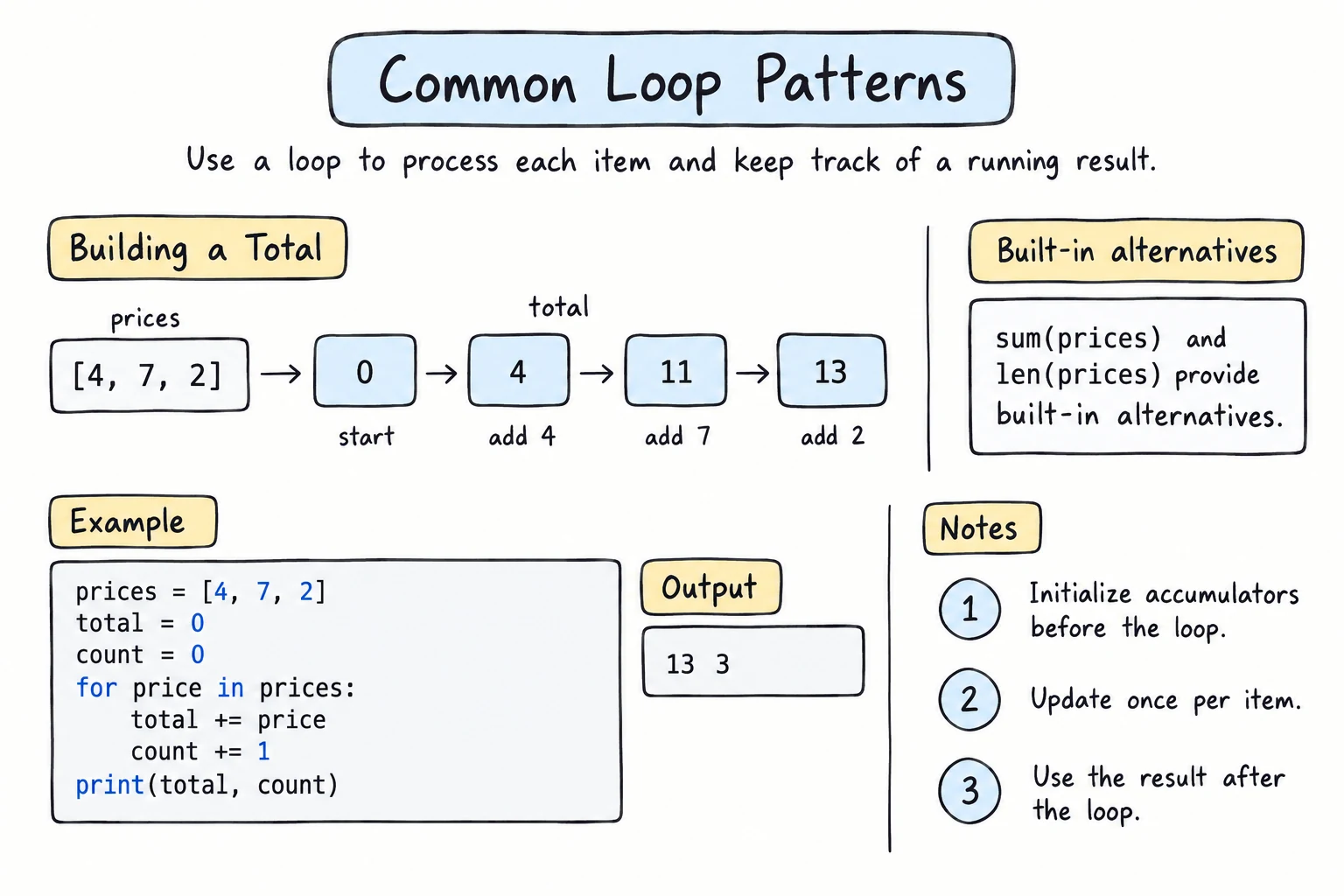
Start with a neutral value, and combine each item into it:
scores = [72, 95, 58, 88, 64, 91]

total = 0
for score in scores:
    total += score

average = total / len(scores)
print(f"Total: {total}, average: {average:.1f}")Total: 468, average: 78.0| Goal | Start with | Update |
|---|---|---|
| Sum | 0 | total += x |
| Product | 1 | product *= x |
| Build a string | "" | text += x |
| Count | 0 | count += 1 |
For simple sums, Python has a built-in: sum(scores). It's still worth knowing the loop, because the pattern works for anything you can combine.
3. Best so far: maximum and minimum
Remember the best item seen so far, and replace it when you find a better one:
scores = [72, 95, 58, 88, 64, 91]

highest = scores[0]          # start with the first item
for score in scores:
    if score > highest:
        highest = score

print(f"Highest: {highest}")Highest: 95scores[0] is the first item, just as text[0] is the first character of a string. Start with the first item, not 0: if all values were negative, starting at 0 would give a wrong answer.
The built-ins max(scores) and min(scores) do this for you. The loop version is needed when you want more than the value, for example the name of the best student. You'll write that with zip() below.
4. Search: is there one?
Loop until you find a match, then stop with break:
scores = [72, 95, 58, 88, 64, 91]

first_fail = None
for score in scores:
    if score < 60:
        first_fail = score
        break

if first_fail is None:
    print("Nobody failed")
else:
print(f"First failing score: {first_fail}")First failing score: 58None is Python's special "no value" marker. It's a good starting value when nothing has been found yet. Check for it with is None, as you saw in Booleans and Comparisons.
If you only need yes or no, a flag works just as well: start with found = False, and set it to True before the break.
5. Build a string
Start with "" and add a piece on each iteration. Adding a character only when it passes a test filters the text:
phone = "+998 (90) 123-45-67"

digits = ""
for char in phone:
    if char.isdecimal():
        digits += char

print(digits)998901234567The same pattern can change characters as it goes:
word = "banana"

result = ""
for letter in word:
    if letter == "a":
        result += "*"
    else:
        result += letter

print(result)b*n*n*6. Running total
Keep an accumulator and show it at every step:
daily_sales = [120, 80, 150, 60]

running = 0
for day_sales in daily_sales:
    running += day_sales
print(f"+{day_sales:>4} → {running:>4}")+ 120 → 120
+ 80 → 200
+ 150 → 350
+ 60 → 410Positions with enumerate()
Often you need both the item and its position. Instead of managing a counter, use enumerate():
tasks = ["write report", "call client", "review code"]

for number, task in enumerate(tasks, start=1):
print(f"{number}. {task}")1. write report
2. call client
3. review codeenumerate() gives pairs of (position, item), and number, task unpacks each pair into two variables. Without start=1, counting starts at 0.
Prefer enumerate() over for i in range(len(tasks)): whenever you need the item itself.
Search: where is it?
Combine enumerate() with the search pattern, and use the loop else from break, continue, and else for "not found":
scores = [72, 95, 58, 88, 64, 91]

for position, score in enumerate(scores):
    if score < 60:
        print(f"First failing score {score} is at position {position}")
        break
else:
print("Nobody failed")First failing score 58 is at position 2Positions start at 0, so 58 is at position 2: the third item.
Two sequences at once with zip()
zip() walks through several sequences side by side:
names = ["Aziza", "Bekzod", "Dilnoza"]
marks = [81, 94, 88]

for name, mark in zip(names, marks):
print(f"{name:<8} {mark}")Aziza 81
Bekzod 94
Dilnoza 88With zip(), the best-so-far pattern can remember the name as well as the mark:
names = ["Aziza", "Bekzod", "Dilnoza"]
marks = [81, 94, 88]

best_name = names[0]
best_mark = marks[0]
for name, mark in zip(names, marks):
    if mark > best_mark:
        best_name = name
        best_mark = mark

print(f"Top student: {best_name} ({best_mark})")Top student: Bekzod (94)Looping backwards with reversed()
for n in reversed(range(1, 4)):
    print(n)
print("Go!")3
2
1
Go!Choosing a pattern
| The question asks… | Pattern |
|---|---|
| "How many…?" | Counter |
| "What's the total / average…?" | Accumulator |
| "Which is the largest / cheapest / longest…?" | Best so far |
| "Is there any… / find the first…" | Search with break |
| "Where is the first…?" | Search with enumerate() |
| "Keep only some characters" / "Change each letter" | Build a string |
| "Show the progress at each step" | Running total |
Try it
Analyze temperatures for a week: count hot days, find the coldest day's name, and compute the average.
Common mistakes
1. Starting max/min at 0
values = [-5, -2, -9]

highest = 0
for value in values:
    if value > highest:
        highest = value

print(f"Highest: {highest}")Highest: 00 isn't even in the list. Fix: start with the first item, highest = values[0].
2. Averaging an empty sequence
values = []
print(sum(values) / len(values))ZeroDivisionError: division by zeroCheck that there's data first: if values:. The same goes for the best-so-far pattern: values[0] on an empty list raises IndexError: list index out of range.
3. Forgetting break in a search
scores = [72, 95, 58, 88, 54, 91]

first_fail = None
for score in scores:
    if score < 60:
        first_fail = score      # no break

print(f"First failing score: {first_fail}")First failing score: 54Without break, the loop keeps going and later matches overwrite earlier ones, so "find the first" becomes "find the last". Fix: add break after the assignment.
4. Using zip() on sequences of different lengths
names = ["Aziza", "Bekzod", "Dilnoza"]
marks = [81, 94]                # one mark is missing

for name, mark in zip(names, marks):
print(f"{name:<8} {mark}")Aziza 81
Bekzod 94No error: zip() silently stops at the shortest sequence, and Dilnoza disappears. If the lengths should match, compare len(names) and len(marks) before the loop.
Practice
1. Count long words
Count how many words in "Python makes repetitive tasks simple and fun" have more than 4 letters.
Solution
sentence = "Python makes repetitive tasks simple and fun"

count = 0
for word in sentence.split():
    if len(word) > 4:
        count += 1

print(count)52. Longest word
Find the longest word in the same sentence using the best-so-far pattern.
Solution
sentence = "Python makes repetitive tasks simple and fun"
words = sentence.split()

longest = words[0]
for word in words:
    if len(word) > len(longest):
        longest = word

print(longest)repetitive3. Numbered shopping list
Given items = ["bread", "milk", "eggs"] and prices = [6000, 12000, 18000], print a numbered list with prices, then the total. Use zip(), a counter, and an accumulator:
1. bread    6,000
2. milk    12,000
3. eggs    18,000
Total: 36,000
Solution
items = ["bread", "milk", "eggs"]
prices = [6000, 12000, 18000]

number = 0
total = 0
for item, price in zip(items, prices):
    number += 1
    total += price
    print(f"{number}. {item:<6} {price:>7,}")

print(f"Total: {total:,}")
4. Capitalize every other letter
Turn "python loops" into "PyThOn lOoPs": uppercase the characters at even positions and lowercase the others (count spaces as positions too).
Solution
text = "python loops"

result = ""
for i, char in enumerate(text):
    if i % 2 == 0:
        result += char.upper()
    else:
        result += char.lower()

print(result)
5. Stock analysis
Given daily closing prices prices = [100, 104, 101, 110, 108, 115, 112], print:
- the biggest one-day increase and which day it happened (day numbers start at 1),
- how many days the price went down compared with the day before,
- whether the price ever dropped below the first day's price.
Solution
prices = [100, 104, 101, 110, 108, 115, 112]

biggest_rise = 0
rise_day = None
down_days = 0

for day in range(1, len(prices)):
    change = prices[day] - prices[day - 1]
    if change > biggest_rise:
        biggest_rise = change
        rise_day = day + 1        # human day numbers start at 1
    if change < 0:
        down_days += 1

dropped_below_start = False
for price in prices:
    if price < prices[0]:
        dropped_below_start = True
        break

print(f"Biggest rise: +{biggest_rise} on day {rise_day}")
print(f"Down days: {down_days}")
print(f"Dropped below start: {dropped_below_start}")Biggest rise: +9 on day 4
Down days: 3
Dropped below start: FalseHere, range(1, len(prices)) is the right tool, because each step compares an item with the previous one. The second loop is a search with a flag.
Recap
- Counter: start at
0, add1on a match. Accumulator: start neutral (0,1,"") and combine. - Best so far: start with the first item and replace it when you find something better.
max()/min()cover simple cases. - Search: loop and
breakon the first match. UseNoneor a flag for "not found yet", or a loopelse. - Build strings with
+=, adding only the characters you want. A running total prints the accumulator at each step. enumerate()gives positions,zip()pairs up sequences (and stops at the shortest), andreversed()goes backwards.