

Inheritance and super()
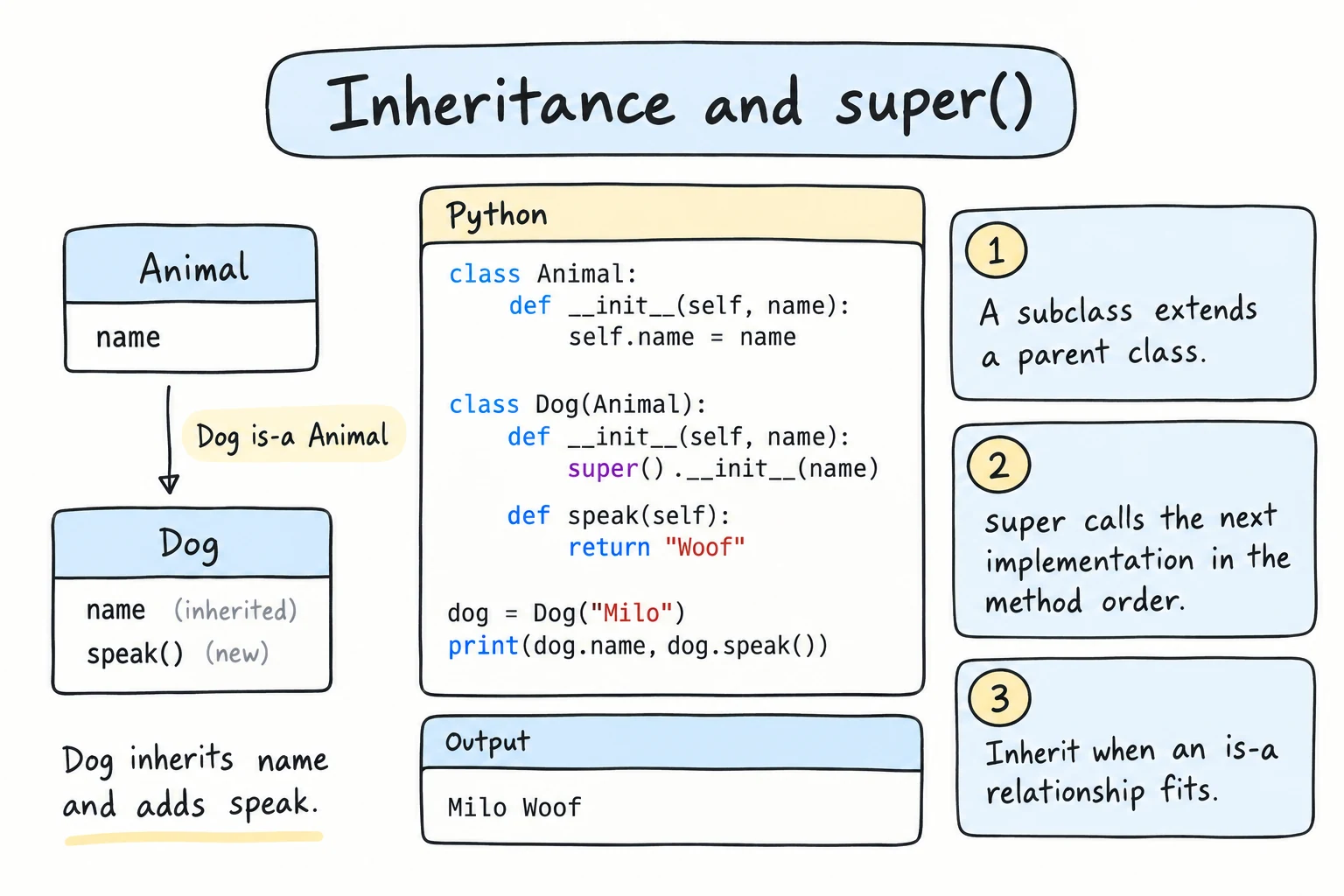
What you'll learn
- When an is-a relationship calls for inheritance
- How a derived class inherits, overrides, and extends methods
- How to call the parent's code with
super() - How
isinstance()andissubclass()work with class families - The
objectbase class, the method resolution order (MRO), and mixins
Why it matters
Real programs have families of similar classes: employees and managers, accounts and savings accounts. Without inheritance you copy shared code into every class and fix every copy when a rule changes. Inheritance puts the shared part once in a base class, and only the differences in each derived class.
The is-a test
Say the relationship out loud. A manager is an employee . A car is an engine (a car has an engine, see Composition vs. Inheritance). If "every X is a Y" sounds right, and everything a Y can do makes sense for an X, inheritance fits.
Base and derived classes
Put the parent class in parentheses after the new class name. If the child defines a method with the same name as the parent, its version wins. This is overriding:
class Employee:
    def __init__(self, name, salary):
        self.name = name
        self.salary = salary

    def yearly_bonus(self):
        return self.salary * 0.5


class Manager(Employee):             # Manager inherits from Employee
    def yearly_bonus(self):          # overrides the parent version
        return self.salary * 1.5

    def approve_leave(self, employee, days):
        return f"{self.name} approved {days} days of leave for {employee.name}"


staff = [Employee("Aziza", 7_000_000), Manager("Dilnoza", 12_000_000)]
for person in staff:
    print(f"{person.name}: {person.yearly_bonus():,.0f} som")
print(staff[1].approve_leave(staff[0], 5))Aziza: 3,500,000 som
Dilnoza: 18,000,000 som
Dilnoza approved 5 days of leave for AzizaEmployee is the base class (parent) and Manager the derived class (child). Manager has no __init__, yet it has name and salary: Python looks in Manager first, then in Employee. The child can also add methods a plain employee lacks. The same call, yearly_bonus(), gives a different result for each class: that is polymorphism, the next lesson.
Python has no method overloading
In Java or C# two methods can share a name with different parameters. In Python the second def replaces the first:
class Rectangle:
    def area(self):
        return 0

    def area(self, scale=1):         # replaces the first area()
        return 6 * scale


print(Rectangle().area(), Rectangle().area(2))6 12Use default parameter values instead.
Extending with super()
To add to the parent's behavior instead of replacing it, call the parent's version with super():
class Employee:
    def __init__(self, name, salary):
        self.name = name
        self.salary = salary

    def describe(self):
        return f"{self.name} earns {self.salary:,} som"


class Manager(Employee):
    def __init__(self, name, salary, team_size):
        super().__init__(name, salary)        # let Employee set name and salary
        self.team_size = team_size

    def describe(self):
        return f"{super().describe()} and manages {self.team_size} people"


print(Employee("Aziza", 7_000_000).describe())
print(Manager("Dilnoza", 12_000_000, 8).describe())Aziza earns 7,000,000 som
Dilnoza earns 12,000,000 som and manages 8 peoplesuper().__init__(name, salary) runs Employee.__init__ on the same object, so there is no self in the call. Override when the child needs different behavior; extend with super() when it needs the parent's behavior plus something extra, so later changes to the parent flow into the child.
Worked example: a savings account
A savings account is an account that also earns interest and allows only a few withdrawals a month:
class Account:
    def __init__(self, owner, balance=0):
        self.owner = owner
        self.balance = balance

    def deposit(self, amount):
        self.balance += amount

    def withdraw(self, amount):
        if amount > self.balance:
            raise ValueError(f"{self.owner} has only {self.balance:,} som")
        self.balance -= amount


class SavingsAccount(Account):
    def __init__(self, owner, balance=0, rate=0.14, max_withdrawals=3):
        super().__init__(owner, balance)
        self.rate = rate
        self.max_withdrawals = max_withdrawals
        self.withdrawals_this_month = 0

    def withdraw(self, amount):
        if self.withdrawals_this_month >= self.max_withdrawals:
            raise ValueError("Monthly withdrawal limit reached")
        super().withdraw(amount)            # the normal balance check
        self.withdrawals_this_month += 1

    def add_monthly_interest(self):
        interest = round(self.balance * self.rate / 12)
        self.deposit(interest)              # inherited method
        return interest


savings = SavingsAccount("Farrukh", 2_000_000, max_withdrawals=2)
print("Interest:", savings.add_monthly_interest())
for amount in [100_000, 50_000, 30_000]:
    try:
        savings.withdraw(amount)
        print(f"Withdrew {amount:,}")
    except ValueError as error:
        print("Refused:", error)
print(f"Balance: {savings.balance:,} som")Interest: 23333
Withdrew 100,000
Withdrew 50,000
Refused: Monthly withdrawal limit reached
Balance: 1,873,333 somSavingsAccount.withdraw checks the limit, then delegates the balance check to the parent.
isinstance() and issubclass()
isinstance(obj, Class) is True for that class or any of its parents:
class Employee:
    pass

class Manager(Employee):
    pass

boss = Manager()
print(isinstance(boss, Employee), isinstance(Employee(), Manager))
print(issubclass(Manager, Employee))
print(type(boss) == Employee)True False
True
Falsetype() gives the exact class. isinstance respects the is-a relationship, which is almost always what you want.
object and the method resolution order
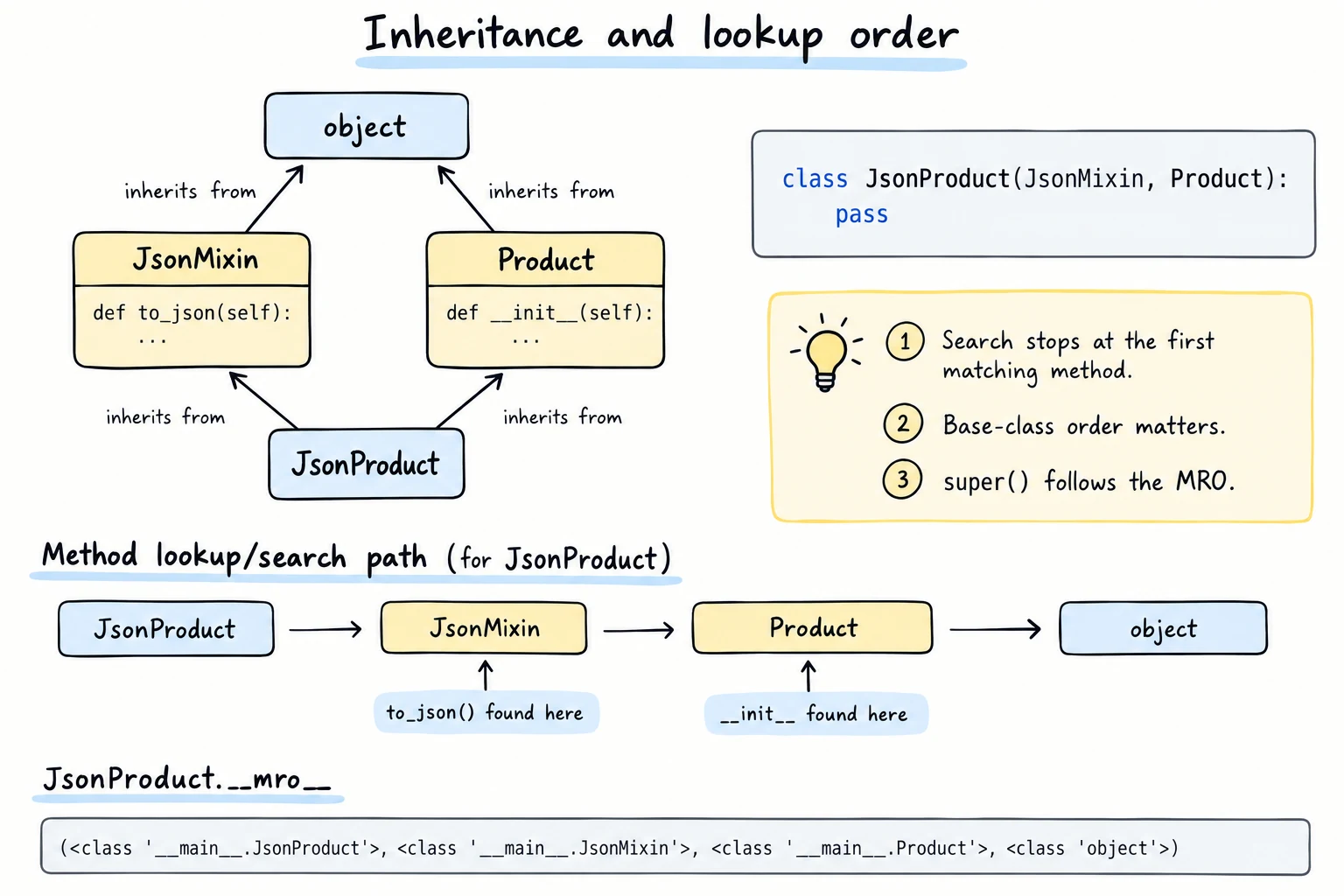
A class with no parent inherits from object, which supplies default __str__, __repr__, and __eq__. Python searches classes in a fixed order, the method resolution order (MRO):
class Shape:
    def describe(self):
        return "Shape.describe"

class Rectangle(Shape):
    pass

class Square(Rectangle):
    pass

print([cls.__name__ for cls in Square.__mro__])
print(Square().describe())['Square', 'Rectangle', 'Shape', 'object']
Shape.describeSquare inherits from Rectangle, which inherits from Shape: multilevel inheritance. super() follows this order too: it means "the next class in the MRO", which with one parent is simply the parent.
Mixins
A class can have several parents: class C(A, B):. Use this mainly for a mixin, a small class that adds one ability:
import json


class JsonMixin:
    def to_json(self):
        return json.dumps(self.__dict__, ensure_ascii=False)


class Product:
    def __init__(self, name, price):
        self.name = name
        self.price = price


class JsonProduct(JsonMixin, Product):
    pass


print(JsonProduct("Green tea", 25000).to_json()){"name": "Green tea", "price": 25000}self.__dict__ holds an object's attributes, so the mixin works with any class. Keep mixins small and hierarchies shallow (one or two levels).
Try it
Add a Contractor class that inherits from Employee, overrides monthly_cost() to add a 10% agency fee, and extends describe() with super().
Common mistakes
1. Forgetting super().__init__()
class Employee:
    def __init__(self, name, salary):
        self.name = name
        self.salary = salary

class Manager(Employee):
    def __init__(self, name, salary, team_size):
        self.team_size = team_size        # parent __init__ never runs

print(Manager("Dilnoza", 12_000_000, 5).name)AttributeError: 'Manager' object has no attribute 'name'Fix: call super().__init__(name, salary) first.
2. Passing self to super() methods
class Shape:
    def __init__(self, name):
        self.name = name

class Circle(Shape):
    def __init__(self, radius):
        super().__init__(self, "Circle")    # self passed twice
        self.radius = radius

Circle(2)TypeError: Shape.__init__() takes 2 positional arguments but 3 were givensuper() already binds self. Fix: super().__init__("Circle").
3. Calling the parent by class name
Parent.__init__(self, ...) works until the hierarchy changes. Here Employee was inserted between Person and Manager later:
class Person:
    def __init__(self, name):
        self.name = name

class Employee(Person):
    def __init__(self, name, salary):
        super().__init__(name)
        self.salary = salary

class Manager(Employee):
    def __init__(self, name, salary):
        Person.__init__(self, name)       # skips Employee.__init__
        self.team = []

print(Manager("Dilnoza", 12_000_000).salary)AttributeError: 'Manager' object has no attribute 'salary'Fix: super().__init__(name, salary), which follows the real MRO even when parents change.
Practice
1. Student and graduate
Create a Student class with name and grades (a list), and a method average(). Create GraduateStudent(Student) that adds a thesis attribute using super().__init__(). Print Aziza's average (grades 92, 88, 95) and thesis.
Solution
class Student:
    def __init__(self, name, grades):
        self.name = name
        self.grades = grades

    def average(self):
        return sum(self.grades) / len(self.grades)


class GraduateStudent(Student):
    def __init__(self, name, grades, thesis):
        super().__init__(name, grades)
        self.thesis = thesis


g = GraduateStudent("Aziza", [92, 88, 95], "Water use in the Fergana Valley")
print(f"{g.name}: {g.average():.1f}")
print(g.thesis)Aziza: 91.7
Water use in the Fergana Valley2. Discounted product
Product has name, price, and final_price(). Create DiscountedProduct with an extra percent whose final_price() applies the discount to super().final_price(). Print prices for a 60,000 som cap and a 200,000 som jacket with 15% off.
Solution
class Product:
    def __init__(self, name, price):
        self.name = name
        self.price = price

    def final_price(self):
        return self.price


class DiscountedProduct(Product):
    def __init__(self, name, price, percent):
        super().__init__(name, price)
        self.percent = percent

    def final_price(self):
        return round(super().final_price() * (1 - self.percent / 100))


for item in [Product("Cap", 60_000), DiscountedProduct("Jacket", 200_000, 15)]:
print(f"{item.name}: {item.final_price():,} som")Cap: 60,000 som
Jacket: 170,000 som3. Vehicle rental
Write Vehicle with daily_rate and rental_cost(days). Add Truck(Vehicle), whose rental_cost extends the parent's with super() and adds 50,000 som per day. Print the 3-day cost of a 300,000 som vehicle and a 450,000 som truck.
Solution
class Vehicle:
    def __init__(self, daily_rate):
        self.daily_rate = daily_rate

    def rental_cost(self, days):
        return self.daily_rate * days


class Truck(Vehicle):
    def rental_cost(self, days):
        return super().rental_cost(days) + 50_000 * days


for v in [Vehicle(300_000), Truck(450_000)]:
print(f"{type(v).__name__}: {v.rental_cost(3):,} som")Vehicle: 900,000 som
Truck: 1,500,000 som4. Design from a description: museum tickets
A museum in Samarkand sells tickets. Every ticket has a visitor name and a base price of 40,000 som, and can print a receipt line. A student ticket costs half. A guided ticket costs 30,000 som more, and its receipt also shows the guide's name. Print receipts for Farrukh (regular), Aziza (student), and Bekzod (guided by Malika).
Solution
class Ticket:
    base_price = 40_000

    def __init__(self, visitor):
        self.visitor = visitor

    def price(self):
        return self.base_price

    def receipt(self):
        return f"{type(self).__name__:<13} {self.visitor:<8} {self.price():>7,} som"


class StudentTicket(Ticket):
    def price(self):
        return super().price() // 2


class GuidedTicket(Ticket):
    def __init__(self, visitor, guide):
        super().__init__(visitor)
        self.guide = guide

    def price(self):
        return super().price() + 30_000

    def receipt(self):
        return super().receipt() + f" (guide: {self.guide})"


tickets = [Ticket("Farrukh"), StudentTicket("Aziza"), GuidedTicket("Bekzod", "Malika")]
for t in tickets:
print(t.receipt())Ticket Farrukh 40,000 som
StudentTicket Aziza 20,000 som
GuidedTicket Bekzod 70,000 som (guide: Malika)receipt() is written once but calls self.price(), so each ticket prints its own price.
5. Logged account with a mixin
Write a HistoryMixin with log(event), which appends to self.history (create the list with hasattr if needed). Write Account (owner, balance, deposit, withdraw) and TrackedAccount(HistoryMixin, Account) that extends both methods to log each operation. Starting from 100,000, deposit 50,000 and withdraw 30,000, then print the MRO names and the numbered history.
Solution
class HistoryMixin:
    def log(self, event):
        if not hasattr(self, "history"):
            self.history = []
        self.history.append(event)


class Account:
    def __init__(self, owner, balance=0):
        self.owner = owner
        self.balance = balance

    def deposit(self, amount):
        self.balance += amount

    def withdraw(self, amount):
        self.balance -= amount


class TrackedAccount(HistoryMixin, Account):
    def deposit(self, amount):
        super().deposit(amount)
        self.log(f"deposit {amount:,} -> {self.balance:,}")

    def withdraw(self, amount):
        super().withdraw(amount)
        self.log(f"withdraw {amount:,} -> {self.balance:,}")


acc = TrackedAccount("Dilnoza", 100_000)
acc.deposit(50_000)
acc.withdraw(30_000)
print([c.__name__ for c in TrackedAccount.__mro__])
for number, event in enumerate(acc.history, start=1):
print(f"{number}. {event}")['TrackedAccount', 'HistoryMixin', 'Account', 'object']
1. deposit 50,000 -> 150,000
2. withdraw 30,000 -> 120,000HistoryMixin has no deposit, so super().deposit() continues along the MRO to Account.
Recap
- Use inheritance for is-a relationships:
class Manager(Employee):. - Override a method by defining it again (there is no overloading). Extend it with
super().method(...). - A child
__init__should callsuper().__init__(...), unless you really mean to replace the parent's setup. isinstance()respects inheritance.type(x) == Cdoes not.- Every class inherits from
object.Class.__mro__shows the lookup order, andsuper()follows it. - Keep hierarchies shallow and mixins small. Use attributes for has-a.