

Pythonic Design Patterns
What you'll learn
- Why design patterns are shared vocabulary, not code to copy
- How to write strategy, factory, and registry with functions, classmethods, dicts, and decorators
- How to build an observer (event emitter) and see generator pipelines as a pattern
- Where the template method idea and abstract classes still fit
- Why a singleton in Python is usually just a module
Why it matters
A design pattern is a named solution to a recurring problem. The names, made famous by the 1994 "Gang of Four" (GoF) book, let a team say "use a strategy here" instead of explaining a design. That book targeted C++ and Smalltalk, and many patterns work around features those languages lacked. In Python, functions are values and decorators exist, so a pattern often shrinks to a few lines. Knowing both keeps you from building a class hierarchy where a dict would do.
Strategy: pass a function
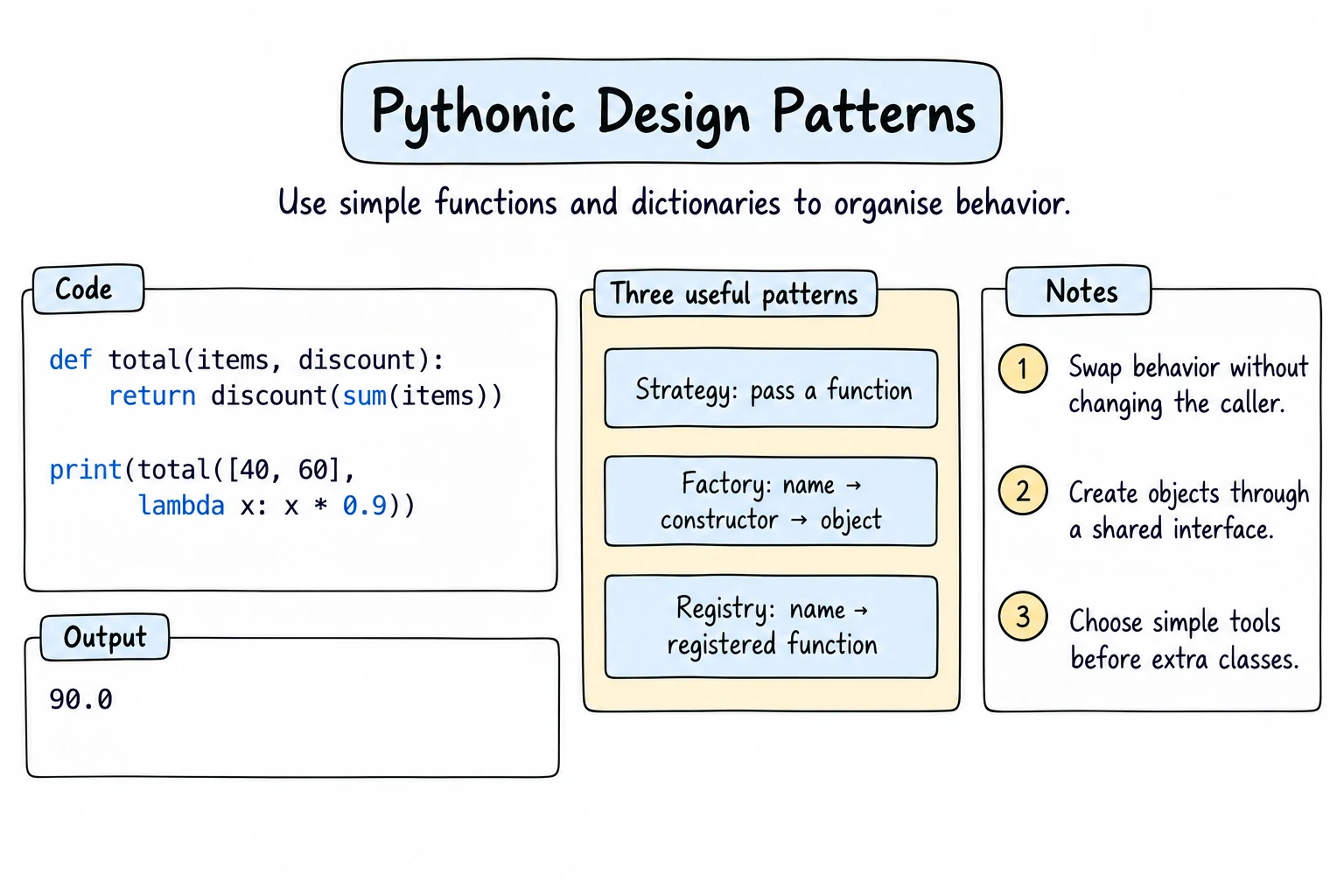
The strategy pattern swaps an algorithm, such as a discount rule. The classic version has a DiscountStrategy base class and a subclass per rule. In Python a strategy is just a function you pass in (Lambdas and Higher-Order Functions):
from functools import partial

def no_discount(total):
    return total

def percent_off(percent, total):
    return total * (100 - percent) / 100

def holiday(total):
    return max(total - 20000, 0)

def checkout(prices, discount=no_discount):
    return round(discount(sum(prices)))

cart = [45000, 15000, 30000]
print(checkout(cart))
print(checkout(cart, holiday))
print(checkout(cart, partial(percent_off, 15)))90000
70000
76500checkout only needs something callable. partial turns a rule with a setting into a one-argument strategy. Use a class when a strategy needs several methods or state.
Factory: classmethods and dicts
A factory creates objects so the caller doesn't need the details. The usual Python factory is a @classmethod constructor from Class Attributes, Class Methods, and Static Methods:
class Payment:
    def __init__(self, method, amount):
        self.method = method
        self.amount = amount

    @classmethod
    def from_string(cls, text):
        method, amount = text.split(":")
        return cls(method.strip(), int(amount))

payment = Payment.from_string("card: 150000")
print(payment.method, payment.amount)card 150000To choose which class to create, use a dict instead of an if/elif chain:
class Courier:
    days = 1

class Post:
    days = 5

DELIVERY_TYPES = {"courier": Courier, "post": Post}

def make_delivery(kind):
    try:
        return DELIVERY_TYPES[kind]()
    except KeyError:
        raise ValueError(f"unknown delivery type: {kind!r}") from None

print(type(make_delivery("post")).__name__)
try:
    make_delivery("drone")
except ValueError as error:
print(error)Post
unknown delivery type: 'drone'Registry: fill the dict with a decorator
A registry fills such a dict automatically: each function or class adds itself with a decorator from Closures and Decorators:
EXPORTERS = {}

def exporter(name):
    def decorator(func):
        EXPORTERS[name] = func
        return func
    return decorator

@exporter("csv")
def to_csv(rows):
    return "\n".join(f"{name},{score}" for name, score in rows)

@exporter("text")
def to_text(rows):
    return "\n".join(f"{name:<6}{score:>3}" for name, score in rows)

rows = [("Aziza", 92), ("Bobur", 85)]
print(sorted(EXPORTERS))
print(EXPORTERS["text"](rows))['csv', 'text']
Aziza 92
Bobur 85A new format is one decorated function. Flask's @app.route works the same way.
Observer: callbacks
The observer pattern lets an object announce events without knowing who listens. In Python the observers are just callbacks in a list:
from collections import defaultdict

class EventEmitter:
    def __init__(self):
        self._listeners = defaultdict(list)

    def subscribe(self, event, callback):
        self._listeners[event].append(callback)

    def notify(self, event, data):
        for callback in self._listeners[event]:
            callback(data)

def send_sms(order):
    print(f"SMS to {order['customer']}: order #{order['id']} is paid")

def update_stock(order):
    print(f"Stock: remove {', '.join(order['items'])}")

events = EventEmitter()
events.subscribe("paid", send_sms)
events.subscribe("paid", update_stock)
events.notify("paid", {"id": 17, "customer": "Dilnoza", "items": ["tea", "samsa"]})SMS to Dilnoza: order #17 is paid
Stock: remove tea, samsaThe order code never imports the SMS or stock code.
Iterator and pipeline: generators
The classic iterator pattern needs a class with methods such as has_next() and next(). In Python every for loop already uses iterators, and generators from Iterators and Generators make pipelines natural:
def strip(lines):
    return (line.strip() for line in lines)

def non_empty(lines):
    return (line for line in lines if line)

def titled(lines):
    return (line.title() for line in lines)

def pipeline(source, *steps):
    for step in steps:
        source = step(source)
    return source

raw = ["  tashkent ", "", "samarkand", "   ", "bukhara"]
print(list(pipeline(raw, strip, non_empty, titled)))['Tashkent', 'Samarkand', 'Bukhara']Each step is small, and the steps themselves are data you can reorder.
Template method and abstract classes
The template method pattern fixes an algorithm's steps in a base class and lets subclasses fill some in. Here the abstract classes from Polymorphism, Duck Typing, and Abstract Classes still fit:
from abc import ABC, abstractmethod

class Report(ABC):
    def render(self):                       # the template: fixed order
        return "\n".join([self.header(), *self.lines(), "-- end --"])

    def header(self):
        return "Report"

    @abstractmethod
    def lines(self): ...

class SalesReport(Report):
    def header(self):
        return "Sales: Tashkent"

    def lines(self):
        return ["tea    15,000", "samsa   8,000"]

print(SalesReport().render())Sales: Tashkent
tea 15,000
samsa 8,000
-- end --If only one step varies, passing it as a function is simpler.
Singleton: use a module
A singleton is a class with exactly one instance, such as app settings. In Python a module runs once, on first import, and later imports share it. So create one instance at module level:
# settings.py
class Settings:
    def __init__(self):
        self.city = "Tashkent"
        self.currency = "som"

settings = Settings()

# any other file
from settings import settings
Imports share one module object:
import json
import json as again

print(json is again)TrueGoF pattern vs. what Python usually does
| GoF pattern | What Python usually does instead |
|---|---|
| Strategy | functions passed as values, partial |
| Factory | @classmethod constructors, a dict of classes |
| Iterator | for, generators |
| Decorator pattern | decorators, composition |
| Command | functions, partial |
| Singleton | a module with a module-level instance |
| Builder | keyword arguments, dataclasses |
Try it
Add a discount rule and see which one wins for different carts.
Common mistakes
1. A class hierarchy for what a dict does
# Bad: a class per region that only holds a number
class TashkentRate:
    def rate(self):
        return 15000

class SamarkandRate:
    def rate(self):
        return 25000

print(SamarkandRate().rate())

# Good: data belongs in a dict
DELIVERY_RATES = {"Tashkent": 15000, "Samarkand": 25000}
print(DELIVERY_RATES["Samarkand"])25000
25000Fix: start with dicts and functions; add classes for behavior or state.
2. A mutable registry shared by accident
class EventEmitter:
    listeners = []          # Bad: one list for every emitter

    def subscribe(self, callback):
        self.listeners.append(callback)

    def notify(self, message):
        for callback in self.listeners:
            callback(message)

shop = EventEmitter()
bank = EventEmitter()
shop.subscribe(lambda message: print("shop got:", message))
bank.notify("salary paid")shop got: salary paidThe class attribute is shared by all instances. Fix: create the list in __init__ with self.listeners = [].
3. A __new__ singleton still runs __init__
class Settings:
    _instance = None

    def __new__(cls):
        if cls._instance is None:
            cls._instance = super().__new__(cls)
        return cls._instance

    def __init__(self):
        print("__init__ runs")
        self.city = "Tashkent"

first = Settings()
first.city = "Samarkand"
second = Settings()
print(first is second, first.city)__init__ runs
__init__ runs
True Tashkent__new__ creates the object, then __init__ sets it up. Here __new__ returns the old object, but Python still calls __init__ on it, which resets city. Fix: use a module-level instance.
4. Changing the listener list while notifying
listeners = []

def welcome_once(name):
    print("Welcome,", name)
    listeners.remove(welcome_once)

def log_signup(name):
    print("log: signup", name)

listeners.extend([welcome_once, log_signup])
for callback in listeners:
callback("Jasur")Welcome, JasurRemoving an item mid-loop shifted log_signup into a slot the loop had passed. Fix: loop over a copy, for callback in list(listeners):.
Practice
1. Shipping cost strategies
Write strategies taking a weight in kg: standard (10,000 som + 2,000 per kg), express (double standard), and pickup (free). Write shipping_cost(weight, strategy) and print each cost for 3 kg.
Solution
def standard(weight):
    return 10000 + 2000 * weight

def express(weight):
    return 2 * standard(weight)

def pickup(weight):
    return 0

def shipping_cost(weight, strategy):
    return strategy(weight)

for strategy in [standard, express, pickup]:
print(f"{strategy.__name__}: {shipping_cost(3, strategy):,} som")standard: 16,000 som
express: 32,000 som
pickup: 0 som2. Plugin registry
Write @plugin, which appends a text function to PLUGINS and returns it. Register strip and no_commas, then run them in order on " Tashkent, Chilonzor " and print the repr of the result.
Solution
PLUGINS = []

def plugin(func):
    PLUGINS.append(func)
    return func

@plugin
def strip(text):
    return text.strip()

@plugin
def no_commas(text):
    return text.replace(",", "")

text = "  Tashkent, Chilonzor  "
for func in PLUGINS:
    text = func(text)
print(repr(text))'Tashkent Chilonzor'3. Event emitter with unsubscribe
Write an EventEmitter whose subscribe(event, callback) returns a function that unsubscribes that callback. Subscribe two listeners to "sale", notify, unsubscribe one, and notify again.
Solution
from collections import defaultdict

class EventEmitter:
    def __init__(self):
        self._listeners = defaultdict(list)

    def subscribe(self, event, callback):
        self._listeners[event].append(callback)

        def unsubscribe():
            self._listeners[event].remove(callback)
        return unsubscribe

    def notify(self, event, data):
        for callback in list(self._listeners[event]):
            callback(data)

emitter = EventEmitter()
stop_email = emitter.subscribe("sale", lambda amount: print(f"email: {amount:,} som"))
emitter.subscribe("sale", lambda amount: print(f"report: {amount:,} som"))

emitter.notify("sale", 150000)
stop_email()
emitter.notify("sale", 80000)email: 150,000 som
report: 150,000 som
report: 80,000 somunsubscribe is a closure over event and callback.
4. Order state machine
An order goes created → paid → shipped; cancel works only before shipping. Store the rules in a table {(state, action): new_state} and write Order.apply(action), raising ValueError for forbidden actions. Run pay, ship, cancel, printing ACTION: now STATE or Error: MESSAGE.
Solution
TRANSITIONS = {
    ("created", "pay"): "paid",
    ("created", "cancel"): "cancelled",
    ("paid", "ship"): "shipped",
    ("paid", "cancel"): "cancelled",
}

class Order:
    def __init__(self):
        self.state = "created"

    def apply(self, action):
        key = (self.state, action)
        if key not in TRANSITIONS:
            raise ValueError(f"cannot {action} an order that is {self.state}")
        self.state = TRANSITIONS[key]

order = Order()
for action in ["pay", "ship", "cancel"]:
    try:
        order.apply(action)
        print(f"{action}: now {order.state}")
    except ValueError as error:
print("Error:", error)pay: now paid
ship: now shipped
Error: cannot cancel an order that is shippedA new step is one table line, not a new if.
5. Pricing plugins
Combine registry and strategy: @pricing("vip") registers a price function for a customer type. Add a factory Order.from_string("vip:120000,80000") and order.total(), which uses the strategy for its type, or "regular" for unknown types. Print the type and total for vip:120000,80000, student:50000 and tourist:30000,20000.
Solution
PRICING = {}

def pricing(customer_type):
    def decorator(func):
        PRICING[customer_type] = func
        return func
    return decorator

@pricing("regular")
def regular(total):
    return total

@pricing("student")
def student(total):
    return total * 0.9

@pricing("vip")
def vip(total):
    return total * 0.8

class Order:
    def __init__(self, customer_type, prices):
        self.customer_type = customer_type
        self.prices = prices

    @classmethod
    def from_string(cls, text):
        customer_type, prices = text.split(":")
        return cls(customer_type, [int(p) for p in prices.split(",")])

    def total(self):
        strategy = PRICING.get(self.customer_type, PRICING["regular"])
        return round(strategy(sum(self.prices)))

for text in ["vip:120000,80000", "student:50000", "tourist:30000,20000"]:
    order = Order.from_string(text)
print(order.customer_type, order.total())vip 160000
student 45000
tourist 50000A new customer type never changes Order.
Recap
- Patterns are vocabulary; in Python many shrink to a language feature.
- Strategy is a function you pass in; a factory is a
@classmethodor a dict of classes; a registry is that dict filled by a decorator. - An observer keeps a list of callbacks; notify from a copy of it.
- The iterator pattern is built into
forloops and generators, which chain into pipelines. Template methods suit abstract base classes. - A singleton is a module-level instance;
__new__tricks still re-run__init__.