

Context Managers in Depth
What you'll learn
- The exact context manager protocol: what
__enter__returns and what__exit__(exc_type, exc, tb)receives - How the return value of
__exit__decides whether an exception is swallowed or propagated - How
contextlib.ExitStackmanages a variable number of resources and clean-up callbacks - When to reach for
closing,redirect_stdoutandnullcontext - Why a
@contextmanagerobject is single-use, and how to design your own managers
Why it matters
In The with Statement you used with open(...) and a small @contextmanager function. Real programs need a transaction that commits on success and rolls back on error, a timer around a slow step, a setting that must be restored no matter what. Once you know the protocol, any "change, then undo" pair fits in one with line.
The protocol, step by step
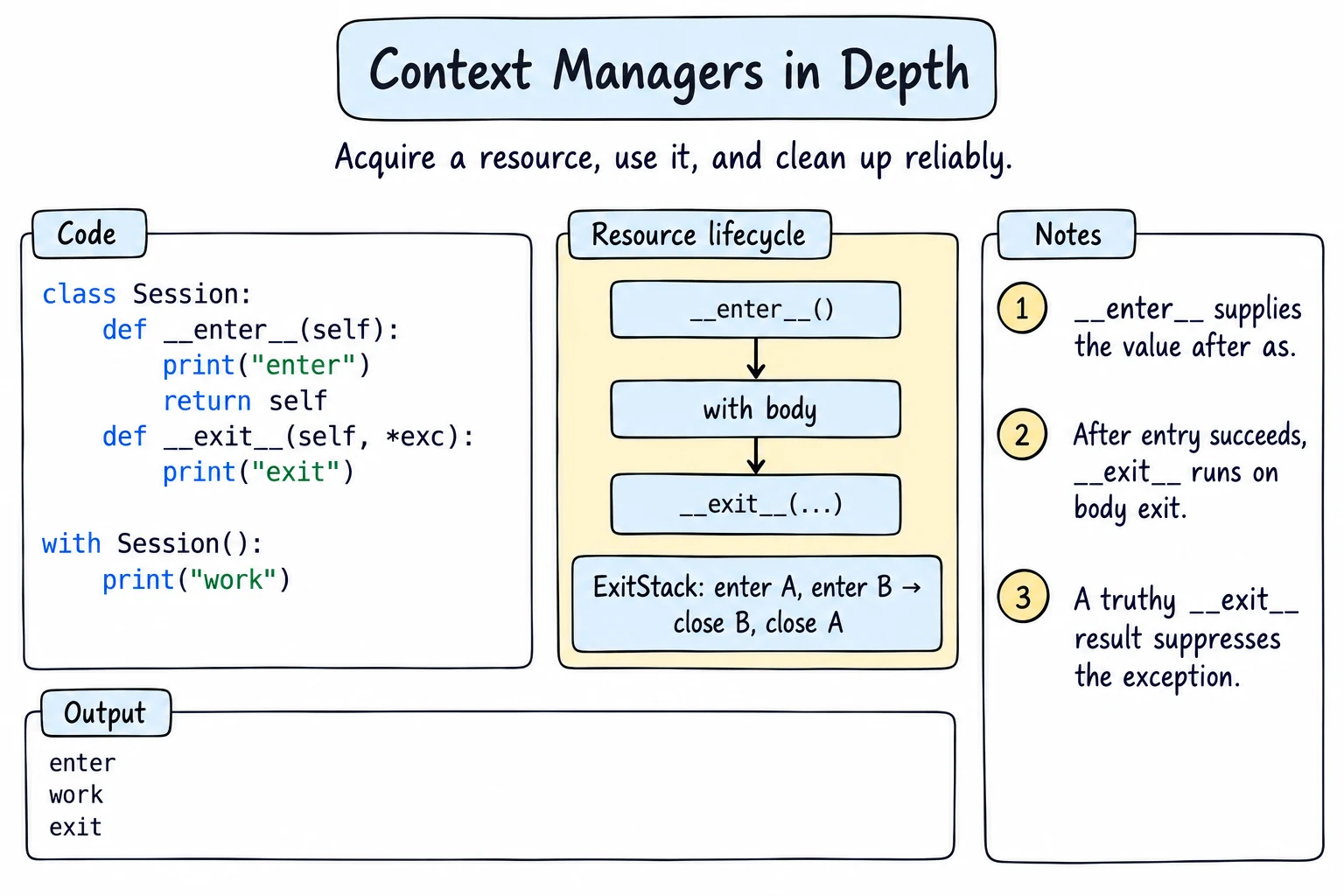
with EXPR as name: does four things:
- Evaluates
EXPRto get the manager. - Calls
__enter__()and binds its return value toname. - Runs the block.
- Calls
__exit__(exc_type, exc, tb): threeNones after a normal finish, otherwise the exception class, object and traceback.
Here is a class-based Timer:
import time

class Timer:
    def __init__(self, label):
        self.label = label
        self.elapsed = None

    def __enter__(self):
        self.start = time.perf_counter()
        return self                      # this becomes `t` below

    def __exit__(self, exc_type, exc, tb):
        self.elapsed = time.perf_counter() - self.start
        print(f"{self.label}: {self.elapsed:.1f} s, error: {exc_type}")

with Timer("load prices") as t:
    time.sleep(0.1)

print("Saved on the object:", round(t.elapsed, 1))load prices: 0.1 s, error: None
Saved on the object: 0.1Returning self is the usual choice, but __enter__ can return anything, like the dictionary in Transaction below.
Swallow or propagate
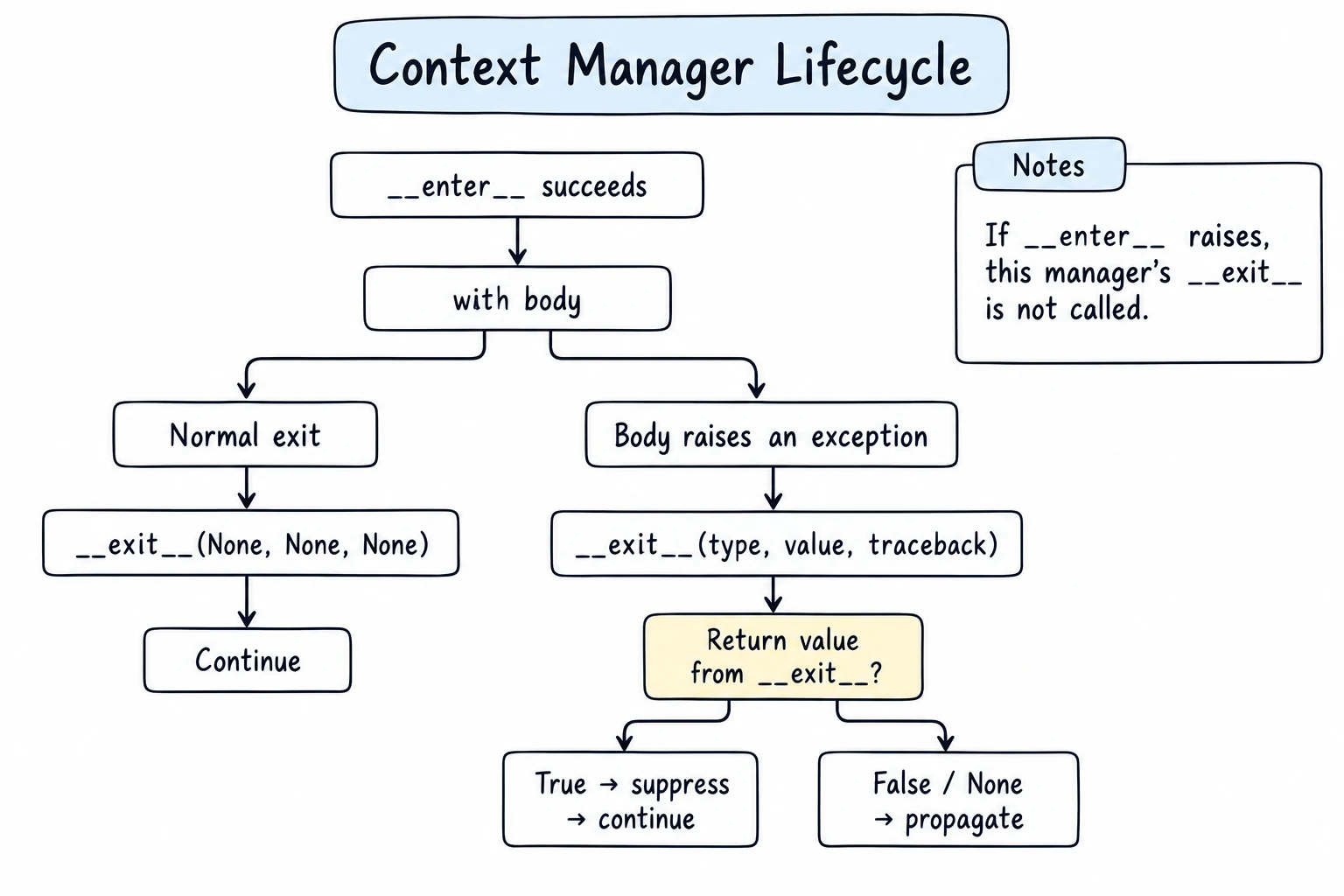
If __exit__ returns a true value, the exception is swallowed. None or False lets it propagate. Most managers return nothing, so errors pass through.
This Transaction works on a copy of the accounts, commits on success, rolls back on error, and swallows only ValueError:
class Transaction:
    def __init__(self, accounts):
        self.accounts = accounts

    def __enter__(self):
        self.draft = dict(self.accounts)
        return self.draft

    def __exit__(self, exc_type, exc, tb):
        if exc_type is None:
            self.accounts.update(self.draft)
            print("commit")
            return False
        print(f"rollback: {exc}")
        return issubclass(exc_type, ValueError)   # True swallows it

accounts = {"Aziza": 500_000, "Bobur": 100_000}

with Transaction(accounts) as draft:
    draft["Aziza"] -= 200_000
    draft["Bobur"] += 200_000
print(accounts)

with Transaction(accounts) as draft:
    draft["Bobur"] -= 900_000
    if draft["Bobur"] < 0:
        raise ValueError("not enough money")
print(accounts)

try:
    with Transaction(accounts) as draft:
        draft["Dilnoza"] += 1
except KeyError as e:
print("still raised:", repr(e))commit
{'Aziza': 300000, 'Bobur': 300000}
rollback: not enough money
{'Aziza': 300000, 'Bobur': 300000}
rollback: 'Dilnoza'
still raised: KeyError('Dilnoza')The ValueError was swallowed; the KeyError reached the try.
When __enter__ raises
If __enter__ raises, the block never runs and __exit__ is not called. Any clean-up for a half-finished setup must happen inside __enter__:
import os

class ChangeDirectory:
    def __init__(self, path):
        self.path = path

    def __enter__(self):
        self.old = os.getcwd()
        os.chdir(self.path)              # may raise
        return self.path

    def __exit__(self, exc_type, exc, tb):
        os.chdir(self.old)
        print("back in the old folder")

os.makedirs("reports", exist_ok=True)
with ChangeDirectory("reports"):
    print("inside:", os.path.basename(os.getcwd()))

try:
    with ChangeDirectory("no_such_folder"):
        print("never printed")
except FileNotFoundError:
print("__enter__ failed, __exit__ skipped")inside: reports
back in the old folder
__enter__ failed, __exit__ skippedExitStack: any number of resources
Commas in one with need a fixed count. When the list of files comes from data, use contextlib.ExitStack. enter_context(cm) enters a manager and remembers it; at the end everything is closed in reverse order, even if the third open fails. callback(func, *args) registers any function as clean-up:
from contextlib import ExitStack

cities = ["tashkent", "samarkand", "bukhara"]

with ExitStack() as stack:
    files = [stack.enter_context(open(f"{c}.txt", "w", encoding="utf-8")) for c in cities]
    stack.callback(print, "all files closed")
    for city, f in zip(cities, files):
        f.write(f"report for {city.title()}\n")
    print("open files:", len(files))

print("closed:", all(f.closed for f in files))open files: 3
all files closed
closed: TrueThe callback ran first because it was registered last.
Handy managers in contextlib
You already know suppress. Three more:
closing(obj)callsobj.close()at the end, for objects withclose()but nowithsupport.redirect_stdout(target)sendsprintoutput elsewhere, such as anio.StringIO.nullcontext(value)does nothing: a stand-in when a manager is optional.
import io
from contextlib import closing, nullcontext, redirect_stdout

class Connection:
    def close(self):
        print("connection closed")

with closing(Connection()):
    print("sending data")

buffer = io.StringIO()
with redirect_stdout(buffer):
    print("Samsa: 8,000 som")
print("captured:", buffer.getvalue().strip())

def report(lock=None):
    with lock if lock is not None else nullcontext():
        print("report written")

report()sending data
connection closed
captured: Samsa: 8,000 som
report writtenSingle-use, reusable and reentrant
A reusable manager works in several with statements in a row; a reentrant one even works inside itself (suppress, redirect_stdout). A @contextmanager object wraps one generator, which runs only once, so it is single-use. Reusing it gives an unhelpful error:
from contextlib import contextmanager

@contextmanager
def tag(name):
    print(f"<{name}>")
    yield
    print(f"</{name}>")

bold = tag("b")
with bold:
    print("Plov")
with bold:          # second use of the same object
print("Lagman")AttributeError: '_GeneratorContextManager' object has no attribute 'args'Call tag("b") again for each with. If the generator never reaches yield (say, it sits inside a false if), you get RuntimeError: generator didn't yield. Every path must yield exactly once.
async with
Code that waits on the network uses asynchronous managers with __aenter__ and __aexit__, entered with async with. contextlib.asynccontextmanager builds one from an async def generator, just like @contextmanager. Async and await uses them.
Context managers as a design tool
Any "change, then undo" pair fits a manager: a temporary setting, an indent level, a lock (with lock: acquires and always releases it; you'll meet locks in Threads and Processes):
from contextlib import contextmanager

settings = {"currency": "som", "debug": False}

@contextmanager
def temporary_setting(key, value):
    old = settings[key]
    settings[key] = value
    try:
        yield
    finally:
        settings[key] = old

with temporary_setting("debug", True):
    print("inside:", settings["debug"])
print("after:", settings["debug"])inside: True
after: FalseTry it
Make the transaction swallow KeyError too, or raise an error before the commit and watch the balances.
Common mistakes
1. Forgetting to return self from __enter__
class Timer:
    def __enter__(self):
        self.start = 0          # no return, so it returns None

    def __exit__(self, exc_type, exc, tb):
        pass

with Timer() as t:
print(t.start)AttributeError: 'NoneType' object has no attribute 'start'Fix: end __enter__ with return self (or the object the block should use).
2. An __exit__ that returns True by accident
class Quiet:
    def __enter__(self):
        return self

    def __exit__(self, exc_type, exc, tb):
        print("cleaning up")
        return True               # Bad: hides every error

with Quiet():
    total = 150_000 / 0
print("looks fine, but the total was never computed")cleaning up
looks fine, but the total was never computedFix: return nothing from __exit__ unless you check exc_type and swallow one specific exception on purpose.
3. Clean-up code that raises
class Upload:
    def __enter__(self):
        return self

    def __exit__(self, exc_type, exc, tb):
        self.connection.close()   # there is no self.connection

with Upload():
raise ValueError("file too big")Traceback (most recent call last):
ValueError: file too big
During handling of the above exception, another exception occurred:
Traceback (most recent call last):
AttributeError: 'Upload' object has no attribute 'connection'The clean-up error replaces the real one; the ValueError survives only as context. Fix: keep __exit__ simple, and guard anything in it that may fail.
4. @contextmanager without try/finally
from contextlib import contextmanager

settings = {"debug": False}

@contextmanager
def debug_on():
    settings["debug"] = True
    yield                         # Bad: no try/finally
    settings["debug"] = False

try:
    with debug_on():
        raise ValueError("bad input")
except ValueError:
    pass
print("debug:", settings["debug"])debug: TrueThe error is raised at the yield, so the line after it never runs. Fix: wrap yield in try/finally, as temporary_setting does.
Practice
1. A Timer class
Write a Timer class whose __enter__ returns the timer and whose __exit__ stores elapsed. Time sum(range(100_000)), print the total, and print whether elapsed is a non-negative float (the value itself changes every run).
Solution
import time

class Timer:
    def __enter__(self):
        self.start = time.perf_counter()
        return self

    def __exit__(self, exc_type, exc, tb):
        self.elapsed = time.perf_counter() - self.start

with Timer() as t:
    total = sum(range(100_000))

print(total)
print(isinstance(t.elapsed, float) and t.elapsed >= 0)4999950000
True2. Nested sections
Write a class Section that, on enter, prints its title indented by a class-level depth and adds one to depth; on exit it subtracts one. Nest Report, Tashkent and Sales, and print an amount inside.
Solution
class Section:
    depth = 0

    def __init__(self, title):
        self.title = title

    def __enter__(self):
        print("  " * Section.depth + self.title)
        Section.depth += 1
        return self

    def __exit__(self, exc_type, exc, tb):
        Section.depth -= 1

with Section("Report"):
    with Section("Tashkent"):
        with Section("Sales"):
print(" " * Section.depth + "1,200,000 som")Report
Tashkent
Sales
1,200,000 som3. temporary_attr
Write a @contextmanager function temporary_attr(obj, name, value) that sets an attribute and restores the old value on exit, even when the block raises. Test it on a Shop with discount = 0: inside, print the discount (15) and raise ValueError; then print the error and the discount.
Solution
from contextlib import contextmanager

@contextmanager
def temporary_attr(obj, name, value):
    old = getattr(obj, name)
    setattr(obj, name, value)
    try:
        yield obj
    finally:
        setattr(obj, name, old)

class Shop:
    discount = 0

shop = Shop()
try:
    with temporary_attr(shop, "discount", 15):
        print("during sale:", shop.discount)
        raise ValueError("register crashed")
except ValueError as e:
    print("error:", e)
print("after sale:", shop.discount)during sale: 15
error: register crashed
after sale: 04. Write to many files
Given names = ["aziza.txt", "bobur.txt", "jasur.txt"], use ExitStack to open all of them for writing and write Exam on Monday to each. Register a callback that prints closed N files, then print the contents of each file.
Solution
from contextlib import ExitStack
from pathlib import Path

names = ["aziza.txt", "bobur.txt", "jasur.txt"]

with ExitStack() as stack:
    files = [stack.enter_context(open(n, "w", encoding="utf-8")) for n in names]
    stack.callback(print, f"closed {len(files)} files")
    for f in files:
        f.write("Exam on Monday\n")

for n in names:
print(n, "->", Path(n).read_text(encoding="utf-8").strip())closed 3 files
aziza.txt -> Exam on Monday
bobur.txt -> Exam on Monday
jasur.txt -> Exam on Monday5. Suppress and log
Write a class ErrorLog that takes exception types, swallows only those, and records each one as "TypeName: message" in a records list. Other exceptions must propagate. Reuse one ErrorLog object for three blocks: int("abc"), {}["plov"], and 1 / 0 (not in the list). Print the error that escaped, then the records.
Solution
class ErrorLog:
    def __init__(self, *types):
        self.types = types
        self.records = []

    def __enter__(self):
        return self

    def __exit__(self, exc_type, exc, tb):
        if exc_type is not None and issubclass(exc_type, self.types):
            self.records.append(f"{exc_type.__name__}: {exc}")
            return True
        return False

log = ErrorLog(ValueError, KeyError)

with log:
    int("abc")
with log:
    {}["plov"]
try:
    with log:
        1 / 0
except ZeroDivisionError as e:
    print("escaped:", e)

for record in log.records:
print(record)escaped: division by zero
ValueError: invalid literal for int() with base 10: 'abc'
KeyError: 'plov'issubclass accepts a tuple of classes. This class keeps no per-block state, so it is reusable, unlike a @contextmanager object.
Recap
withbinds the return value of__enter__, then calls__exit__(exc_type, exc, tb)however the block ends.- A true return from
__exit__swallows the exception;None/Falselets it propagate. If__enter__raises,__exit__never runs. ExitStackenters any number of managers and callbacks and closes them in reverse order.closing,redirect_stdoutandnullcontextcover objects withoutwithsupport, captured output and optional managers.- A
@contextmanagerobject is single-use; put itsyieldinsidetry/finally. - Package any "change, then undo" pair, such as settings and locks, as a manager.