

Class Attributes, Class Methods, and Static Methods
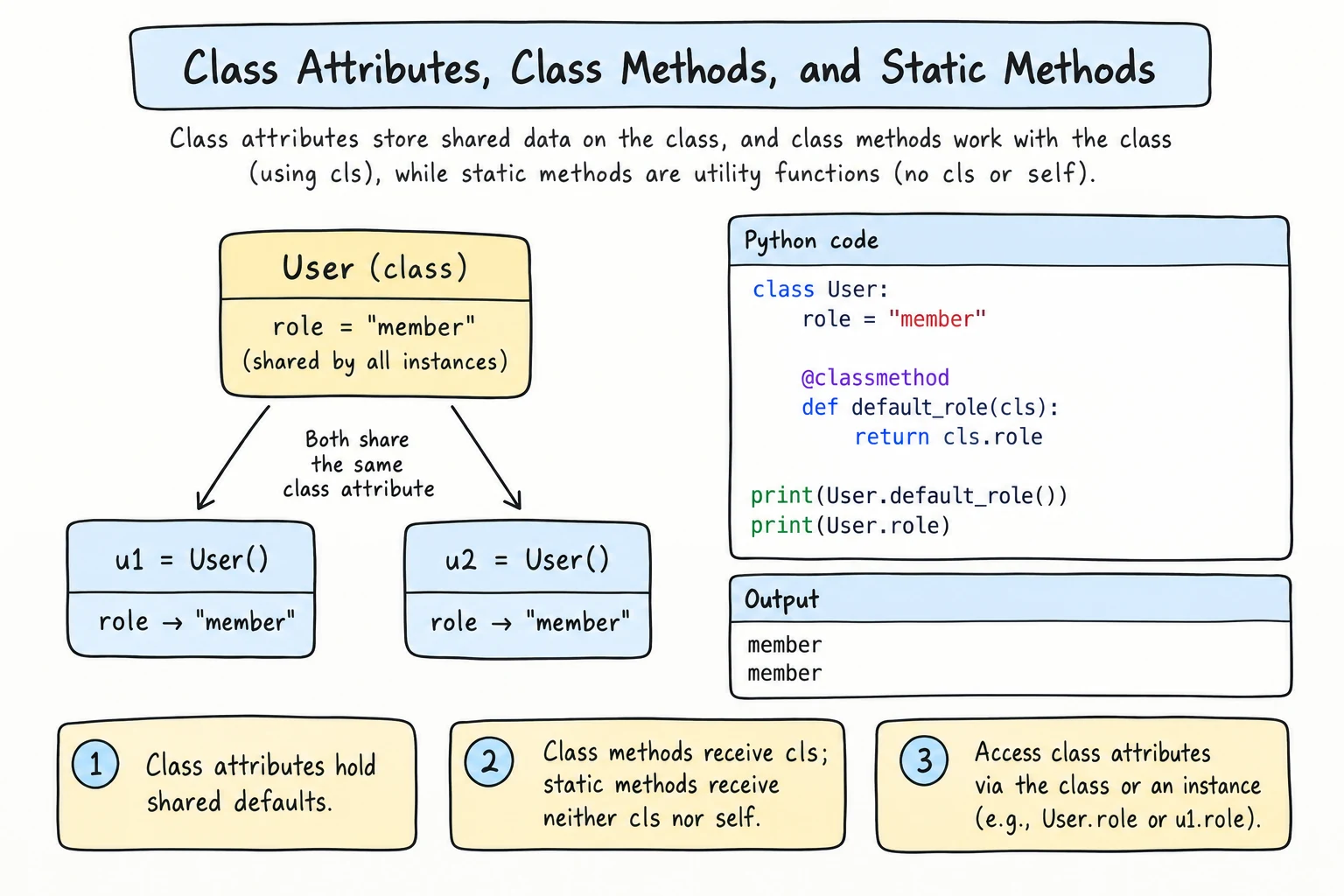
What you'll learn
- The difference between instance attributes (one per object) and class attributes (shared by all)
- How Python looks up an attribute, and the shadowing trap that follows from it
- How
@classmethodcreates alternative constructors such asfrom_string() - How
@staticmethodgroups helper functions with their class, and how to choose between the three kinds of methods
Why it matters
Some information belongs to each object, like an account's balance. Other information belongs to the whole class, like a bank's interest rate. Classes also often need several ways to create objects, from separate values or from a line of text. Real libraries use these tools constantly.
Class attributes
A variable in the class body, outside any method, is a class attribute. All instances can read it, and assigning through the class name changes it for everyone:
class BankAccount:
    interest_rate = 0.14              # class attribute: shared by all accounts

    def __init__(self, owner, balance):
        self.owner = owner            # instance attributes: one per account
        self.balance = balance

    def yearly_interest(self):
        return self.balance * self.interest_rate

aziza = BankAccount("Aziza", 1000000)
bekzod = BankAccount("Bekzod", 250000)
print(BankAccount.interest_rate, aziza.interest_rate)
print(aziza.yearly_interest(), bekzod.yearly_interest())

BankAccount.interest_rate = 0.16      # the central bank changed the rate
print(aziza.yearly_interest(), bekzod.yearly_interest())0.14 0.14
140000.0 35000.0
160000.0 40000.0The value lives in one place, so accounts can't disagree about it. Class attributes are also the natural home for constants such as MAX_TOPPINGS = 5, named in UPPER_CASE.
How Python finds an attribute, and the shadowing trap
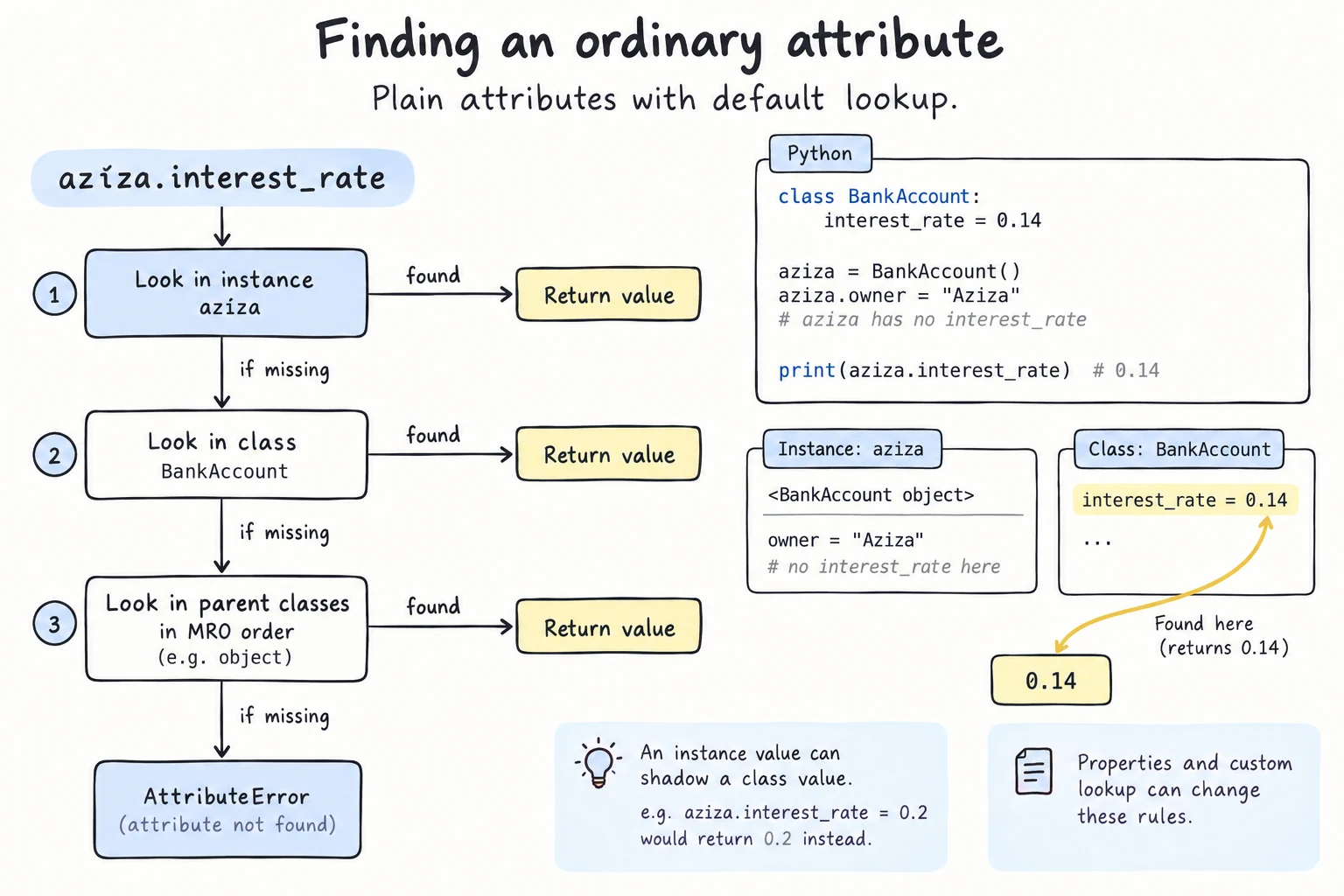
For aziza.interest_rate, Python looks on the object first, then on its class, and raises AttributeError only if neither has it. So reading a class attribute through an instance is fine. Assigning through an instance is different: it never changes the class attribute. It creates a new instance attribute with the same name, which hides (shadows) the class value for that one object:
class BankAccount:
    interest_rate = 0.14

    def __init__(self, owner):
        self.owner = owner

aziza = BankAccount("Aziza")
bekzod = BankAccount("Bekzod")

aziza.interest_rate = 0.20            # creates an instance attribute on aziza only
print(aziza.interest_rate, bekzod.interest_rate, BankAccount.interest_rate)
print(vars(aziza), vars(bekzod))0.2 0.14 0.14
{'owner': 'Aziza', 'interest_rate': 0.2} {'owner': 'Bekzod'}Now aziza ignores later changes to BankAccount.interest_rate. Occasionally that's intended (a VIP rate), but usually it's an accident. Rule: change a class attribute through the class name, or through cls in a class method.
Class methods: @classmethod
A class method receives the class as its first argument, named cls, instead of the instance. You create one with the @classmethod decorator, a line starting with @ just above def. Its most common use is an alternative constructor that creates objects from a different kind of input. cls(...) calls the class, exactly like Student(...), and runs __init__:
class Student:
    def __init__(self, name, grade_level, city):
        self.name = name
        self.grade_level = grade_level
        self.city = city

    @classmethod
    def from_string(cls, text):
        """Create a student from text like 'Aziza,9,Tashkent'."""
        name, grade, city = text.split(",")
        return cls(name.strip(), int(grade), city.strip())

    def describe(self):
        return f"{self.name} (grade {self.grade_level}, {self.city})"

print(Student("Farrukh", 10, "Bukhara").describe())
print(Student.from_string("Aziza, 9, Samarkand").describe())Farrukh (grade 10, Bukhara)
Aziza (grade 9, Samarkand)The regular constructor stays simple, while from_string() parses one input format (date.fromisoformat() works the same way). Using cls rather than the class name means a subclass gets a working from_string() (see Inheritance and super()). Class methods are also the place for validated class-wide settings: cls.interest_rate = rate assigns on the class, so shadowing can't happen.
Static methods: @staticmethod
A static method receives neither the instance nor the class. It's an ordinary function that lives inside the class because it's closely related to it:
class TemperatureSensor:
    def __init__(self):
        self.readings = []

    @staticmethod
    def is_valid(celsius):
        return -60 <= celsius <= 60

    def record(self, celsius):
        if not self.is_valid(celsius):
            raise ValueError(f"Sensor error: {celsius} C")
        self.readings.append(celsius)

print(TemperatureSensor.is_valid(150))     # usable without any sensor
sensor = TemperatureSensor()
sensor.record(31.5)
print(sensor.readings)False
[31.5]Static methods are only a matter of organization: is_valid() could just as well be a module-level function. Put a helper in the class when mainly the class uses it.
Choosing the right kind of method
| Kind | Decorator | First parameter | Typical uses |
|---|---|---|---|
| instance method | none | self (the object) | almost everything: deposit(), describe() |
| class method | @classmethod | cls (the class) | alternative constructors, class-wide settings |
| static method | @staticmethod | none | validation and conversion helpers |
Outside the class, call class and static methods through the class name (TemperatureSensor.is_valid(150)). Inside its methods, self.is_valid(celsius) is just as normal, and lets a subclass replace the helper.
Try it
Create more students with from_string(), then add a from_dict() class method and print the counter.
Common mistakes
1. Updating a class counter through self
class Student:
    count = 0

    def __init__(self, name):
        self.name = name
        self.count += 1               # Bad: creates self.count, the class value stays 0

a = Student("Aziza")
b = Student("Bekzod")
print(Student.count, a.count, b.count)0 1 1self.count += 1 reads the class value, then writes an instance attribute. Fix: Student.count += 1.
2. A list as a class attribute
class ShoppingCart:
    items = []                        # Bad: one list for every cart

    def add(self, item):
        self.items.append(item)       # no assignment, so the shared list changes

aziza_cart = ShoppingCart()
bekzod_cart = ShoppingCart()
aziza_cart.add("tea")
bekzod_cart.add("bread")
print(aziza_cart.items)['tea', 'bread']append() changed the one shared list. Fix: self.items = [] in __init__.
3. Forgetting the @classmethod decorator
class Student:
    def __init__(self, name, grade):
        self.name = name
        self.grade = grade

    def from_string(cls, text):          # missing @classmethod
        name, grade = text.split(",")
        return cls(name, int(grade))

s = Student.from_string("Aziza,9")TypeError: Student.from_string() missing 1 required positional argument: 'text'Without the decorator, Python passed "Aziza,9" as cls and found nothing for text. Fix: add @classmethod above def.
4. Using self inside a static method
class TemperatureSensor:
    def __init__(self, location):
        self.location = location

    @staticmethod
    def label(celsius):
        return f"{self.location}: {celsius} C"

sensor = TemperatureSensor("Tashkent")
print(sensor.label(30))NameError: name 'self' is not definedA static method doesn't receive the object. If it needs instance data, make it a regular method.
Practice
1. Shared tax rate
Write a Product class with a class attribute TAX_RATE = 0.12, instance attributes name and price, and a method price_with_tax() that returns a rounded whole number. For a Notebook costing 15,000, print Notebook 16800, change the rate to 0.15 through the class, and print again.
Solution
class Product:
    TAX_RATE = 0.12

    def __init__(self, name, price):
        self.name = name
        self.price = price

    def price_with_tax(self):
        return round(self.price * (1 + self.TAX_RATE))

notebook = Product("Notebook", 15000)
print(notebook.name, notebook.price_with_tax())
Product.TAX_RATE = 0.15
print(notebook.name, notebook.price_with_tax())Notebook 16800
Notebook 172502. Taxi IDs
Write a Taxi class that gives each new taxi an ID like "TX-1", "TX-2", ... and counts how many taxis exist. Create taxis for Farrukh, Aziza, and Bekzod, print each ID and driver (TX-1 Farrukh), and finally Taxis: 3.
Solution
class Taxi:
    total = 0

    def __init__(self, driver):
        Taxi.total += 1
        self.taxi_id = f"TX-{Taxi.total}"
        self.driver = driver

fleet = [Taxi("Farrukh"), Taxi("Aziza"), Taxi("Bekzod")]
for taxi in fleet:
    print(taxi.taxi_id, taxi.driver)
print("Taxis:", Taxi.total)TX-1 Farrukh
TX-2 Aziza
TX-3 Bekzod
Taxis: 33. Time from a string
Write a ClockTime class (hours, minutes) with a static is_valid(hours, minutes), an __init__ that raises ValueError(f"Invalid time: {hours}:{minutes}"), a class method from_string("14:30"), and minutes_until(other). For a train from "07:28" to "09:38", print The trip takes 2 h 10 min. Then try ClockTime.from_string("25:10") and print Error: with the message.
Solution
class ClockTime:
    def __init__(self, hours, minutes):
        if not self.is_valid(hours, minutes):
            raise ValueError(f"Invalid time: {hours}:{minutes}")
        self.hours = hours
        self.minutes = minutes

    @staticmethod
    def is_valid(hours, minutes):
        return 0 <= hours < 24 and 0 <= minutes < 60

    @classmethod
    def from_string(cls, text):
        hours, minutes = text.split(":")
        return cls(int(hours), int(minutes))

    def minutes_until(self, other):
        return (other.hours - self.hours) * 60 + other.minutes - self.minutes

departure = ClockTime.from_string("07:28")
arrival = ClockTime.from_string("09:38")
trip = departure.minutes_until(arrival)
print(f"The trip takes {trip // 60} h {trip % 60} min")

try:
    ClockTime.from_string("25:10")
except ValueError as error:
print("Error:", error)The trip takes 2 h 10 min
Error: Invalid time: 25:104. Design a class: employees
Design an Employee class, deciding which kind of attribute or method each part should be:
Employees have a name, a position, and a monthly salary. Everyone gets the same yearly raise percentage (currently 8%), which can be changed only to 0-30. Employees are created from CSV lines, and
apply_raise()raises one salary.
It must work with this driver code and print exactly this output:
dilnoza = Employee.from_csv_line("Dilnoza Rahimova,Designer,9500000")
Employee.set_raise_percent(10)
dilnoza.apply_raise()
print(dilnoza.name, dilnoza.position, dilnoza.salary)
try:
    Employee.set_raise_percent(50)
except ValueError as error:
print("Error:", error)Dilnoza Rahimova Designer 10450000
Error: Raise must be between 0 and 30 percentSolution
class Employee:
    raise_percent = 8

    def __init__(self, name, position, salary):
        self.name = name
        self.position = position
        self.salary = salary

    @staticmethod
    def is_valid_percent(percent):
        return 0 <= percent <= 30

    @classmethod
    def set_raise_percent(cls, percent):
        if not cls.is_valid_percent(percent):
            raise ValueError("Raise must be between 0 and 30 percent")
        cls.raise_percent = percent

    @classmethod
    def from_csv_line(cls, line):
        name, position, salary = line.split(",")
        return cls(name, position, int(salary))

    def apply_raise(self):
        self.salary = round(self.salary * (100 + self.raise_percent) / 100)

dilnoza = Employee.from_csv_line("Dilnoza Rahimova,Designer,9500000")
Employee.set_raise_percent(10)
dilnoza.apply_raise()
print(dilnoza.name, dilnoza.position, dilnoza.salary)
try:
    Employee.set_raise_percent(50)
except ValueError as error:
    print("Error:", error)
5. Currency exchange desk
Write a Money class (amount, currency) with a class attribute RATES = {"som": 1, "usd": 12600, "eur": 13700} (rates to som), an __init__ that raises ValueError(f"Unknown currency: {currency}"), a class method from_string("250 usd"), to(currency) returning a new Money rounded to 2 decimals, and describe() returning 250.00 USD. Print 250.00 USD = 229.93 EUR, then try "10 gbp" and print Error: with the message.
Solution
class Money:
    RATES = {"som": 1, "usd": 12600, "eur": 13700}

    def __init__(self, amount, currency):
        currency = currency.lower()
        if currency not in self.RATES:
            raise ValueError(f"Unknown currency: {currency}")
        self.amount = amount
        self.currency = currency

    @classmethod
    def from_string(cls, text):
        amount, currency = text.split()
        return cls(float(amount), currency)

    def to(self, currency):
        in_som = self.amount * self.RATES[self.currency]
        return type(self)(round(in_som / self.RATES[currency.lower()], 2), currency)

    def describe(self):
        return f"{self.amount:,.2f} {self.currency.upper()}"

cash = Money.from_string("250 usd")
print(cash.describe(), "=", cash.to("eur").describe())

try:
    Money.from_string("10 gbp")
except ValueError as error:
print("Error:", error)250.00 USD = 229.93 EUR
Error: Unknown currency: gbpAn instance method has no cls, so to() uses type(self), the object's own class, rather than hard-coding Money.
Recap
- Class attributes live in the class body and are shared by all instances; instance attributes belong to one object.
- Python looks up an attribute on the object first, then on the class. Assigning through an instance shadows the class attribute, so change it through the class name or
cls. - A mutable class attribute is shared by everyone. Create per-object lists in
__init__. - Most methods are regular instance methods; use the other two only when needed.
@classmethodmethods receivecls: use them for alternative constructors and class-wide settings.@staticmethodmethods receive nothing automatically.