

Choosing Test Cases
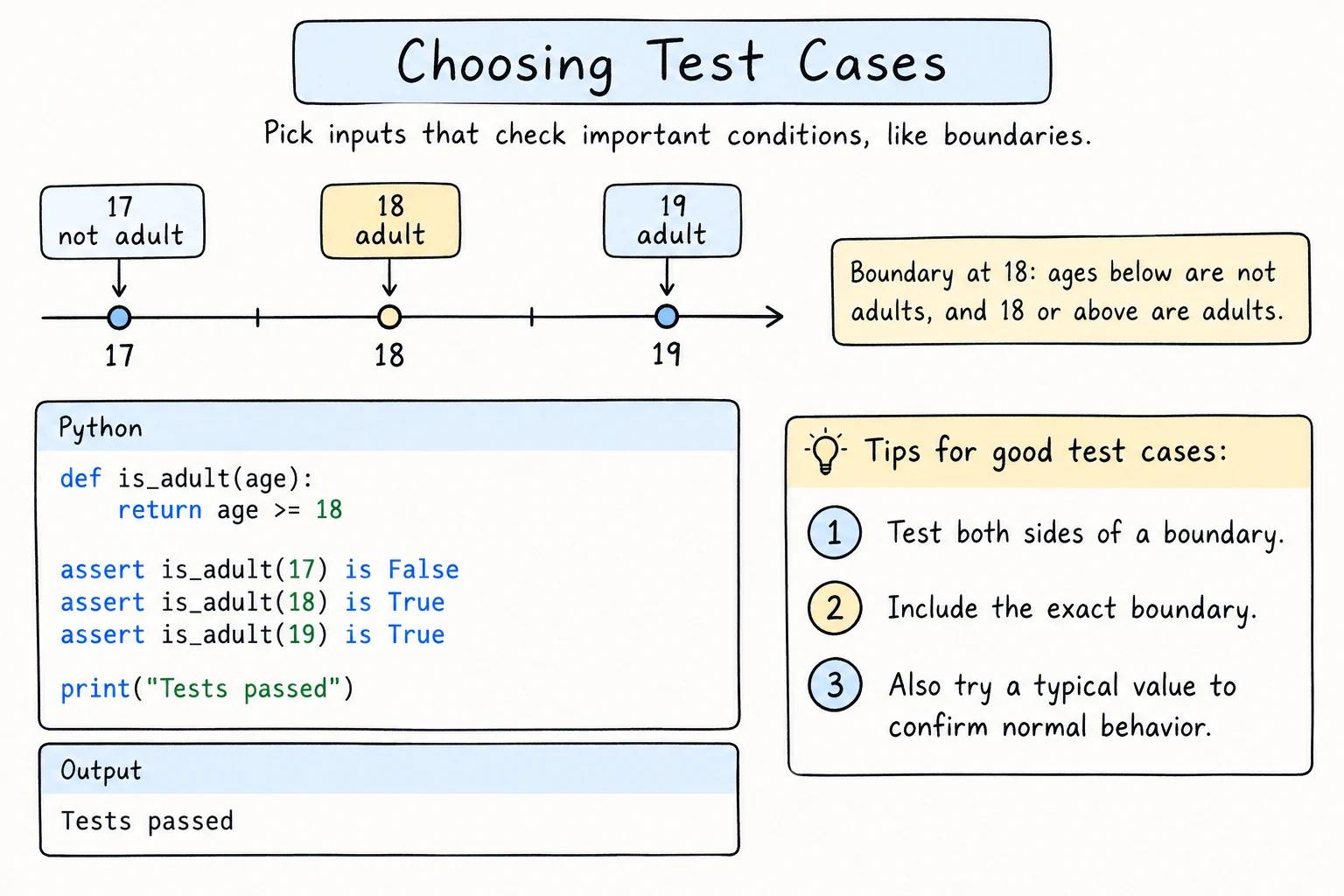
What you'll learn
- The three kinds of cases: normal, edge, and invalid
- How equivalence classes and branches tell you which inputs to pick
- How to write many cases as a table and check them in a loop
- How to test code that uses randomness, today's date, or
input() - How to write a regression test, and when you have enough tests
Why it matters
Writing assert is easy. Knowing what to assert is the real skill: a function can pass ten tests and still be wrong if all ten check the same easy case. So a tester asks "How could this break?" Many bugs hide at limits like 0 or "exactly 18", in empty lists, and in inputs nobody expected.
Three kinds of test cases
A museum in Bukhara charges nothing under 7, 20,000 som under 18, and 40,000 som for adults; a negative age is an error. For almost every function, you want cases from three groups:
| Kind | Question | Examples for ticket_price |
|---|---|---|
| Normal | Does the usual case work? | 30, 12, 3 |
| Edge (boundary) | Does it work at the limits? | 0, 6, 7, 17, 18 |
| Invalid | Does it reject bad input correctly? | -1 |
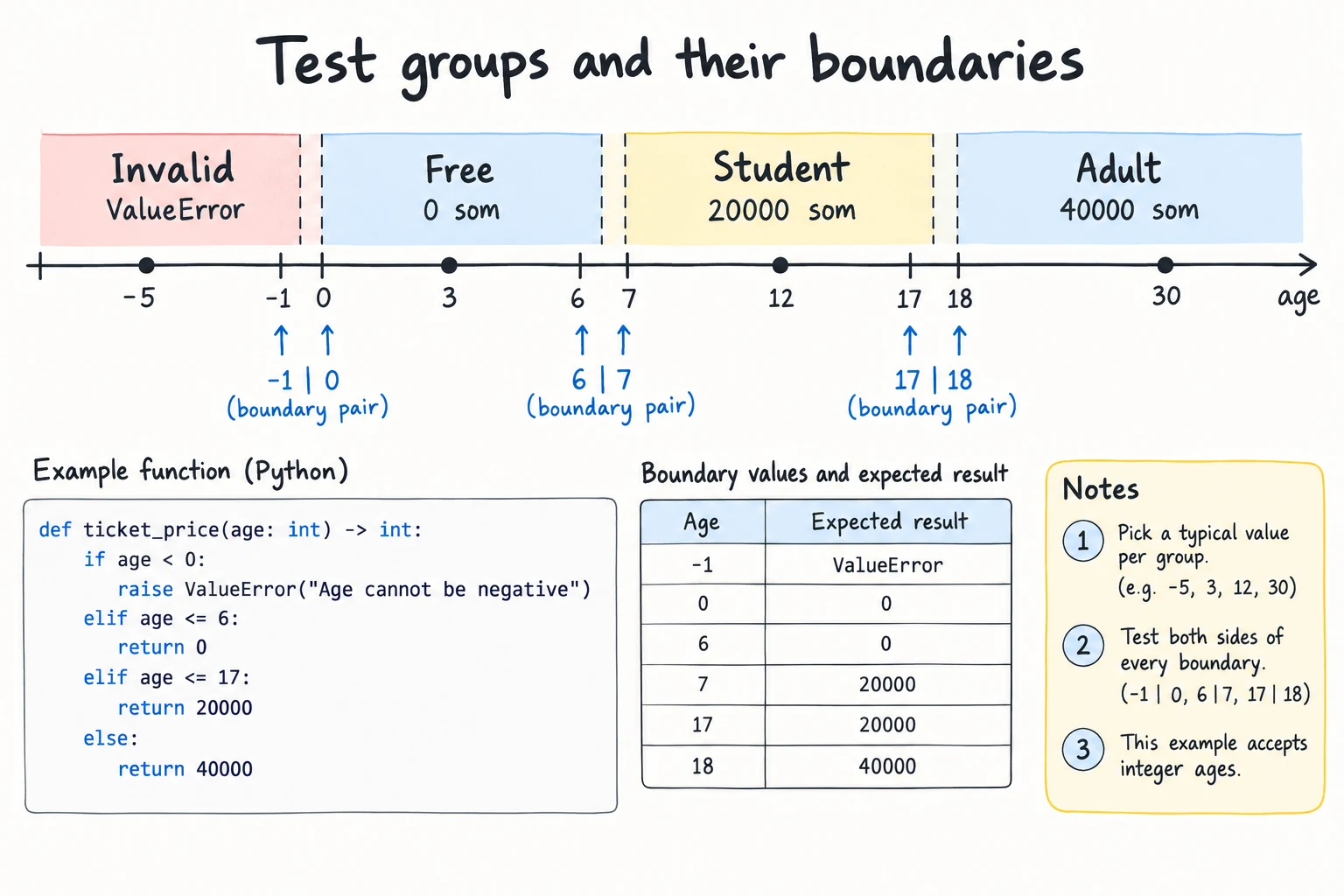
Invalid cases prove the function fails in the way you promised.
Equivalence classes and branches
You cannot test every age, and you do not need to: 25, 40, and 63 go through the same code. Split the inputs into equivalence classes, groups of values the function treats the same way, and pick one typical value from each, plus the values at the edges between groups:
    invalid   |  free   |  student   |       adult
  ... -2 -1   | 0 ... 6 | 7 ... 17   | 18 ... 120 ...
                ^     ^   ^     ^      ^
              edges: 0, 6, 7, 17, 18 (and -1 just outside)
A second way is to read the code: every if, elif, and else is a branch, and each needs at least one test. Classes (from the description) find cases the code forgot; branches (from the code) find paths the description never mentioned.
A table of cases
Instead of one assert per case, put the cases in a list of (input, expected) tuples and loop over them:
def ticket_price(age):
    if age < 0:
        raise ValueError("age cannot be negative")
    if age < 7:
        return 0          # small children are free
    if age < 18:
        return 20000      # students
    return 40000          # adults

def test_ticket_price():
    cases = [
        (30, 40000),   # normal adult
        (12, 20000),   # normal student
        (0, 0),        # edge: youngest possible
        (6, 0),        # edge: last free age
        (7, 20000),    # edge: first student age
        (18, 40000),   # edge: first adult age
    ]
    for age, expected in cases:
        result = ticket_price(age)
        assert result == expected, f"age {age}: expected {expected}, got {result}"

test_ticket_price()
print("All tests passed")All tests passedAdding a case is one line, the comments say why each row is there, and the message names the failing case. The invalid age -1 gets its own try / except / else test, as in Testing with assert, because its promise is an exception.
Edge cases that find real bugs
A shop in Tashkent gives 5% off orders from 100,000 som and 10% off orders from 500,000 som. This version passes a quick check with 200000:
def discount_percent(total):
    if total >= 100000:
        return 5
    elif total >= 500000:
        return 10
    return 0

cases = [(50000, 0), (200000, 5), (800000, 10),   # one value per class
         (99999, 0), (100000, 5), (500000, 10)]   # edges

for total, expected in cases:
    result = discount_percent(total)
    if result != expected:
print(f"{total}: expected {expected}%, got {result}%")800000: expected 10%, got 5%
500000: expected 10%, got 5%The conditions are in the wrong order: every total of 500,000 or more also passes >= 100000, so the 10% branch can never run. One value from each class found the dead code.
A checklist of edge cases
When you are not sure what to test, walk through this list:
| Input type | Edge cases to try |
|---|---|
| Numbers | 0, -1, very large, one below / at / one above each limit |
| Strings | "", only spaces, upper vs lower case, leading/trailing spaces |
| Lists / dicts | empty, one item, duplicates, reverse sorted |
| Files / JSON | missing file, empty file, missing key |
Off-by-one errors (< versus <=, range(n) versus range(n + 1)) are among the most common bugs, so a limit of 18 means testing 17, 18, and 19.
Randomness, dates, and input()
A test must give the same answer every run, but code that calls random, date.today(), or input() does not. Pass the changing thing in as a parameter, with the real source as the default:
import random
from datetime import date

def is_weekend(today=None):
    if today is None:
        today = date.today()
    return today.weekday() >= 5

def pick_winner(names, rng=random):
    return rng.choice(names)

def test_is_weekend():
    assert is_weekend(date(2026, 9, 19))        # a Saturday
    assert not is_weekend(date(2026, 9, 16))    # a Wednesday

def test_pick_winner():
    names = ["Aziza", "Bekzod", "Dilnoza", "Farrukh"]
    first = pick_winner(names, random.Random(42))
    second = pick_winner(names, random.Random(42))
    assert first == second, "the same seed should give the same winner"

test_is_weekend()
test_pick_winner()
print("All tests passed")All tests passedThe program gets today; the test picks the day. Likewise, pick_winner uses the random module unless a test passes random.Random(42), a separate random number generator with its own fixed seed. Both have choice(), and the seeded one picks the same name every run. For input(), keep the call in the outer code and test a function that receives the typed text.
Write the test before fixing the bug
When Dilnoza reports that average([]) crashes the report page with ZeroDivisionError, first write assert average([]) == 0.0 in a test and watch it fail: that proves the test really catches the bug. Then fix the function until the test passes. This regression test stays forever, so the bug cannot quietly come back.
You have enough tests when every class, boundary, branch, promised error, and fixed bug has one. Ten well-chosen tests beat a hundred random ones.
Try it
Find the bug the edge cases reveal, and fix it.
Common mistakes
1. Calculating the expected value with the same logic
def tax(price):
    return price * 12 // 10      # bug: should be // 100

price = 15000
assert tax(price) == price * 12 // 10   # Bad: copies the code, bug and all
assert tax(price) == 1800 # Good: an answer you worked out yourselfAssertionErrorThe first assert passed, because it repeats the bug; only the second catches it. Fix: write expected values as plain numbers you worked out yourself.
2. A loop that hides which case failed
def double(n):
    return n + n if n > 0 else 0

cases = [(2, 4), (5, 10), (-3, -6)]
for n, expected in cases:
assert double(n) == expectedAssertionErrorWhich case failed? Fix: add a message: assert double(n) == expected, f"n={n}: expected {expected}, got {double(n)}".
Practice
1. Pick the cases
can_rent_car(age) returns True for ages 21 to 75 (both included). Write a table of at least 7 (age, expected) cases covering normal values and all edges.
Solution
def can_rent_car(age):
    return 21 <= age <= 75

cases = [(40, True), (10, False), (90, False),              # normal
         (20, False), (21, True), (75, True), (76, False)]  # edges
for age, expected in cases:
    result = can_rent_car(age)
    assert result == expected, f"age {age}: expected {expected}, got {result}"
print("All tests passed")All tests passed2. Find the off-by-one bug
count_up_to(n) should return [1, 2, ..., n]. Test it with n=1 and n=0 too, then find and fix the bug:
def count_up_to(n):
    return list(range(1, n))
Solution
def count_up_to(n):
    return list(range(1, n + 1))

cases = [(3, [1, 2, 3]), (1, [1]), (0, [])]
for n, expected in cases:
    result = count_up_to(n)
    assert result == expected, f"n={n}: expected {expected}, got {result}"
print("All tests passed")All tests passed3. Equivalence classes for shipping
Shipping is free up to 1 kg, 20,000 som up to 5 kg, and 50,000 som above that. Weights of 0 or less raise ValueError. Write shipping_cost(kg) and test one value per class, the edges, and the invalid inputs.
Solution
def shipping_cost(kg):
    if kg <= 0:
        raise ValueError("weight must be positive")
    if kg <= 1:
        return 0
    if kg <= 5:
        return 20000
    return 50000

cases = [(0.5, 0), (3, 20000), (12, 50000),     # one per class
         (1, 0), (1.01, 20000), (5, 20000), (5.01, 50000)]   # edges
for kg, expected in cases:
    result = shipping_cost(kg)
    assert result == expected, f"{kg} kg: expected {expected}, got {result}"

for bad in [0, -2]:
    try:
        shipping_cost(bad)
    except ValueError:
        pass
    else:
        assert False, f"{bad} should raise ValueError"

print("All tests passed")All tests passed4. Regression test first
title_case("aziza karimova") (two spaces) keeps both spaces in the result. Write a regression test, confirm it fails with the version below, then fix the function.
def title_case(name):
    return " ".join(part.capitalize() for part in name.split(" "))
Solution
def title_case(name):
    return " ".join(part.capitalize() for part in name.split())

def test_title_case_extra_spaces():
    # Regression: double spaces used to be kept in the result
    result = title_case("aziza  karimova")
    assert result == "Aziza Karimova", f"got {result!r}"

test_title_case_extra_spaces()
print("All tests passed")All tests passedsplit(" ") keeps an empty string between the two spaces. split() drops it.
5. Test a list function thoroughly
Write second_largest(numbers): the second largest distinct value, or ValueError if there is none. Test an unsorted list, a repeated largest value, exactly two items, and invalid lists (empty, one item, all equal).
Solution
def second_largest(numbers):
    distinct = sorted(set(numbers))
    if len(distinct) < 2:
        raise ValueError("need at least two different numbers")
    return distinct[-2]

cases = [([30, 10, 20], 20), ([50, 50, 40], 40), ([7, 3], 3)]
for numbers, expected in cases:
    result = second_largest(numbers)
    assert result == expected, f"{numbers}: expected {expected}, got {result}"

for bad in [[], [4], [8, 8, 8]]:
    try:
        second_largest(bad)
    except ValueError:
        pass
    else:
        assert False, f"{bad} should raise ValueError"

print("All tests passed")All tests passedThe duplicates case is the trap: sorted(numbers)[-2] gives 50 for [50, 50, 40].
Recap
- Test three kinds of cases: normal, edge, and invalid.
- Pick one value per equivalence class, test around every limit, and run every branch.
- Put cases in a table of
(input, expected)tuples and loop, with a message that names the failing case. - Pass randomness, dates, and typed text in as parameters so tests give the same answer every run.
- Before fixing a bug, write a regression test that fails, then make it pass.